

Listen to this article
Estimated 4 minutes
The audio version of this article is generated by AI-based technology. Mispronunciations can occur. We are working with our partners to continually review and improve the results.
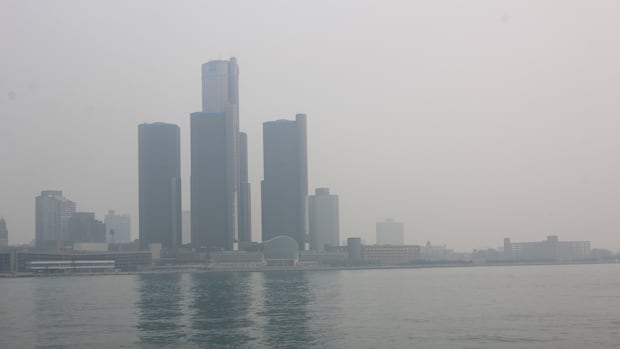
After Canadian wildfires brought extremely poor air quality to Detroit in the summers of 2023 and 2025, Michigan is updating how it communicates air quality risks to residents this year.
The state is streamlining a system that has evolved with the emergence of severe smoke impacts.
The state will issue an air quality alert any time fine particulate matter or ozone levels climb into the federal Air Quality Index’s “unhealthy for sensitive groups,” or orange range, said Jim Haywood, senior meteorologist with the Michigan Department of Environment, Great Lakes, Energy (EGLE).
The agency previously issued alerts when the air quality index, or AQI, was forecast for the “unhealthy,” or red, range, while advisories were issued for levels in the orange range.
Haywood said forecasting models are improving, but he doesn’t like forecasting smoke conditions for Michigan beyond a 24-to-48-hour time frame.
It can be difficult to predict where smoke traveling over long distances will go, and if it will affect air quality or remain well above ground-level, he said.
Fire conditions in Canada, western U.S.
The managing director of the research partnership Canada Wildfire said he expects fewer fires north of the border than last year, but the possible emergence of an El Niño weather pattern could lead to greater fire risk in late summer in western Canada.
Drought or dry conditions are present in Saskatchewan, Manitoba, Ontario and Quebec, but recent storms have improved conditions in some areas, Canada Wildfire’s Brian Wiens told Planet Detroit.
If an El Niño weather pattern sets in, it could lead to hot weather in Alberta and British Columbia and greater fire risk, he said.
In the United States, officials predict a severe fire season in the west at the beginning of the summer as every state except Michigan and North Dakota is experiencing some level of drought or abnormal dryness.
The National Interagency Fire Center’s April outlook forecasts significant fire potential in much of the south and southwest in April and May, while large portions of the west are at increased risk for wildfire in June and July.
Protect yourself from wildfire smoke
Climate change, including increased heat and drought, has increased the risk and extent of U.S. wildfires over the last two decades, according to the National Oceanic and Atmospheric Administration.
Children, pregnant people, and older adults are often most at risk from air pollution, Laina Stebbins, a spokesperson for the Michigan Department of Health and Human Services (MDHHS), said in a statement.
“Studies have shown that exposure to higher levels of outdoor air pollution is associated with increased emergency department visits, hospitalizations and even deaths,” Stebbins said.
Wildfire smoke contains large amounts of PM2.5, which is 30 times smaller than a human hair, allowing it to lodge itself in lung cells and move into the bloodstream. It’s associated with cardiopulmonary illnesses, premature mortality, and mental health issues.
The MDHHS wildfire smoke webpage recommends that residents use an air purifier to protect themselves from wildfire smoke; run air conditioning; and use a MERV-13 filter, or better, for both.
People without access to an air purifier or air conditioning could consider setting up a “clean room,” where levels of smoke and particulates are kept as low as possible, or building a do-it-yourself air filter with a box fan and MERV-13 air filter, according to MDHHS.
If you must go outside in heavy air pollution, MDHHS recommends using an N95 or P100 respirator marked with “NIOSH.” KN95 and KF94 respirators can also be used if the first choices are not available.