
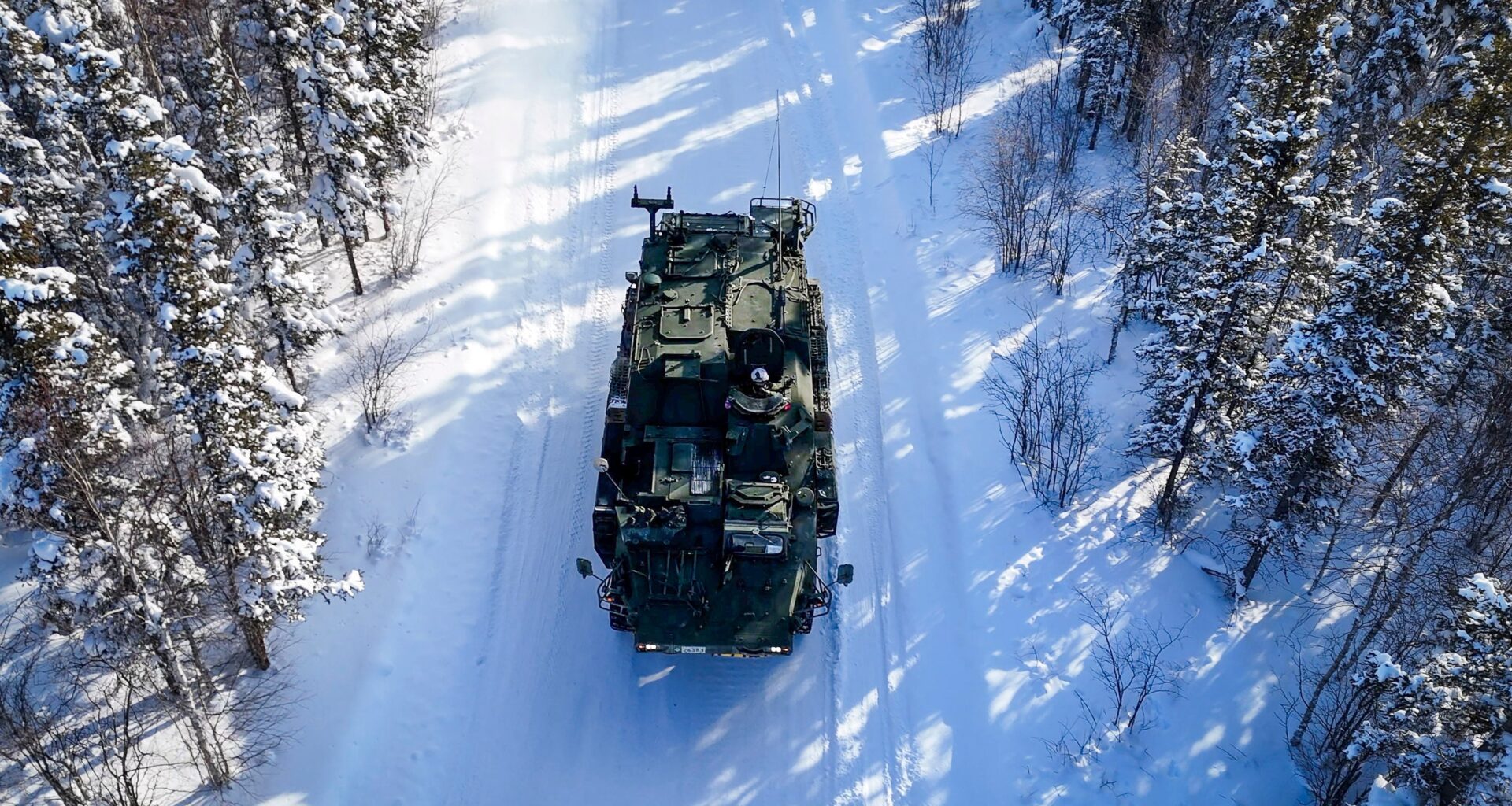
Cabin Radio has reported extensively on the military money coming north. Here’s a Canadian Arctic security expert’s take on what the threats actually are.
When Prime Minister Mark Carney promises $35 billion in Arctic sovereignty spending – including likely commitments of $5 billion each for Yellowknife and Inuvik – what are the dangers we’re trying to address with that money?
Listen to this episode wherever you get your podcasts.
While many northerners have celebrated the promise of big new investments in infrastructure, critics say Canada hasn’t done a great job of clearly identifying the military rationale.
Should we be expecting a Russian invasion of the Beaufort Delta? Are we building up northern bases to shoot missiles out of the sky, or repel Chinese ground forces, or keep Donald Trump quiet?
Whitney Lackenbauer is the Tier 1 Canada Research Chair in the study of the Canadian North at Trent University.
Advertisement.
Advertisement.
He’s routinely consulted and quoted when people are studying government policy in the Arctic, and he just co-authored a paper that compares how Canada and the United States assess the Arctic threats they face.
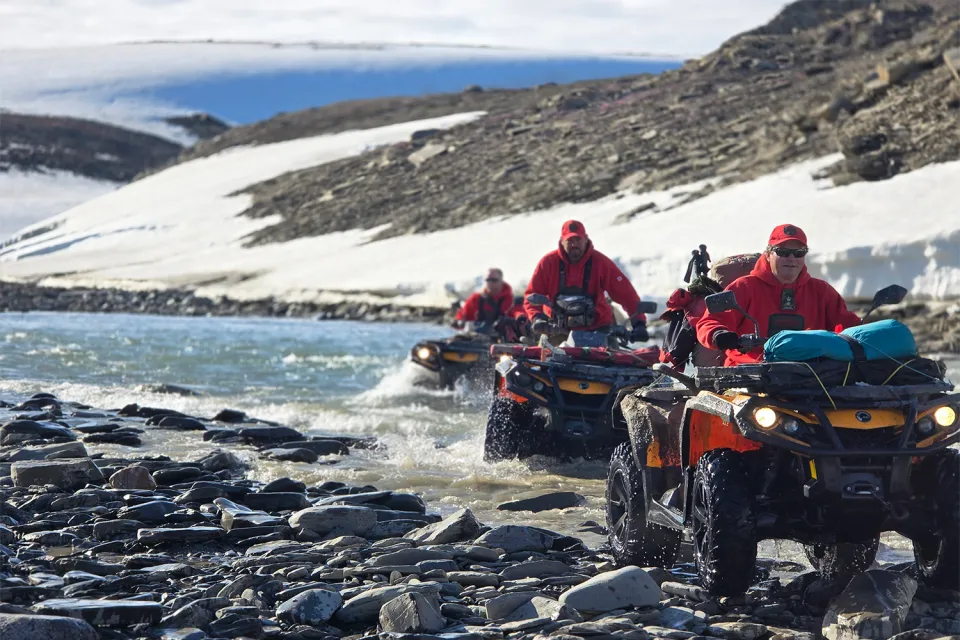 Whitney Lackenbauer, right, with Canadian Rangers on Operation Nanook-Takuniq in 2025, in a photo published to his website.
We asked him to help us understand what Ottawa says those threats are, what the threats actually look like to him, and how Canada’s military spending lines up with all of that.
Listen to the podcast for the full discussion. We’ve reproduced a transcript of some key questions and answers below.
This interview was recorded on April 14, 2026. The transcript has been lightly edited for clarity.
Advertisement.
Advertisement.
Ollie Williams: Walk us through the basics of your analysis of the way that Canada and the US think about Arctic threats. The impression that I got, reading your article, is that you think Canada sometimes has quite a vague way of articulating what it’s actually worried about.
Whitney Lackenbauer: I think that is true, and I think the more we can bring clarity to where we’re aligned with the United States – and where perhaps we see things through a different lens – the better we as Canadians can understand where we’re going, where we share a viewpoint, and where we might need to look at things through our own lens.
The basic takeaway here is comparing how Canada thinks about Arctic security and how the Alaskans, in particular, think about their place in the world.
I often break things down into threats through the Arctic, threats to the Arctic and threats in the Arctic – different categories that are not mutually exclusive but give us a sense of thinking about: what is the nature of that which we’re fearful of?
So if we think about threats passing through the Arctic, this is something that’s common to both the United States and Canada. We think about bombers, we think about ballistic missiles, we think about cruise missiles. They follow vectors or pathways that would fly over Alaska, over the Yukon, over the Northwest Territories, to strike at targets that are not typically in the Arctic itself.
The Arctic gives us what we might call defence in depth. It gives us more time to detect things and defeat things before they strike at targets, generally in southern Canada or the lower 48 of the United States.
In this sense, we actually work really closely together. It’s why when we hear Donald Trump talk about a Golden Dome, and when Canada talks about Norad modernization, we’re actually investing in some of the same things that are about shared defence of North America.
When we think about threats to the Arctic, here’s where things get a little different. In Canada, we do have Joint Task Force North based in Yellowknife. We have North Warning System radars along the Arctic coastline. We do have some modest defence infrastructure in our Arctic, but not a lot compared to the Americans. We don’t have tens of thousands of soldiers based in our Arctic like the Americans do. So the military threat – in the conventional sense – that we face to the Canadian Arctic is different than the US one.
Advertisement.
Advertisement.
What our article was trying to suggest was: we think about those threats to our Arctic in different ways. We often read or hear in Canada analogies saying, “Well, the Americans have got all these forces in their Arctic. We don’t, therefore we’re underprepared.” I keep saying it’s because we face different threats. Those US forces are largely based there to be able to fly down to the Indo-Pacific theatre, let’s say the East China Sea or South China Sea, in case of a scenario involving Taiwan. Whereas in Canada, the curvature of the Earth means we don’t need that.
You write that the idea of a full-spectrum military invasion of the North American Arctic is “preposterous,” and you push back to a degree on the narrative that melting ice automatically means greater threat from a climate perspective as well. I don’t know that these are the messages we’re getting from the federal government. How would you characterize what Ottawa is telling northerners about Arctic threats right now, and what you see the actual picture to be?
The threats that a lot of listeners are experiencing on a daily, weekly and certainly seasonal level relate to a changing climate. It’s more uncertainty when you’re heading out on the land, whether it’s on boats, whether it’s on snowmobiles, right? There’s a lot more unpredictability and uncertainty. Those are very real.
Nothing that I’m writing is denying climate change and the effects that has on people at a community level. Those are threats within the Arctic. They’re caused by drivers outside the region.
Unfortunately, the national narratives and international narratives talk about the region becoming more accessible. That’s not what I’m seeing. It’s not what I’m hearing. It’s not what I’m experiencing on a local level, at least not in the immediate term.
What’s driving a lot of the change or concern? It’s global politics. It’s what we’re hearing from Donald Trump and his sycophants, his followers in the White House, disrupting things. It’s what we’re hearing from Russia and China.
But they’re typically not about Arctic dynamics. They’re not about competing for Arctic resources or competing for Arctic shipping lanes in the immediate sense. They’re imagining potential futures. And a lot of the threats that would pass through the Arctic are ones that relate to global drivers. This is about global balance of power and global intimidation.
So I think, unfortunately, we’re sometimes bombarded with messages suggesting that the Arctic and dynamics in the Arctic are raising the risk environment. I just don’t see it.
Advertisement.
Advertisement.
The Arctic is more risky because the entire global security picture is more risky, and we can’t pretend like the Arctic is separate from the rest of the world. But why might the Arctic be more vulnerable? It’s because it provides us with that domain awareness. It provides us with the advanced warning.
In Canada, we’re really fortunate that we have such a supportive northern population that, in the case of the Canadian Rangers, serves as our eyes and ears on the ground, but also is supporting the notion that we’re going to build up more of our detection systems, our sensor systems in the North to defend all of Canada.
Where our messaging has not been very precise – or certainly not very reassuring for northern audiences – is that you’re actually supporting the rest of Canada. Your willingness to support this investment in your homelands is actually about defending all of Canada and then, by extension, defending all of North America.
So thank you for doing that, but it’s not because Inuvik, or certainly not Kugaaruk or Łútsël K’é, are at urgent, immediate risk of being attacked by the Russians or the Chinese.
What problems are we solving, out of the ones you’ve identified, by spending $30 billion on major new military infrastructure in the North? Or are we solving the wrong problems?
I think we are solving some of the right problems.
Our next-generation fighter interceptor aircraft are important for being able to go and meet the Russians when they fly their patterns out into the Canadian Air Defence Identification Zone – so they’re not crossing over into Canadian sovereign airspace, that would be a whole different type of threat to us, right? We have to have capabilities to go and meet them.
This is a very choreographed dance that we’ve been doing for a long, long time with the Russians. That’s going to mean new infrastructure. It’s going to mean increasing the footprint in Yellowknife, let’s say, at the forward operating location, to have new hangars to accommodate the F-35 or whatever airframe we’re going to use for that role.
Advertisement.
Advertisement.
At the same time, these operational support hubs are going to support a whole bunch of other activities that allow us to project forces in the extreme, and I think, almost preposterous case that we’d face any kind of kinetic – so, conventional – military attack on our territory, but enable a whole bunch of other types of operations.
These are humanitarian and disaster response scenarios. Just the very act of building this infrastructure, which will allow forces that are based in the south to to project north and do whatever they need to do up here, also communicates to would-be invaders or people threatening us: “Don’t even think about it.”
Already now, we’re capable of doing things that nobody else can. Once we get this additional footprint in the North, we’ll be even more agile and more prepared to meet whatever comes.
So why I’m such a big proponent is not because I think that we need to militarize the Arctic to bolster our sovereignty, and some of the other rhetoric I think gets caught up in some of this. It’s because we want to be able to be more agile and more effective in getting Canadian Armed Forces and other government actors into the North to respond to the whole span of emergencies and, for the foreseeable future, those emergencies are largely going to be driven by environmental or humanitarian disasters.
Gjoa Haven right now in Nunavut is dealing with a failure of their diesel electric generator. These things require us to be able to bring supports from outside. Investing in this infrastructure will allow us to do that better. I think all Canadians benefit from that.
At the same time, it is building towards a future that’s more uncertain, and I think the way we think about the military in the North is something that’s going to change as we look ahead.
So I really don’t think northerners need to feel like we’ve somehow failed as Canadians for not building things up over the last 20 years. The threat environment is just changing now. What served us in the past may not serve us going into the future.
We’re starting to make these investments now, and let’s make sure we do them in a way where, where possible, we also get the civilian benefits, the dual-use benefits, where extending runways and building infrastructure in and around communities can be helpful, because it can address some of those basic infrastructure needs that northern Canadians have been calling for for a long time.
Advertisement.
Advertisement.
What is one thing you’d want people living in the North to understand that you maybe don’t think the current public conversation is getting across?
At the end of the day, it is thinking about how building this infrastructure actually provides much more necessary strategic redundancy to some of the infrastructure that we have in place.
Think about common issues we have responding to environmental change, extreme weather. In Yellowknife, we’re often thinking about the wildfires in 2023. In western Alaska, they’re thinking about Typhoon Halong in 2025.
A lot of these investments going into infrastructure, yes, will enable military operations. They’ll also enable a lot of responses to some of the real present drivers of security and safety concerns in the North.
These investments are attuned to what Canadians have been calling for, and are also being designed to address some of those longstanding infrastructure deficits that I know are priorities to address for northern audiences.
Related Articles