
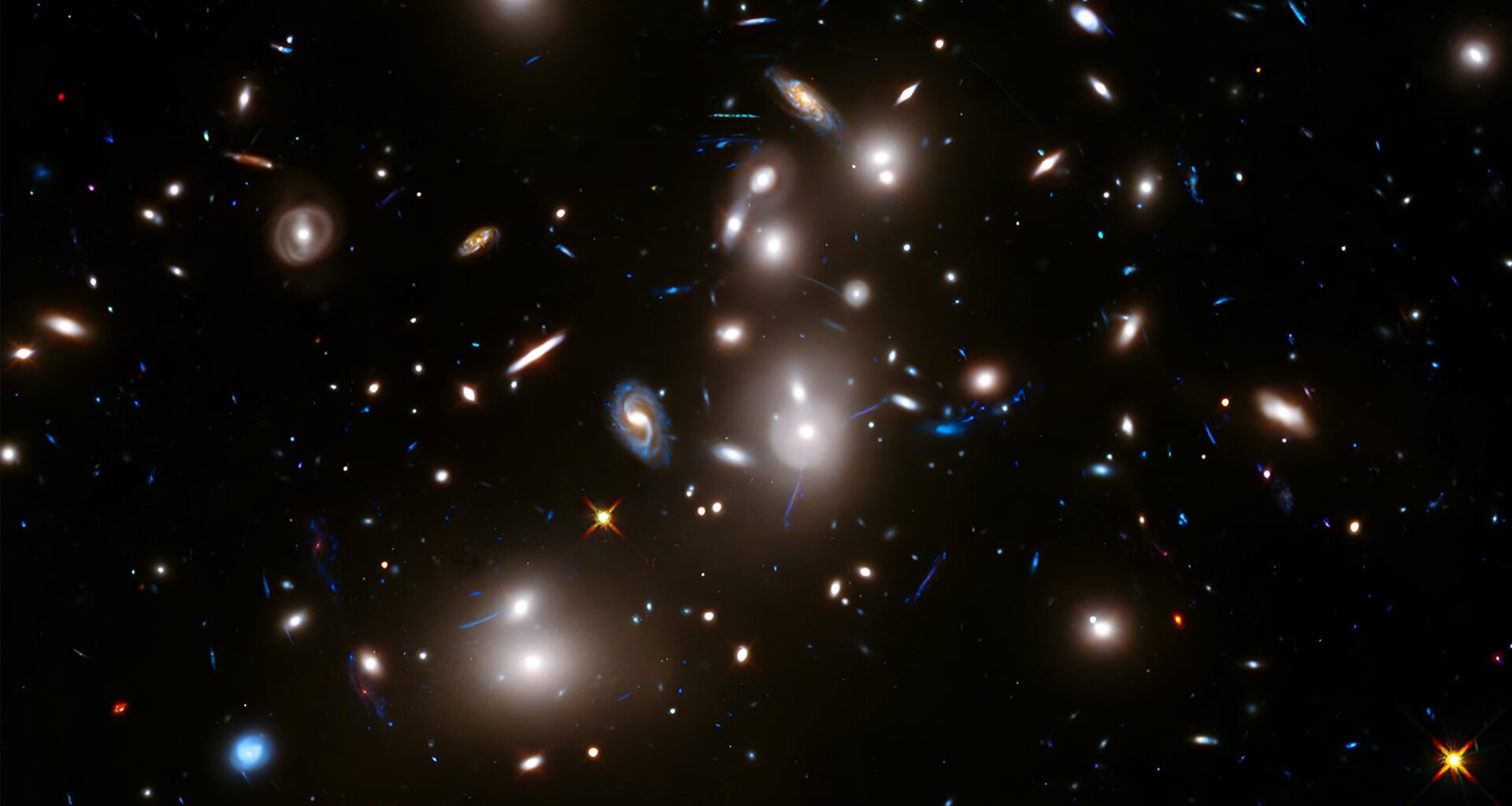
For more than 300 years, Isaac Newton’s simple rule about gravity has held up: the farther apart two objects are, the weaker their pull on each other. It works for apples. It works for planets.
Now, scientists have put that same rule to the test on a scale Newton could never have imagined — across hundreds of millions of light-years, where entire clusters of galaxies drift through space.
A new study in Physical Review Letters finds that gravity still behaves as expected even at those distances. And that result strengthens the case for something scientists still can’t see directly: dark matter.
“This is really a test of a basic question,” said Kris Pardo, co-author of the study and assistant professor of physics and astronomy at the USC Dornsife College of Letters, Arts and Sciences. “If you look at how galaxy clusters fall toward each other, does it match what our current theory of gravity predicts?”
The answer, according to the study, is yes.
Scientists watch galaxies fall to test gravity
To test gravity on such enormous scales, researchers needed a clever workaround. You can’t exactly drop two galaxy clusters and watch what happens.
Instead, the team measured how large numbers of clusters of galaxies move toward one another over time in a kind of cosmic dance driven by gravity.
They used data from the Atacama Cosmology Telescope in Chile, which observes faint radiation left over from the Big Bang known as the cosmic microwave background. When galaxy clusters move, they leave tiny imprints in this ancient light.
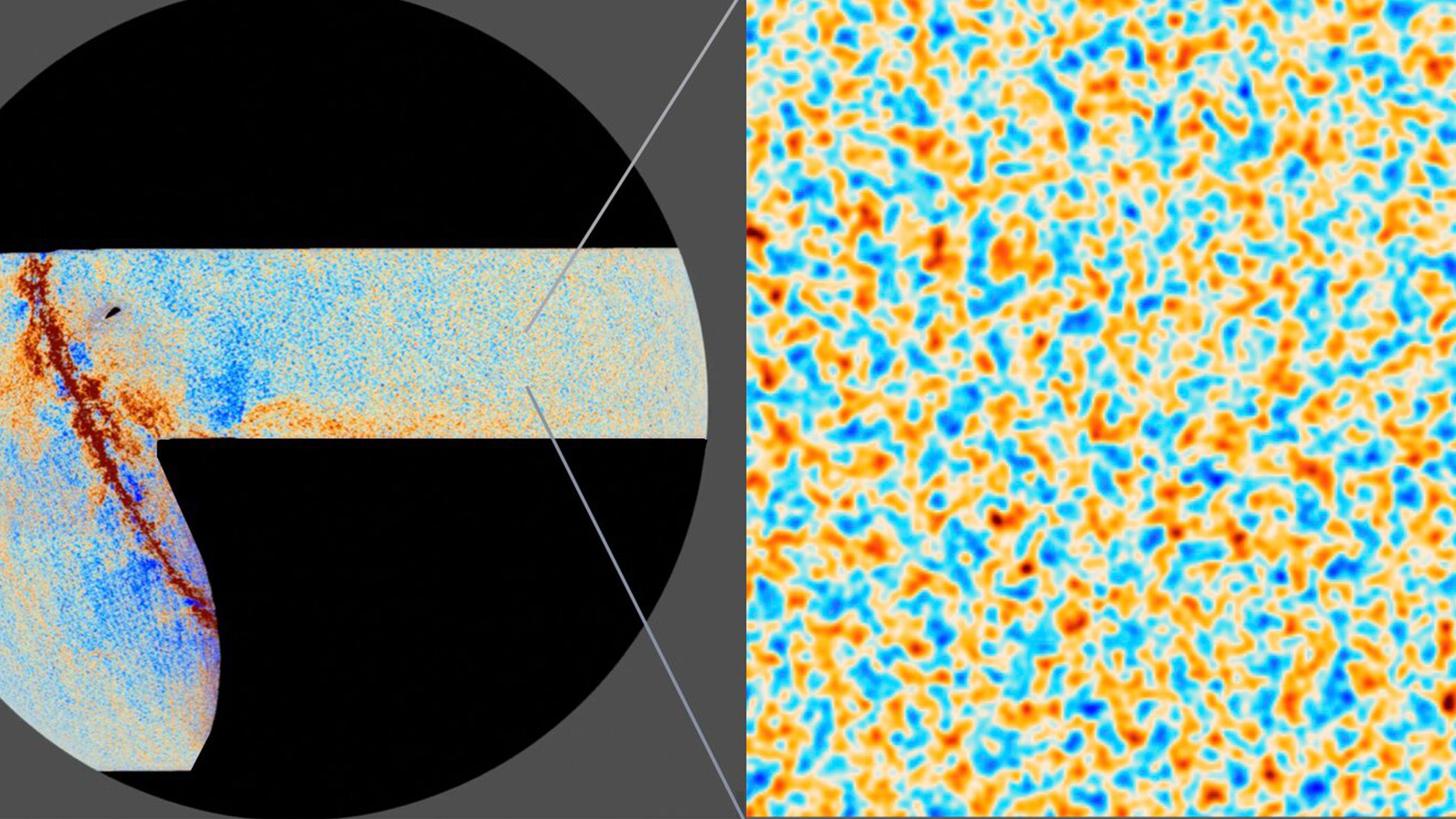 Research by the Atacama Cosmology Telescope collaboration has led to the most precise images yet of the cosmic microwave background radiation that was visible only 380,000 years after the Big Bang. (Image source: ACT Collaboration; ESA/Planck Collaboration.)
Despite this phenomenon’s long name — the kinematic Sunyaev-Zeldovich effect — the idea is simple: Moving galaxy clusters slightly nudge this background radiation in a way that reveals how fast the clusters are traveling.
The researchers combined those velocity measurements with a massive map of galaxy positions. By comparing where clusters are and how they move, the team could estimate how strongly gravity is pulling them together.
“We’re basically asking, given where all this matter is, how fast should things be moving if gravity works the way we think it does?” Pardo said. “And then we check that against what we actually see.”
Newton’s rule holds up on cosmic scales
The researchers found that gravity indeed does appear to weaken with distance almost exactly as Newton predicted.
“We found that galaxy clusters fall toward each other in a way that’s consistent with our standard model of the universe,” Pardo said.
That might sound unsurprising, but testing gravity’s basic rule on such vast scales has been difficult, and some scientists have proposed alternatives.
One idea, known as Modified Newtonian Dynamics, or MOND, suggests that gravity behaves differently at very large distances. If so, dark matter — the mysterious, invisible substance thought to make up most of the universe’s matter — might not be needed to explain how galaxies move.
The new study puts MOND under pressure on these scales. “We were able to essentially rule out one popular alternative in this analysis,” Pardo said. “This is a particularly clean test because it looks at how things are moving right now, not just how structure formed over time.”
Gravity study makes a case for dark matter
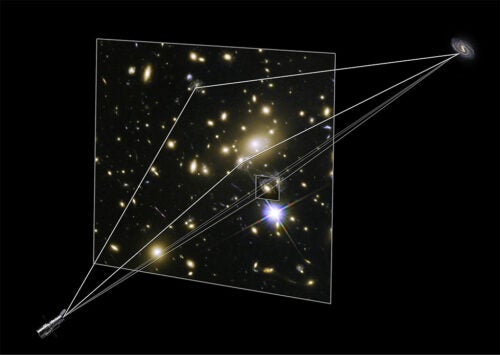 This sketch shows paths of light from a distant galaxy that is being gravitationally lensed by a foreground cluster. (Image source: NASA; ESA.)
The findings also speak to one of the biggest open questions in physics: What is the universe made of?
If gravity behaves as expected on these vast scales, then the motions of galaxies and galaxy clusters are still best explained by extra mass — mass we can’t see.
“Our results suggest that the standard theory of gravity works really well,” said Patricio Gallardo, a research associate at the University of Pennsylvania and lead author of the study. “If that’s the case, then we do need dark matter to explain the rotations of galaxies and the movements of galaxies within clusters.”
In other words, the study doesn’t detect dark matter directly. But by narrowing the alternatives, it strengthens the argument that something unseen is out there.
Gallardo says he was surprised just how well the basic rule still holds up. “It’s kind of amazing. Newton was thinking about planets in the solar system. And now we’re testing the same rule on galaxy clusters separated by hundreds of millions of light-years — and it still works.”
Why the scale matters — and what’s next
The study, one of the largest-scale direct tests of gravity to date, probes distances far beyond anything previously measured in this way.
That scale matters because scientists want to know whether the laws of physics are truly universal — the same everywhere, from Earth to the farthest reaches of space. So far, the results suggest they are.
The work also opens the door to even more precise tests. Upcoming surveys and telescopes are expected to collect far more data, allowing researchers to push these measurements further.
“With better data, we can start looking for even tiny deviations,” Gallardo said. “If there’s any new physics hiding out there, this is one way we might find it.”
What this test can’t answer yet
The test probes enormous distances, but it doesn’t cover every scale or environment in the universe. Also, the signal the researchers measured is extremely subtle, and the analysis depends on combining data from hundreds of thousands of galaxies. That means the results rely on statistical methods and high quality probes of galaxies and the cosmic microwave background.
“There are some technical limitations, especially when applying this to alternative theories like MOND,” Pardo said. “But overall, this is a pretty clean test.”
Gallardo added that the precision of the measurement, which is still limited by the amount of available data, should improve.
“As we get larger galaxy samples and better observations, we’ll be able to tighten these constraints,” he said.
For now, the takeaway is simple: Across vast distances, gravity still seems to follow the same basic rule first written down in the 1600s — quietly guiding galaxy clusters, just as it guides falling apples.