
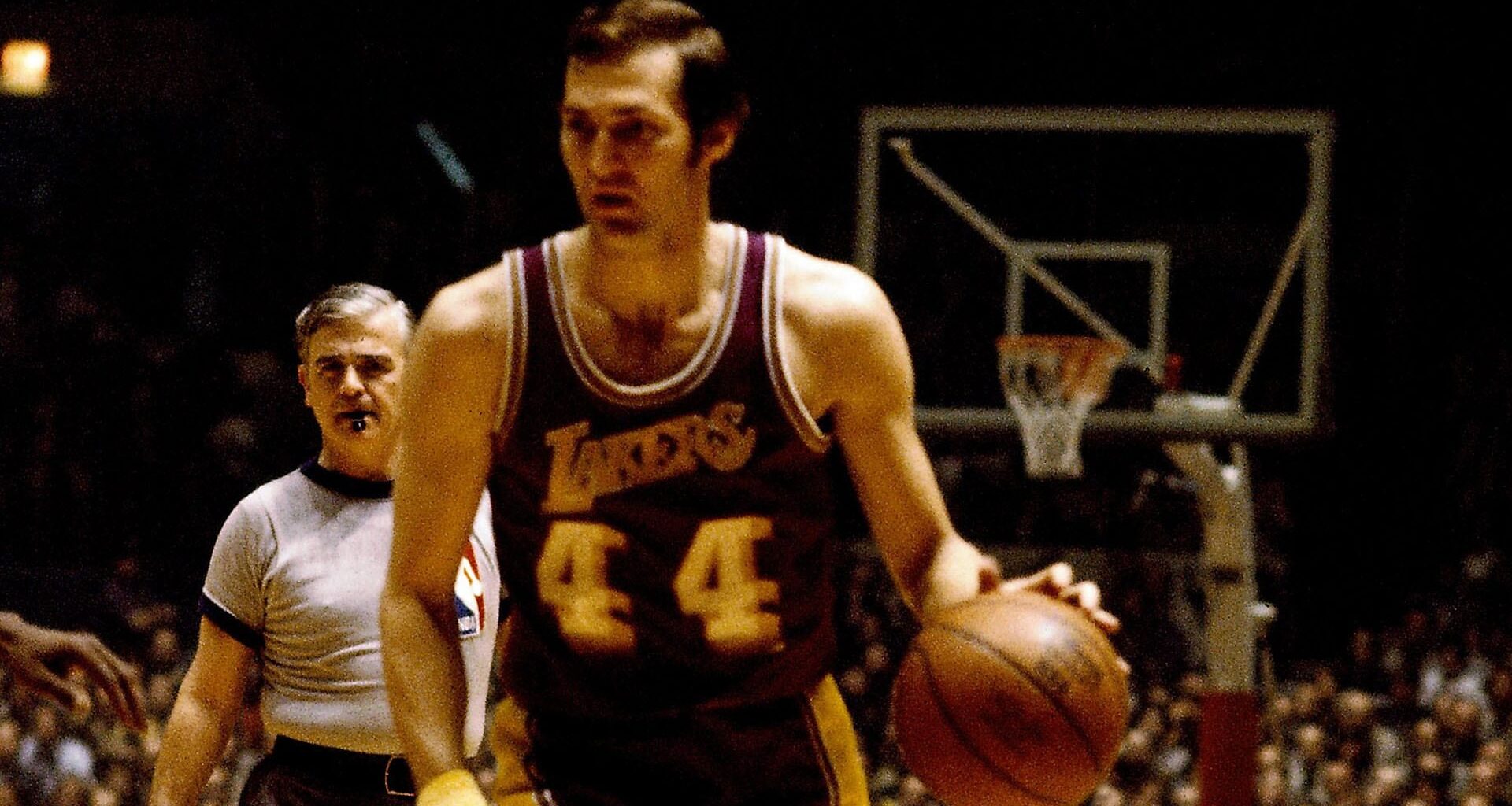
He is forever linked to the NBA’s official symbol, the sleek white silhouette outlined by red and blue that is marvelous for its simplicity, which is quite curious because the man who modeled The Logo was anything but simple.
Jerry West was complicated, overwhelmingly in a very good way, partly in a painful way. He was a brilliant player, and an even better team executive because in that office chair no one else compared — back then or even now.
Yet his road to those riches came at a personal cost. And it was a price worth paying.
That’s because his work brought unbridled joy to basketball fans and built one of the world’s most valuable and successful sports franchises. Even he would admit it gave him satisfaction as well.
The downside was that this successful quest for greatness was rooted in despair, from an unhappy family life as a boy, to a fear of failure once he set the bar steeply high as an adult. West always seemed to compete with that, and thankfully, in this game of forces, he won a hell of a lot more than he lost.
A defining figure in the NBA, Jerry West left a monumental legacy as a player, executive and stalwart in the game.
He detailed this and more years ago in “West By West: My Charmed, Tormented Life,” his critically-acclaimed and best-selling autobiography hailed for its brutal honesty. And now, the story of West is captured just as poignantly in Jerry West: The Logo, which debuts Thursday on Prime Video and which was still in production when West died last June.
The documentary was directed by Kenya Barris, whose most famous work is the TV series “black-ish.” Barris steers the West story with the touch of a chef, giving multiple tastes of West’s life to provide a complete picture, leaving the viewer hungry for another helping.
“I like telling stories about culture,” Barris said. “And Jerry West was culture. He came from this homogenized white poor place and went into the Olympics with Muhammad Ali there, came to the NBA in a really racially pivotal time. He transitioned into the front office at a time when that role was being redefined.
“I got a kinship with him. I spent more personal time on this than I did on most TV shows. He had so much to talk about. It was a story that, in the world we live in, really needs to be told.”
West’s lasting legacy in life & the game
The segment where West returns home to small-town West Virginia is very vivid. West stands outside his former home and later describes the events in that small, often turbulent and poor household that shaped his life for better and worse.
“There’s a version of me that never would’ve wanted to go back,” said Barris. “But the fact he did go back so often it says a lot of who he was. He never wanted to run from what made him. Even though it had a lot of darkness and tragedy, it was also a lot of peace and calm. There’s a purity to it.”
West’s father, Howard, was abusive to him and his siblings. West recounts how he attacked his father after the father threatened his sister with a hammer; West also slept with a shotgun under his bed in the event his father’s abuse took a more wicked turn.
His older brother, David, was killed in the Korean War, which devastated West. While discussing David’s loss in the documentary, West tears up, and it’s not the only time in the documentary West gets emotional. He reacts similarly to Magic Johnson announcing the results of his HIV test and subsequent retirement, and when Kobe Bryant perished in a helicopter crash.
Because of those issues back home, West gravitated to escapes as a young boy, one of which was basketball, where he shot hoops by himself at a neighbor’s house. West was so determined to stay away from his father that he practiced constantly, even in snow, working on the basic skills that would eventually make him a schoolboy legend, Olympian, 14-time All-Star and send him to the Hall of Fame — three times, in his case.
The most interesting event during his return to West Virginia with the documentary filmmakers actually happened off-camera. The filming crew noticed a body being carried from a nearby house — one of the residents had died — and when West approached and asked the family members whether something was wrong, they instantly recognized him and asked for autographs and pictures.
That was such a telling moment, how West — 85 at the time — still cut an imposing figure, not only with the people back home, but around the country with folks who weren’t even born when he played or when he formed the Los Angeles Lakers during the “Showtime” era.
His son, Ryan, said in a recent interview: “I think it’s more than a basketball documentary. It’s a movie about a great human being who impacted a lot of lives.”
West’s ability to shatter generation gaps and connect with much younger people explained one of his greatest gifts. In the documentary, therefore, are appearances by Stephen Curry, Draymond Green, Andre Iguodala and Klay Thompson, all members of the Golden State Warriors when West worked for the organization as a consultant.
Ryan notes that part of his father’s connection with present-day players is rooted in mutual respect: “My dad always wanted to carry the game forward. He never complained about what players were making. He was always a great ambassador for the NBA.”
Beyond that, the doc has the expected storytellers (with Lakers ties) in Johnson, Kareem Abdul-Jabbar, Michael Cooper, Pat Riley and Shaquille O’Neal. West impacted their lives and basketball legacies while brilliantly running the Lakers for two decades.
A mentor, friend and perfectionist
Jerry West was a 12-time All-NBA performer who knew how to elevate his game when the lights shined the brightest.
There are two others whose presence in the film raises curiosity. One is Michael Jordan. He never worked with West in any basketball capacity, but they were friends. Barris thought Jordan’s cameo was crucial, and besides, he’s Michael Jordan.
“I saw a lot of Jordan in Jerry,” said Barris, who became a big basketball fan in the Jordan era and who adds that Jordan’s response to a request to be in the film was a quick yes.”
The other interesting cameo is supplied by Jeanie Buss, the longtime Lakers’ chairman after her father’s death. West did not always see eye-to-eye with the Buss family following Jerry Buss’ passing and a rift developed.
However, not only did Jeanie Buss agree to appear, but her reflections on her father regarding his impact on the Lakers were positive.
“I don’t know where things went awry with the Lakers,” said Ryan West. “I don’t think my dad really understood it, either. We were very happy Jeanie agreed to participate and I’m glad she had a chance to say some kind words about my father. The relationship was damaged a little bit. I wish before he passed it could’ve been repaired. I think it’s something that haunted him until the day he died.”
Jerry West was tortured by coming up short as a player with the Lakers, which was understandable. He played during the 1960s, an era that the Boston Celtics dominated. West is still the only losing player to be named NBA Finals MVP, which happened in 1969 against Boston. Bill Russell was so impressed that he consoled West before celebrating with his own Celtics teammates after Game 7.
West eventually won as a player in 1972 and eight more times as an executive with the Lakers and Warriors.
“He’s a perfectionist,” said Ryan West. “Even winning a championship wasn’t good enough. If he didn’t win in six games he’d wonder, ‘Why didn’t we sweep them?’”
Jerry West raised three boys with his first wife, then added Ryan and Jonnie with his second wife, Karen, who was with him until his death. Both work in NBA front offices: Ryan with the Detroit Pistons and Jonnie with the Warriors.
Asked what Jerry West was like as a father, Ryan said:
“He explained in the documentary that he can’t say `I love you.’ He was a great father, but he loved by example. You knew he cared about you. He had a hard time vocalizing that he cared about you. But he showed his love in different kind of ways. When he likes somebody and cared about somebody, he would’ve done anything for them. He did the best job he could do given the circumstances he had growing up. He was always there as a provider a mentor and somebody who would always shoot you straight. I would hear things he would say about me through other people.
“I miss him every single second, every single day. He was my mentor.”
The documentary finishes with some news. The NBA and West always had an uneasiness about the logo, which was designed from a photograph of West in Sport Magazine.
Ryan West said: “It’s not something he talked about. It was something he wasn’t comfortable with because he never wanted to draw attention to himself, but deep down he was very prideful.”
The league never recognized the logo as West because of potential legal issues, according to legend. Anyway, it’s now official: Commissioner Adam Silver admits in the documentary that West is indeed the logo.
The sadness is that West isn’t alive to hear that, or to see his life captured in this documentary.
“I wanted Jerry to feel really good about it,” Barris said. “This was for his family. I wanted them to feel really good about it. I wanted to make sure it was shaped in a fair way … told in a way that I felt was inspiring.”
* * *
Shaun Powell has covered the NBA since 1985. You can e-mail him at spowell@nba.com, find his archive here and follow him on X.