
The Winnipeg Jets could have been a wild-card team with better luck, but luck is not a plan. They cannot afford to go through the offseason losing as much talent as they did last summer — or make as many missed bets on old, slow veterans — and talk about the Stanley Cup as a realistic goal.
The Jets have key, foundational pieces such as Connor Hellebuyck, Mark Scheifele and Josh Morrissey in place, but they’ve missed on enough key decisions in the past year to warrant an intensive offseason review. The Jets have weaknesses to be identified and dealt with — regardless of their late-season push — including problems with roster construction, player deployment and a deviation from their “draft and develop” identity so severe it’s threatening to leave them without a sorely needed second wave of stars.
Today, we’re talking about the Jets’ top seven offseason priorities. We’ll dive deeper to each one as the offseason progresses — from key contracts, managerial and coaching decisions to philosophical challenges, problems with player development and forging realistic paths to success for a team that can’t buy its way out of trouble on the unrestricted free-agent market.
1. Review Kevin Cheveldayoff’s recent track record
Kevin Cheveldayoff should not be untouchable as the Winnipeg Jets’ general manager. He has the loyalty of True North and long-term support from its chairman, Mark Chipman, so he’s going to reprise his role, but his resume should not be above reproach. The Jets have won 24 playoff games during his 15-year tenure as GM — 22nd most, with playoff-bound Ottawa and Philadelphia close behind them.
There are aspects of Cheveldayoff’s job in which management excels. He’s been made to trade top players from positions of little leverage and has then won some of those trades — particularly the Pierre-Luc Dubois trade to Los Angeles. The acquisition of Dubois for disgruntled young players Patrik Laine and Jack Roslovic was also good work. Cheveldayoff is a grinder, fastidious enough in trade negotiations to extract extra assets when selling — as he did getting Morgan Barron and the draft picks that became Brad Lambert, Elias Salomonsson and Thomas Milic for Andrew Copp.
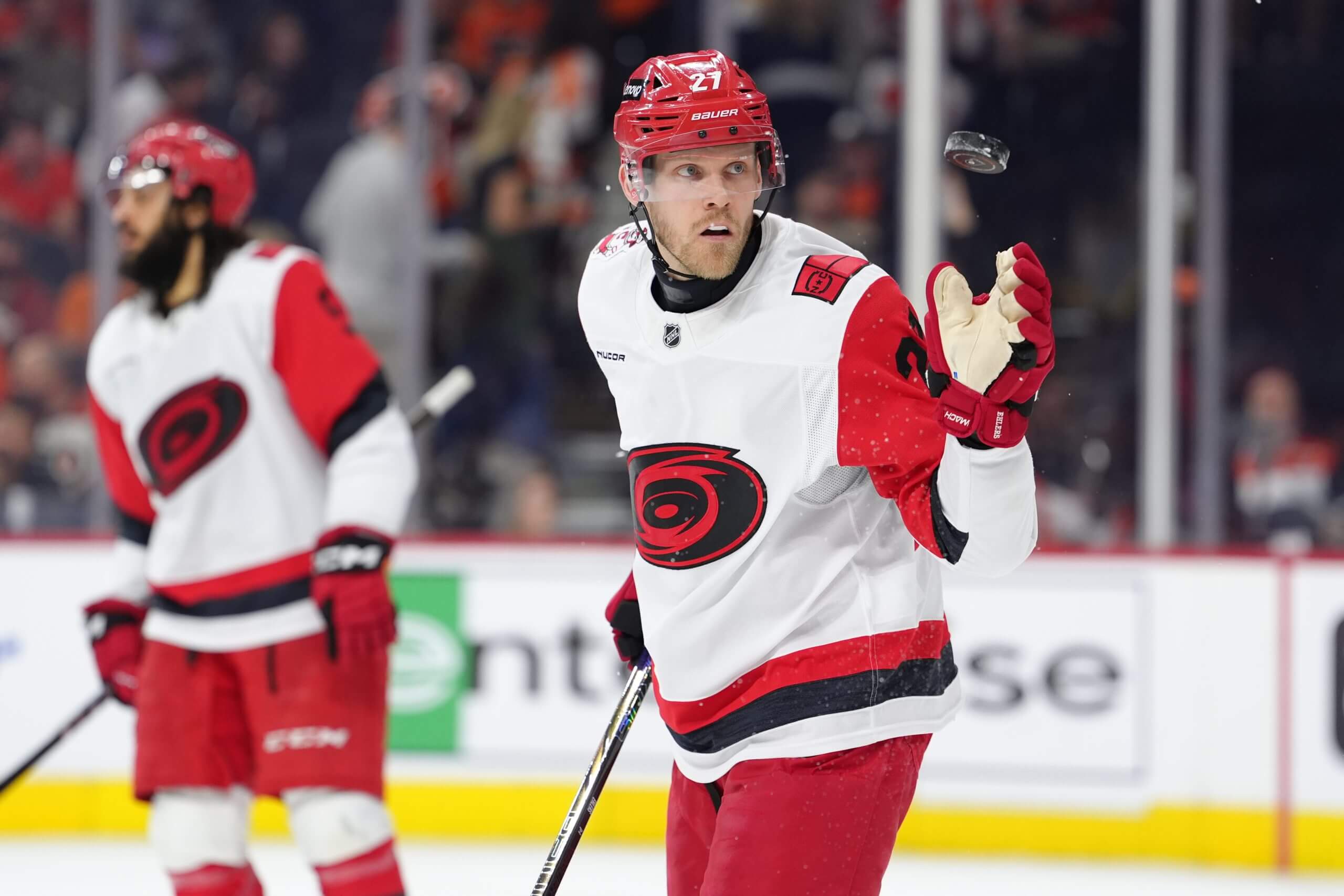
The Jets didn’t replace the offence lost with Nikolaj Ehlers’ free-agent departure to the Hurricanes. (Kyle Ross / Imagn Images)
We also know that Cheveldayoff’s job is more difficult than that of many rival GMs, with so many no-trade clauses and a UFA market that does not favour Winnipeg. Still, the Jets have made more poor decisions than good ones on the trade and free-agency markets over the past year. Last season, Cheveldayoff traded two second-round picks and a fourth-round pick for Brandon Tanev, who didn’t stay, and Luke Schenn, who made last year’s Presidents’ Trophy-winning team worse and then hurt this year’s team, too. Last summer, Cheveldayoff billed Jonathan Toews, Tanner Pearson and Gustav Nyquist as veterans who could replace some of Nikolaj Ehlers’ offence while helping the Jets in the playoffs.
Were there players with superior impacts available — and why didn’t the Jets move on sooner when players such as Schenn and Nyquist struggled? Cheveldayoff knows more about hockey than we’re likely to ever learn, but there have been some inefficiencies in team decision-making over the past year.
2. Decide how the Winnipeg Jets are supposed to build a winning team
Winnipeg’s focus should be on drafting, development and proactive trading, but the Jets have been below average at drafting and worse at development in recent seasons.
Winnipeg has sent so much draft capital away for players who haven’t ultimately remained Jets as to undercut what’s meant to be the organization’s biggest strength. The recent trade of Schenn and Logan Stanley for Isak Rosen, Jacob Bryson, a second-round pick in 2027 and a fourth-round pick in 2026 helps move things back in the right direction but is not enough to reverse three troubling trends.
The first is that Winnipeg’s draft success has faded since 2015. We wrote about that here. The second is that, when picks have developed into players who can help the Jets win games, Winnipeg has been slow to integrate them into its roster. Salomonsson is the most recent example of that. The third is that Winnipeg has held on to players after drafting them — but without putting them in the best position to succeed — so as to undercut their trade value.
Ville Heinola was once a player whose trade requests Cheveldayoff outright refused. Now’s Heinola a spare part on a losing team, unable to get into game action for months at a time — even when healthy — and will depart as a free agent because he hasn’t played enough NHL games. Roslovic was a first-round pick and a point-per-game 20-year-old in the AHL. He, too, was the subject of interest from rival clubs. When Roslovic didn’t get the NHL opportunity he sought, he asked out, but it was too late: He’d become a depreciated asset.
When the Jets look at their current crop of young players — Cole Perfetti, Lambert, Brayden Yager, Colby Barlow — can they say they’re being put in the best positions to succeed? If so, great: Keep them. Or are they simply not in the plans, no matter what is said in the media? Move on before lack of use makes them useless as assets, too. Time is running out on the Hellebuyck, Scheifele and Morrissey window.
3. Develop a better plan for player development, Manitoba Moose
Winnipeg went into the season ascribing AHL value to Salomonsson. By doing so, the Jets robbed themselves of superior results.
Were they uncomfortable with the extra mentorship or guidance he might need, given his youth and inexperience, had they kept him in the NHL? It’s possible that he simply developed beyond any person’s reasonable sense of expectation, but Salomonsson had already achieved AHL results similar to that of Dylan Samberg — at a younger age. Perhaps they thought promoting Lambert and Nikita Chibrikov when injuries hit at training camp was sufficient investment in youth.
Winnipeg’s proclivity for slow-playing its prospects is well-known around the NHL. If there are advantages to that strategy, the Jets haven’t been reaping them — Perfetti and Samberg are the only Jets draft picks from 2017 to now who had full-time NHL jobs this season.
Player development has not been a strength. At the AHL level, the Manitoba Moose seem to be caught between two extremes. Two years ago, there weren’t enough minor-league veterans, and Winnipeg’s top prospects had no insulation at all. This season, head coach Mark Morrison favours high-quality AHL veterans such that top prospects often play depth roles at even strength. Barlow needs power-play time, even when he’s struggling at five-on-five. Yager needs to be on the ice taking faceoffs late in games, trying to protect one-goal leads.
4. Find a route to the Jets’ next great second and third lines
Scheifele and Kyle Connor are good enough to be key contributors of a top NHL team. They are not good enough to do it by themselves.
Last season, they were the offensive leaders on a team whose second and third lines dominated their matchups. This season, coach Scott Arniel played them together more often than any other forward or defence pair in the NHL, because the Jets’ middle-six players were struggling to score.

Kyle Connor is a proven goal scorer, but the Jets need more offence from other lines. (Alex Goodlett / Getty Images)
Arniel’s commitment to the duo, regardless of losing streaks or standings position, might indicate he didn’t see alternate routes to success. An alternate hypothesis is that the Jets know Connor and Scheifele like playing together and want to keep their star players happy. I’m not sure if that’s true, but there’s logic in it: Winnipeg might be able to get more out of Connor and Scheifele if they split up and help other players produce more offence; they can’t get more out of them if they ever decide they’re done with Winnipeg.
Remember that Connor and Scheifele got outscored this season unless Morrissey was on the ice. If the Jets are keen to keep them together, then they need massive steps forward from Perfetti and Gabriel Vilardi — or a stunning offseason trade — to achieve competitive scoring depth. Meanwhile, the Jets’ search for a second-line centre is unending, Adam Lowry needs a bounce back to return to form as a good No. 3 centre, and Winnipeg already needed one more star player than it had before Ehlers left.
5. Determine whether Scott Arniel is still the right head coach
Several of the issues identified in this piece have coaching as a root. Deployment decisions, call-ups and deference to star players despite the accumulation of losses and after Winnipeg’s elimination from the playoffs are all under the purview of Arniel.
The Jets have the seventh-worst record this season and the eighth-best record over two seasons since Arniel took over as head coach. If Cheveldayoff believes his top players still believe in Arniel, then Arniel deserves a chance to prove he’s capable of delivering better results from the group of players who fell short this season. If there’s wobble in that belief — or if ownership believes that Arniel’s coaching and not Cheveldayoff’s roster construction is to blame for the fall — then Arniel’s tenure in Winnipeg could be shorter than expected.
6. Elevate Winnipeg’s analytical investment to match that of top teams
I take issue with the opinion that the Jets should “use analytics” in an effort to get better. The Jets do use analytics. Video coach Matt Prefontaine, James Cochrane (Prefontaine’s assistant) and three data scientists — Adam Konefal, Jordy Finnigan and Rozen Noureev — are employed by the team on an ongoing basis.
The Jets have used Sportlogiq data for years, with former head coach Paul Maurice, Prefontaine, Konefal and Finnigan building a system wherein coaches can link Sportlogiq’s analytics — slot shots, as one example — to the team’s video software. The Jets review and iterate on these processes every year, including at Arniel’s analytics “summit,” which we detailed at The Athletic. If the coaching staff names an item as a core tenet of Jets hockey — say, protecting the guts of the ice — then Prefontaine and company have ways of measuring Winnipeg’s performance.
The problem is not that Winnipeg is analytics averse. It’s that the Jets’ in-house integration of Sportlogiq data lags behind the more ambitious, project-based analytical work of industry leaders such as the Colorado Avalanche, Florida Panthers, Washington Capitals and Carolina Hurricanes.
Thanks to Prefontaine, Arniel can get real-time updates as to how the Jets are performing on key in-house metrics, but the downstream impact of this type of information is minimal compared with the capabilities of rival clubs. What’s the monetary value of a Jets draft pick? How dynamic and robust is the Jets’ ability to evaluate and price talent in trades, contract negotiations and roster-deployment decisions? Where are the independent analyses — out-of-the-box research projects, separate from the Sportlogiq environment, that seek to give Winnipeg systemic edges on and off the ice?
Winnipeg tasks Prefontaine with double duty as video and analytics coach. Compare Winnipeg’s staffing to that of top teams, who tend to have a head of analytics employed at the level of director or assistant general manager (in addition to multiple software engineers and developers), and the Jets fall short. I don’t believe that Prefontaine and company outperform — or have nearly the same influence as — Arik Parnass, Dawson Sprigings and company in Colorado.
7. Re-sign RFAs Perfetti and Rosen, plus UFA Cole Koepke if you can
We’ll get into contract comparables for Perfetti and Rosen in the coming weeks. Toews’ future will also command attention. Their inclusion so far down this list is an indication of two realities: The first is that Winnipeg enters the offseason without a massive UFA concern such as Ehlers, Connor, Scheifele or Hellebuyck for the first time in several years. The second is that the Jets’ issues are more philosophical — and more deeply rooted — than these rather straightforward roster decisions.
Winnipeg does need a second-line centre. Winnipeg would ideally upgrade its defence. But what the Jets need most of all is a re-evaluation of the decision-making processes that burned a year of their core players’ prime without bringing Winnipeg closer to the Stanley Cup.