
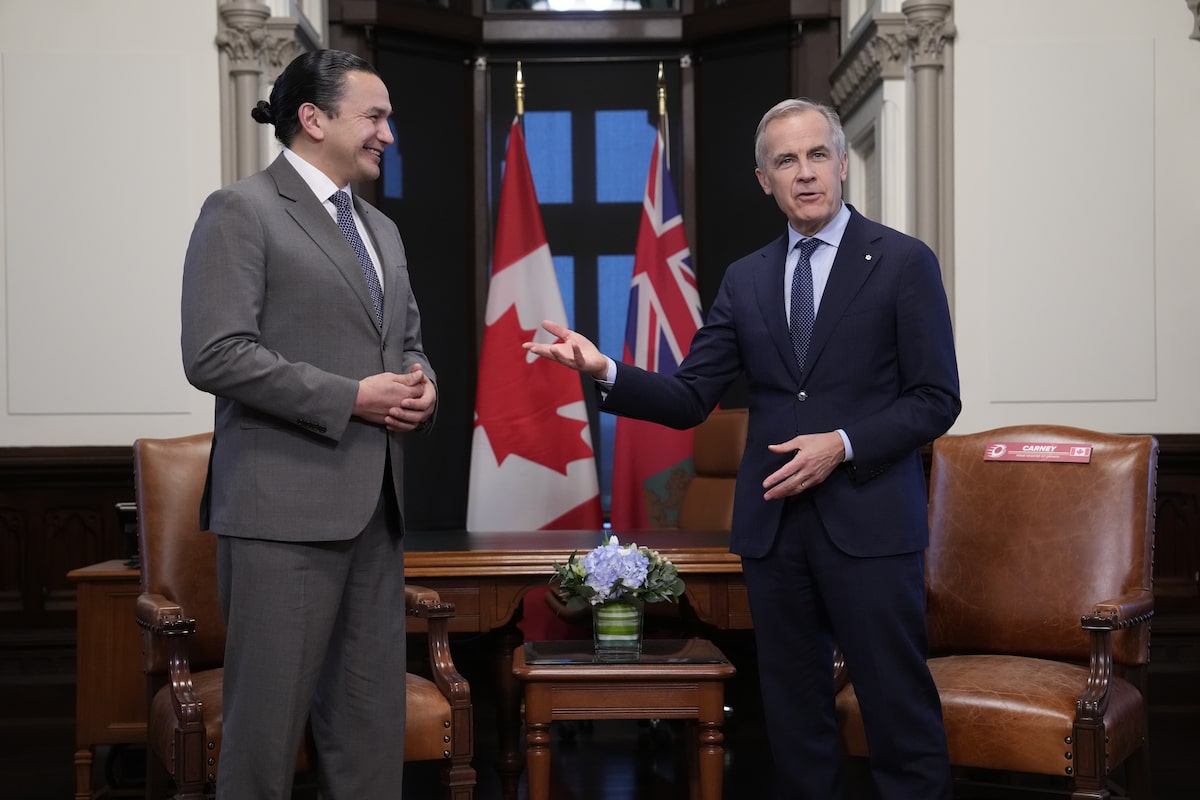
Manitoba Premier Wab Kinew, left, meets with Prime Minister Mark Carney in Ottawa on Tuesday.Adrian Wyld/The Canadian Press
Manitoba Premier Wab Kinew says Ottawa wants to start shipping liquefied natural gas from the Port of Churchill by 2030, calling it “a very aggressive, ambitious” target that will likely also include the construction of a new pipeline connecting to the Hudson Bay region.
In an interview with The Globe and Mail, Mr. Kinew outlined his government’s early plans for the small, deepwater port in Northern Manitoba after meeting with Prime Minister Mark Carney this week.
“The Prime Minister was very clear about shipping LNG by 2030,” Mr. Kinew said, adding that the onus is now on the Manitoba government to begin construction and secure private-sector investment “as soon as possible.”
Neither Ottawa nor Manitoba have previously specified a timeline for Churchill’s expansion or announced plans for a pipeline to the area. Since last year, the federal and provincial governments have committed around $280-million toward planning and design for the port, eyeing it as a major infrastructure project for fast-track approval and funding.
Churchill port operator partners with Fednav to study year-round shipping
Although Mr. Carney and Mr. Kinew have repeatedly called Churchill a “nation-building” project, critics have raised concerns about the environmental impact on a region that is a crucial ecological hub for polar bears and beluga whales and functions as a global climate regulator.
Industry officials and experts, meanwhile, have been wary of Churchill’s short shipping season, as it is frozen for about eight months a year and would require icebreakers to expand access.
Mr. Kinew said he has been pitching the LNG project for more than a year to Indigenous communities, along with seeking support from Ottawa.
Arctic Gateway Group LP, a partnership of 41 northern communities and First Nations that operates the port and the railway that serves it, has been conducting feasibility studies with the province and federal government to gather industry perspectives about the possible export hub and energy corridor. Simultaneously, the University of Manitoba has been examining how new machinery could enable year-round shipping without harming the environment.
Manitoba plans improved health care, tax cuts despite projected $498-million budget deficit
This new target shows that the “time and energy spent on this” are worth the effort, Mr. Kinew said.
“I think this just provides a lot of clarity,” he said. “Being challenged with a specific timeline gives us the opportunity to pull people together and say, ‘Hey, if we want to do this in 3½ years, we’re going to need to work together and we’re going to need to roll up our sleeves and just sort through these issues.’”
The Premier did not say how much Manitoba and the federal government are willing to spend on Churchill in the future, including for a pipeline.
The Prime Minister’s Office did not respond to a request for comment Thursday.
More than 1,000 kilometres north of Winnipeg, Churchill has a long history of shipping grain, though that business dwindled after subsidies were phased out just over a decade ago.
Recently, the Arctic Gateway Group began exporting test shipments of zinc concentrate from a Manitoba mine run by Hudbay Minerals Inc.
Proposals for what has been dubbed the “Port of Churchill Plus” have envisioned a resource corridor that would transport LNG, potash, oil, mineral ores, fertilizer and other agricultural products from Western Canada to Hudson Bay for delivery to international markets. That requires upgrades to the northern railway system, an all-season road, all-season shipping routes and a fossil-fuel pipeline.
Chris Avery, Arctic Gateway’s president and chief executive, said in a brief statement that he is “confident” about the 2030 target.
“Canada has what the world needs and now is the time to move,” he said.
At least two companies – NeeStaNan and Western Energy Corridor – have separately proposed pipeline routes from Alberta to Hudson Bay, though neither have been approved.
Christopher Doleman, an Alberta-based LNG specialist for the U.S. Institute for Energy Economics and Financial Analysis, said while “nothing is impossible,” the 2030 target appears tough to achieve.
Typically, he said, pipeline permits take five years for approval, with another five years or so needed for construction.
A Hudson Bay pipeline would need to account for permafrost concerns, Mr. Doleman said, meaning it would likely be constructed above ground. An LNG liquefaction facility would also be required.
Feiyue Wang, director of the Churchill Marine Observatory and Canada Research Chair in Arctic environmental chemistry, said he worries about the risk of oil spills as shipping traffic increases.
“We need to develop technologies that can help us respond better in the event of a tanker spill and other concerns,” he said. “And these technologies will need to address the very specific problems of Arctic waters, especially if we want to do this project not only early but also do it right.”
Mr. Kinew said constructing the LNG pipeline to Hudson Bay is paramount, citing the need to withstand the effects of the war in Iran, which has driven up energy costs and destabilized global supply chains.
Opinion: Manitoba holds the key to nation building in Canada
“I will fully acknowledge that 2030 is very, very aggressive,” he said. “But, hey, we are in a time of unprecedented upheaval. We have unprecedented collaboration between a federal and a provincial government, so why don’t we just challenge ourselves as Canadians and say, you know what, other countries do big things when they set their minds to it. Why not us?”
The Premier added that building up Churchill would not only provide “spinoff benefits” for the whole country, but he believes it also maintains a critical role in Canada’s sovereignty.
U.S. President Donald Trump’s musings in recent months about annexing Greenland have raised significant alarm and placed a geopolitical spotlight on Arctic security.
Earlier this year, Mr. Carney announced a multibillion-dollar defence plan that includes upgrades to existing northern military sites. Mr. Kinew told The Globe that he believes Churchill, a former military outpost, would be part of that endeavour.