
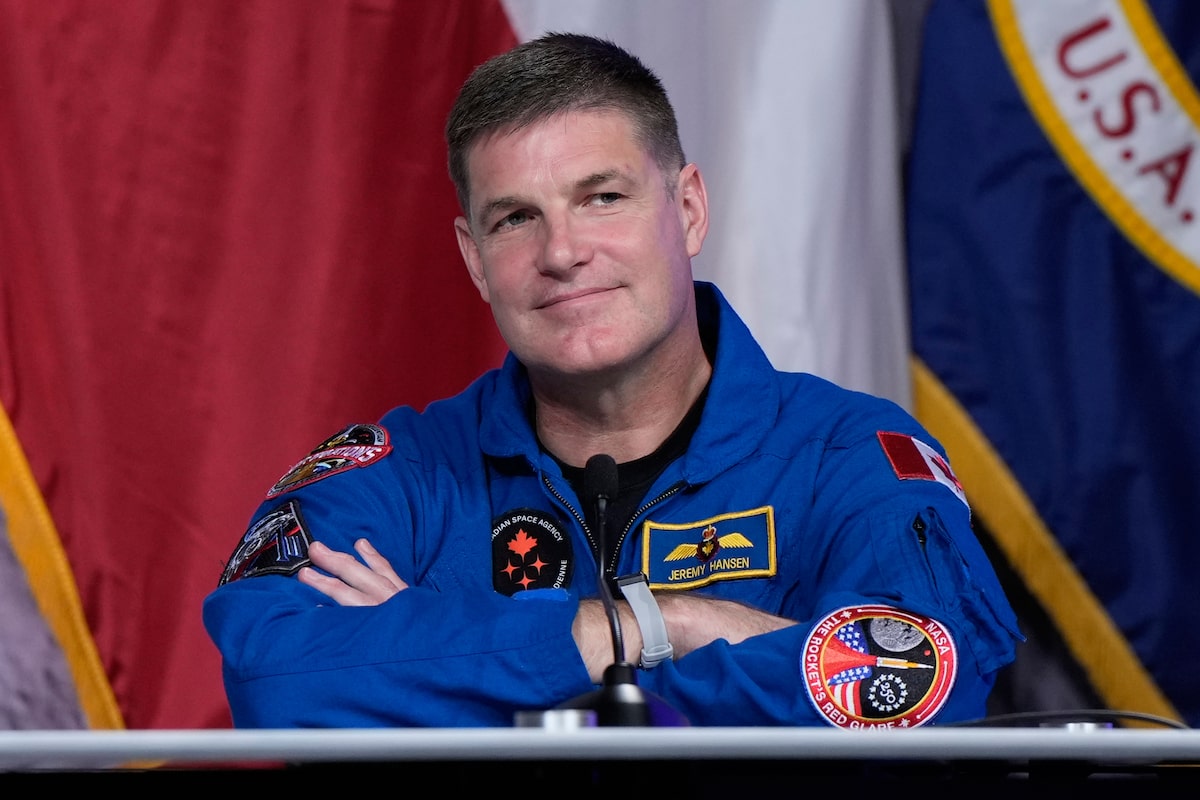
Canadian Space Agency astronaut Jeremy Hansen, a member of the NASA’s Artemis II crew, listens to a question during a press conference on Thursday in Houston.Ashley Landis/The Associated Press
Canadian astronaut Jeremy Hansen learned a lot about himself on his historic flight around the moon.
One revelation was that despite the risk inherent in such a mission − and in being on the first crew to fly the vehicle designed to accomplish it − Col. Hansen was not as struck by fear as he once thought he might be.
“It wasn’t a courageous thing or a bravado thing. It was mental preparation,” Col. Hansen said at NASA’s Johnson Space Center in Houston on Thursday.
The comment was made in his first sit-down interview with The Globe and Mail since he and his crewmates on the Artemis II mission returned to Earth.
“I was very optimistic that we would come back, that it would go in our favour, but I was also resigned to the fact that I might not be coming back,” Col. Hansen added. “I just got in the mental headspace of I’m just going to enjoy the journey.”
The journey proved to be one for the ages, captivating global attention as Col. Hansen, together with NASA astronauts Reid Wiseman, Victor Glover and Christina Koch set out to jump-start a new era of lunar exploration by the U.S. space agency and its partners.
Artemis II launched from the Kennedy Space Center in Florida on April 1, and ended with a splashdown in the Pacific Ocean just over nine days later.
In between, their crew capsule, dubbed Integrity, took them on a flyby of the moon’s far side during which they set the record for the farthest distance that humans have ever travelled from Earth.
Nine Apollo missions flew to the moon between 1968 and 1972, six of which also landed there. Yet Artemis II put a new spin on the moonshots of old as the first to do it in the digital age, with much of the voyage livestreamed and spectacular images shared worldwide even before the crew were back.
Artemis II NASA astronaut Christina Koch and Hansen greet NASA team members the day after their splashdown, in San Diego, Calif., on April 11.NASA/Keegan Barber/Reuters
In his interview, Col. Hansen recalled the subtle differences in colour and shading that he noticed when observing lunar features and the way their overlapping layers implied different events and epochs in the moon’s geological history.
Near the large impact basin called Mare Orientale, he said “it looked to me like it really, at one point in history, resurfaced the portion of the far side of the moon that I could see, and that was really neat.”
He also described watching a solar eclipse, which the crew only witnessed by chance because of the particular day of their launch. Streamer-like features of the sun’s outer atmosphere, the corona, could be seen extending far beyond the edge of the moon during the event.
Once the sun was eclipsed, he said, the moon went to an eerie matte black colour while surrounded by a glowing halo, but it was not invisible and it still retained a sense of being a three-dimensional object.
Prime Minister Mark Carney, left, speaks to Artemis II mission astronauts, left to right, Koch, Hansen, Reid Wiseman and Victor Glover during a live feed at the Canadian Space Agency headquarters in Longueuil, Que., on April 8.Graham Hughes/The Canadian Press
At a press briefing earlier in the day other crew members spoke about their sense that they had witnessed something unlike anything they expected or had ever experienced before.
“We did not feel like we were capturing what we were seeing on our cameras,” Col. Hansen said.
Another recurring theme that the crew has repeated throughout the mission is the importance of teamwork and the way they bonded during the mission while their capsule hurled them away from Earth at tens of thousands of kilometres per hour.
“We launched as friends and we came back as best friends,” Commander Wiseman said during the briefing.
Col. Hansen added that being in space and looking at Earth from a great distance can create a sense of fragility and smallness. But the group’s efforts to come together and make the mission a success had the opposite effect.
“I kept seeing that same thing and that same feeling,” Col. Hansen said. “Small and powerless, but yet powerful together.”
Astronauts, from left, Hansen, Glover, Wiseman and Koch leave the Operations and Checkout building on their way to the Artemis II launch, on April 1, in Cape Canaveral, Fla.John Raoux/The Associated Press
As the only first-time space traveller aboard Integrity, Col. Hansen had no point of reference in knowing how his body would respond to being in a zero-gravity environment.
During the flight, and again at the briefing, his crewmates pointed out how easily he seemed to take to spaceflight.
Col. Hansen said that perception was correct. He did not experience motion sickness, as many astronauts do − and that came as a relief because he had opted not to take motion sickness medication to avoid its side effects.
“I’m just so grateful,” he said. “I would not have expected it to feel as good as it did.”
The mission sets the stage for the next Artemis flight, slated for next year, which is to be a test of the spacecraft’s ability to dock with a vehicle that can transport astronauts to the lunar surface. The first Artemis moon landing would then follow in 2028.
Asked why it was important to continue, Col. Hansen said the results of Artemis II speak for themselves.
“We set big goals. We accomplished some amazing things,” he said. “Let’s not stop here. Let’s go do the next big thing.”