
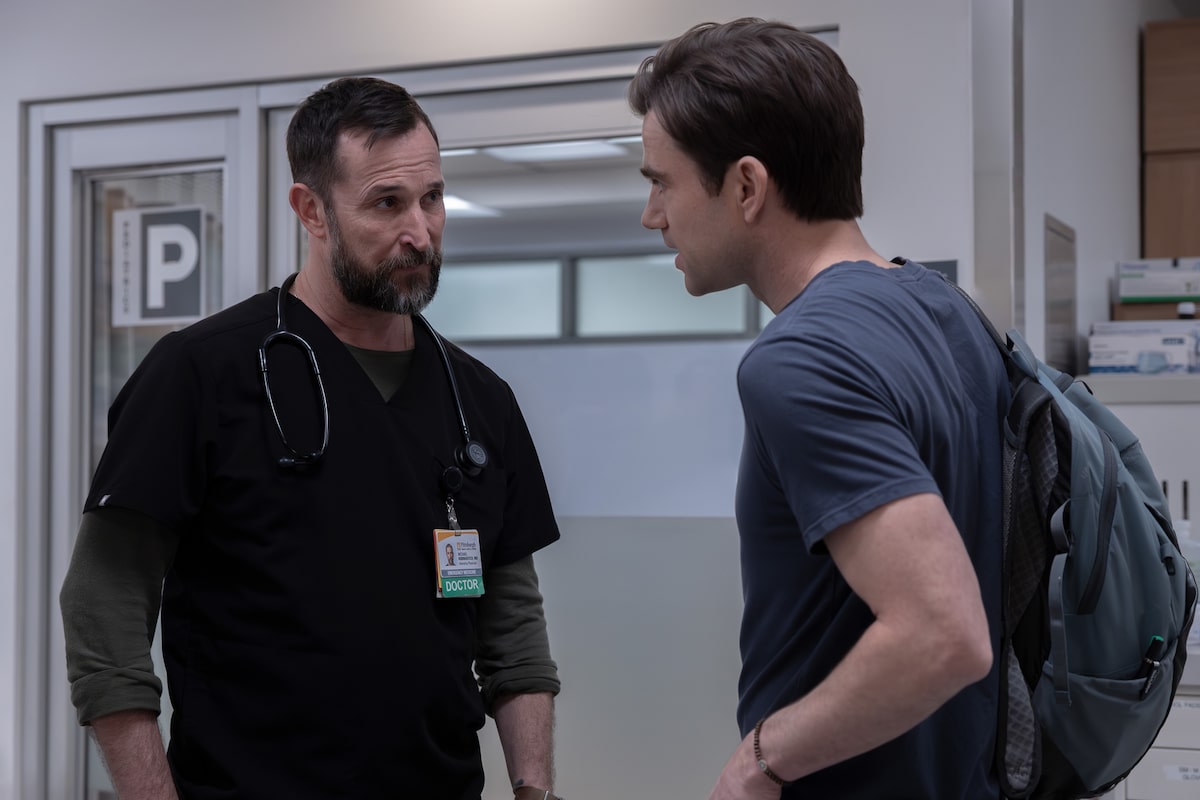
Noah Wyle and Patrick Ball in The Pitt.Warrick Page/Supplied
The most talked about aspect of The Pitt’s second season, which came to a satisfying, emotional conclusion on Thursday night, wasn’t anything that actually appeared onscreen in the medical drama.
Rather, it was how many viewers had started to view the lead character, Dr. Robby (played by Noah Wyle), as a villain rather than a hero – with some even taking to denouncing the show online.
Vanity Fair kicked off the conversation in February with an article titled “Why are The Pitt’s most devoted fans turning against saintly Dr. Robby?
Since then, there’s been a flurry of think pieces delving into why the vocal fandom is “putting The Pitt’s characters on trial to be deemed ‘good’ or ‘bad’” or how the show’s fans “are proving that yes, it’s possible to be bad at watching a TV show.”
Back in the day of HBO’s “difficult men” dramas such as The Sopranos, critics fretted about some viewers celebrating its criminal anti-heroes.
Sepideh Moafi and Wyle in The Pitt.Warrick Page/Supplied
It amuses me, in a way, that the concern now is that viewers are judging characters such as Dr. Robby too harshly.
I can’t get too upset about what a few Pitt viewers say in the heat of the moment on Reddit forums, however.
For one thing, it simply makes the case for the continued existence of professional criticism at a time when everyone has a voice, but algorithms inevitably highlight the most toxic ones.
But also, I completely understand why The Pitt’s second season has alienated some.
When the show premiered last year on HBO Max in the United States and on Crave in Canada, there was a lot of chatter about streaming services turning to the comfort food of medical procedurals.
The Pitt was an ER for our times, with a nostalgic network-style week-to-week release.
Supriya Ganesh in The Pitt.Warrick Page/Supplied
In its first season, Dr. Robby – brilliantly leading his emergency department through a mass shooting despite his PTSD – soothed many viewers in the same way that the Artemis II astronauts did with their recent mission around the moon.
It is soul-stirring to see people showcase integrity alongside high-level excellence under pressure.
But even the best people aren’t perfect everyday, of course. And The Pitt wouldn’t be a great drama if it showed the same day over and over.
For all its familiar trappings, the HBO show is not actually easy viewing – the title itself suggests despair or bottomlessness – and is quite experimental with its form.
It’s structured into 15 episodes meant to represent 15 sequential hours.
There’s a reason that real-time TV shows have previously mostly been thrillers, such as the Fox classic 24 and Apple TV’s Hijack. Nobody is looking for psychological realism in that genre.
Isa Briones, Shabana Azeez, and Gerran Howell in The Pitt.Warrick Page/Supplied
In a medical procedural, however, viewers expect main characters to have an emotional arc in each episode amid the action.
So that’s made it especially difficult to watch Dr. Robby struggling with his well-being for a full season. While in the previous season, his sharp superior side was mainly reserved for cost-conscious administrators and anti-vaxxers, he has now turned it on his own colleagues.
In the end, however, The Pitt has been brave in highlighting how hard it actually is to keep your empathy up over time for people who you love as they go through mental-health struggles.
Creator R. Scott Gemmill and his writing team have not exactly been subtle in communicating to viewers that Dr. Robby is suicidal this season.
The opening scenes of the first episode showed him riding his motorcycle to work without a helmet on his last day before a sabbatical. He’s been planning to ride to Head-Smashed-In Buffalo Jump, no less.
But even though viewers know Dr. Robby is fantasizing about killing himself, his pity party started to get tiring.
Howell and Wyle in The Pitt.Warrick Page/Supplied
The scenes where the white male doctor has been cutting or condescending toward the women of colour he works with have been particularly hard to brush off.
His defensive attitude toward Dr. Baran Al-Hashimi (Sepideh Moafi) was off-putting from the get go – even if his suspicion that she was hiding something turned out to be right.
But what really struck a nerve was when Dr. Robby upbraided Dr. Samira Mohan (Supriya Ganesh), who had a panic attack, for letting her “mommy issues” affect her work in episode 10.
Viewers had to stew online about that for three more episodes before The Pitt revealed that this wasn’t just cruelty, but projection.
In a climactic scene in episode 13, nurse Dana Evans (Katherine LaNasa) told Dr. Robby she’d give him a time out if he were her kid. He shot back that his actual mother had left him when he was a child.
Because Dr. Robby said this during a fight, I don’t think it fully sunk in for viewers.
It didn’t really sink in for me until Thursday’s finale. In the last images of that episode, Dr. Robby cradled the baby “Jane Doe” who had been left in the emergency department in the season premiere.
This was the quiet, tearful moment that will heal viewers’ relationship with the character, I suspect.
Catharsis has followed conflict, but as is so often the case with a visit to the hospital these days, the waiting time was hard to handle.