
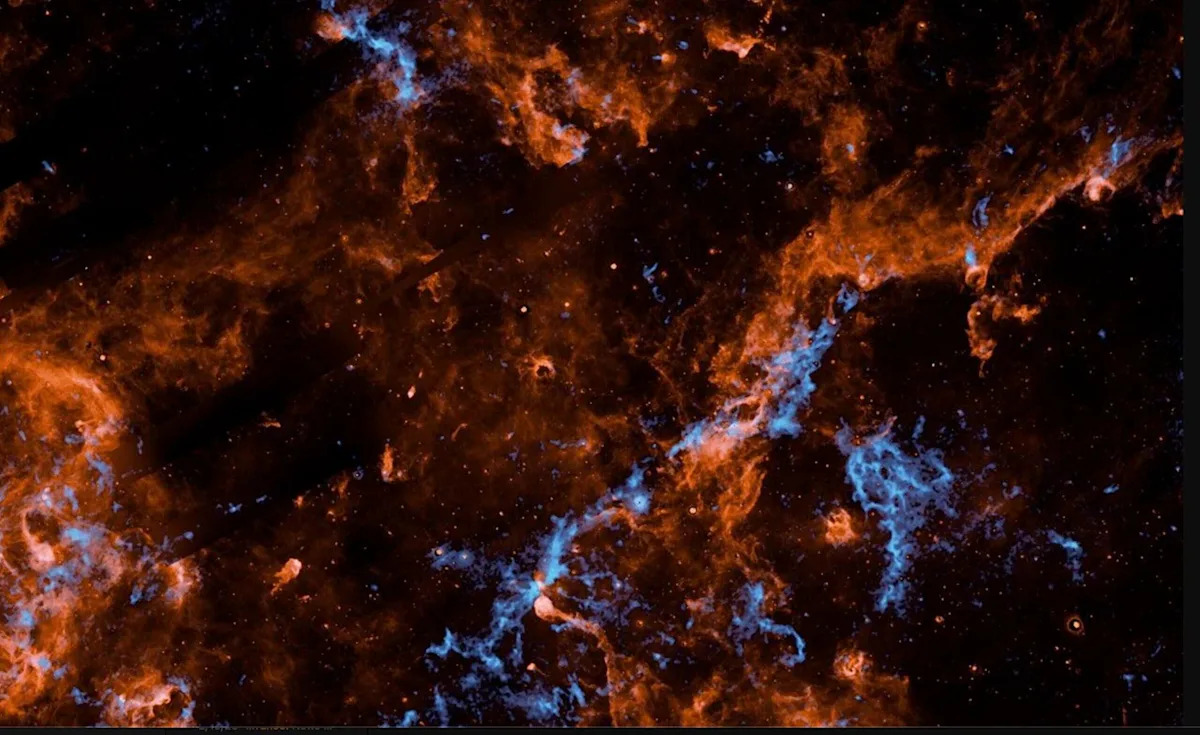
Imagine glaciers the size of entire star systems just floating in space. Actual frozen reservoirs stretching across hundreds of light-years. That’s what NASA just mapped.
These icy giants do not just make for cool visuals. They might be the reason planets like Earth even have water in the first place.
What are “interstellar” glaciers?
The discovery comes from NASA’s SPHEREx telescope, which is basically doing a full-sky scan but in 102 different infrared “colors.” That lets scientists see what normal telescopes can’t: the chemical fingerprints of ice floating in space.
And instead of just spotting tiny pockets, SPHEREx found huge, continuous stretches of frozen material inside massive molecular clouds, regions where stars and planets are born.
Picture giant clouds of gas and dust floating in space. Now zoom in. Tiny dust particles, basically cosmic soot, are coated in layers of ice. Water, carbon dioxide, carbon monoxide, and other icy molecules.
Now zoom way out again. All those particles together form enormous frozen regions inside these clouds. We’re talking structures so big they stretch across hundreds of light-years.
Scientists are calling them the space equivalent of glaciers. Except instead of slowly carving mountains, they are helping build entire solar systems.
This is where your water probably came from
Researchers think these icy regions are basically the universe’s water reservoirs. Over time, that ice gets pulled into forming stars, planets, comets, everything including Earth.
So the water in your glass? The oceans? Even ice on Mars or moons like Europa? There’s a very real chance it all started in one of these cold, dusty clouds drifting through space billions of years ago.
Why this hits different from past discoveries
We’ve seen ice in space before. Telescopes like James Webb and Spitzer have picked up traces. But SPHEREx is mapping it at scale.
Instead of looking at one star at a time, it is capturing entire regions, hundreds of light-years wide, and showing how ice is distributed across them.
SPHEREx has only completed its first full-sky scan. More data is coming, and scientists are already seeking more clarity on how stars and planets, and maybe life, come together. Which means there is more discovery on the way.
Source: NASA
Read the original article on GEEKSPIN.
Affiliate links on GEEKSPIN may earn us and our partners a commission.