
The New England Patriots front office puts together a list of prospects for each position coach to review. They’re looking for insights into why coaches think a player may or may not be a fit for their scheme. Head coach Mike Vrabel goes through the whole list, offering his opinions on each one.
That’s the work that was being done at the Patriots’ new facility this week. By the end of this weekend, they hope to have a plan in place and their draft board mostly set.
But with the 31st pick, it’s so hard to predict what will happen before the Patriots are on the clock. So as we await next week’s 2026 NFL Draft, let’s go on the record with one possible plan.
Here’s what I’d do if I were running the Patriots’ draft.
Prioritize edge rusher in the first round
This year’s run-up to the draft hasn’t carried the same level of excitement for the Patriots as in recent years, after picking Drake Maye with the No. 3 pick in 2024 and Will Campbell at No. 4 last year. But this year’s draft also comes with a lot more options.
The team knew who it was likely to pick in the first round in each of those years. Next week could go any number of ways. You could make a reasonable case for the Patriots picking an edge rusher, a wide receiver, an offensive tackle or maybe even a defensive tackle in the first round. A trade back is also possible.
But if I were in charge, I’d focus on an edge rusher. Last season, the Patriots had the third-slowest average time to sack (4.01 seconds), a sign that a lot of their sacks were the result of good coverage in the secondary. In the second half of the season, they blitzed at the fifth-highest rate (31.7 percent of the time) because they believed they had to send extra rushers to get pressure.
Between the secondary’s success and the effectiveness of defensive signal caller Zak Kuhr’s blitzes, a lot of it worked and masked the Patriots’ weakness on the edge. But that’s a hard way to live long-term. So New England’s pass rush needs to get better, particularly off the edge.
One of the projected starters there, Harold Landry III, is dealing with a lingering knee injury that still requires rehab. The other, Dre’Mont Jones, is a bulked-up run stuffer who is so big he can play on the inside of the D-line on passing downs.
So the Patriots need to get a shifty, fast edge rusher whose primary role is getting after the quarterback, even if it means he might struggle against the run.
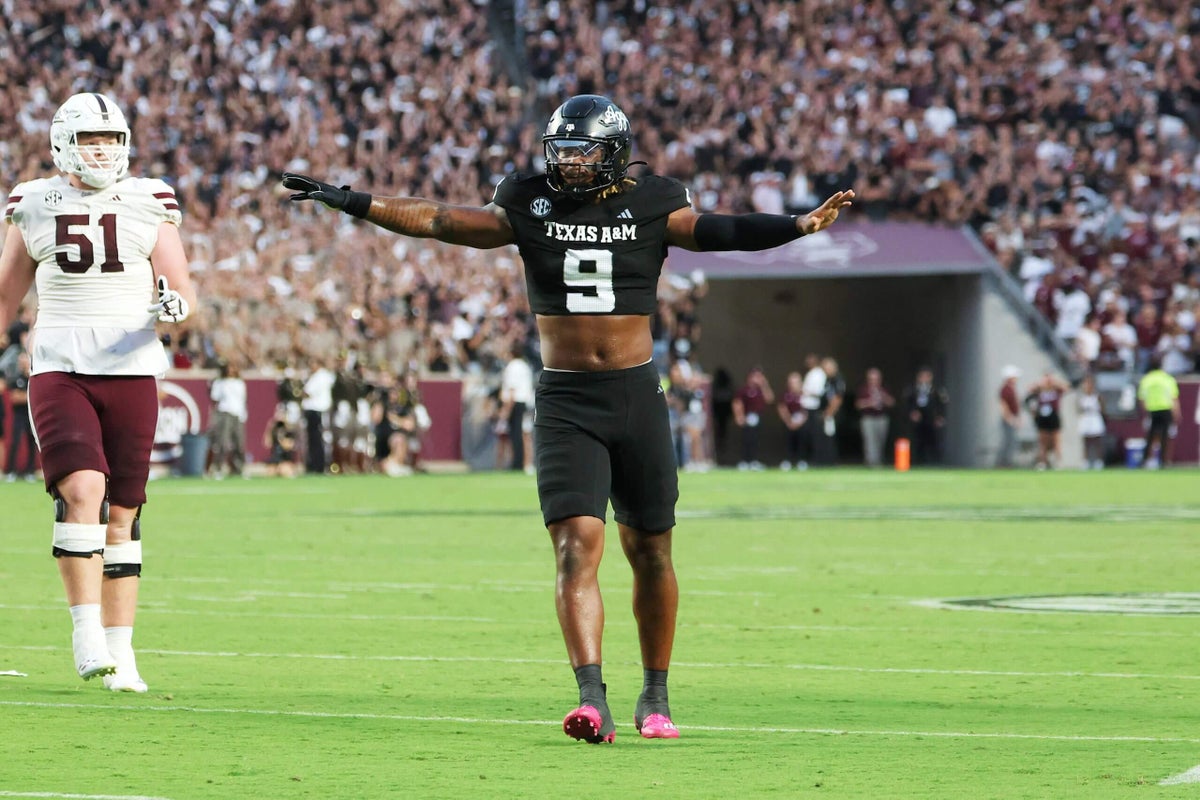
My ideal pick at No. 31 would be Texas A&M’s Cashius Howell. If he’s not available, I’d go with (in order) Clemson’s T.J. Parker, UCF’s Malachi Lawrence or Oklahoma’s R Mason Thomas.
If a run on edge rushers before the 31st pick meant none of them were available, I’d look to trade out of the first round.
Wait on offensive tackle
This one might be a bit controversial, but even after New England’s offensive line struggled so much in the playoffs, I wouldn’t draft an offensive tackle in the first two rounds (or maybe the first two days altogether).
The problem for me is that you already know your starters there, with Campbell protecting Maye’s blind side and Morgan Moses at right tackle. If you draft an offensive tackle in, say, the second round, the best-case scenario for the team is that the player doesn’t get any snaps all year (because it would mean Moses stayed healthy). If you draft a backup edge rusher, he’d play plenty as a rookie. If you draft a backup tight end, there are still plenty of snaps to go around. But backup offensive linemen don’t play, barring injury. And I wouldn’t want to use a first- or second-round pick on a guy who isn’t supposed to play all year, wasting one of the cost-controlled years of a rookie contract.
Plus, according to Dane Brugler’s “The Beast,” the depth of offensive tackles this year drops off dramatically after the top seven. In his latest (and outrageously comprehensive 257-pick) mock draft, Brugler has seven offensive tackles taken in the first 35 selections, then just two in the next 71 picks.
So if you’re not going to pick an offensive tackle in the first round (which I wouldn’t), it’s probably wise to wait.
Does that mean right tackle becomes a big need next year? It does. But the Patriots have too many other needs to use one of their most valuable resources (say, their second-round pick) on a guy who, even if healthy, might not play in 2026.
Prioritize tight end
I’ve gone back and forth on how early the Patriots should draft a tight end for one main reason: This is such a deep draft class at the position that you could probably get a player capable of becoming a starter early on Day 3. So from that perspective, it might not make sense to use an early pick at tight end.
But this offseason could unlock some fun concepts if they pick a receiving tight end early, perhaps Vanderbilt’s Eli Stowers in the second round. That would give New England the ability to lean on multiple-tight-end formations with Julian Hill as a true blocking tight end and Stowers as the receiving mismatch.
The idea of building an offense around multiple-tight-end usage is in vogue. The Los Angeles Rams ranked first in the NFL in how frequently they used multiple tight ends (including a league-high 30.5 percent of snaps with three tight ends on the field), and they ranked second in expected points added per play, behind only the Pats.
One way the Patriots can improve their offense is by trading for a high-end wide receiver like A.J. Brown. But another would be by picking a receiving tight end like Stowers, who could make their scheme more dynamic.