
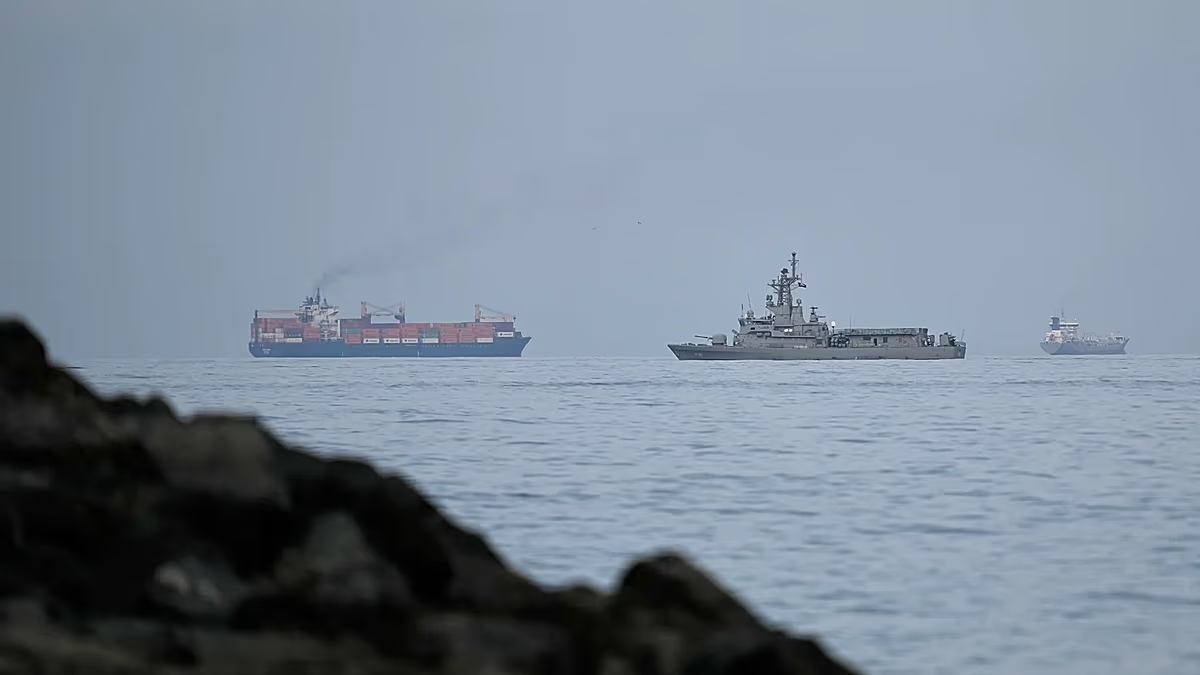
that maritime traffic through the Strait of Hormuz was “declared completely open for the remaining period of ceasefire,” Iranian Foreign Minister Abbas Araghchi announced in a post on X on Friday.

ADVERTISEMENT
ADVERTISEMENT
Moments later, US President Donald Trump announced in a social media post that “Iran has just announced that the Strait of Hormuz is fully open and ready for full passage.”
“Thank you!” Trump wrote on his Truth Social platform.
After that initial surprise announcement, Trump continued making several key statements about further details of an apparent agreement with Iran, including that the US will get all of the country’s enriched uranium after joint excavations from bombed nuclear facilities, referring to it as “nuclear dust”.
In a series of social media posts, Trump said that “Iran, with the help of the USA, has removed, or is removing, all sea mines” in the Strait of Hormuz and that Tehran has “agreed to never close the Strait of Hormuz again,” adding that “it will no longer be used as a weapon against the world.”
To underline the US commitment to the peace process, Trump also announced that “Israel will not be bombing Lebanon any longer. They are prohibited from doing so by the USA. Enough is enough!”
A spokesperson for Iran’s president, Seyyed Mohammad Mehdi Tabatabaei, contradicted Trump’s announcements on the Hormuz reopening, calling them “baseless statements of the enemy” and “aimed at stripping the Iranian nation of their sense of pride for the great victories they have achieved through their resolute defence.”
“The conditional and limited reopening of a portion of the Strait of Hormuz is solely an Iranian initiative, one that creates responsibility and serves to test the firm commitments of the opposing side,” Tabatabaei said on X.
In a further sign of the complexities of power in Tehran, two semi-official news agencies challenged Araghchi’s announcement, stating that such a decision needed “clarification” and “requires the Supreme Leader’s approval.”
Considered close to the powerful Revolutionary Guard (IRGC), the Fars news agency questioned the “strange silence from the Supreme National Security Council and the negotiating team.”
Iran’s Supreme National Security Council has recently acted as the de facto top decision-making body in the country, as doubts swirl over the status of the new Ayatollah Mojtaba Khamenei, who was reportedly injured early in the war.
The state-run Tasnim news agency quoted what it called “informed sources” who reportedly stated that navigation can only go through corridors decided by Iran, while a senior military official told the state television that any passage must be approved by the IRGC.
But Iran’s Ambassador to Pakistan Reza Amiri Moghadam wrote on X that the Lebanon ceasefire and the resulting reopening of the Strait of Hormuz “pave the ground” for a US-Iran agreement, for “permanent peace and collective security, sustainable development, progress and prosperity for All in the region and beyond.”
Meanwhile, late on Friday, the secretary general of the International Maritime Organisation, Arsenio Dominguez, announced that the UN shipping agency has already started monitoring the reopening of the Strait of Hormuz.
First reports from Euronews journalists on the ground indicate that cruise ships that were stuck in Gulf ports — two in Doha, of which one is owned by German-based TUI, and one in Abu Dhabi — have since prepared to depart or have left, an apparent sign that traffic through the Strait of Hormuz has resumed.
Two Greek-operated cruise ships have been identified on maritime traffic tracking apps as on the move, with Celestyal Discovery already crossing the Strait of Hormuz and Celestyal Journey leaving the port in Doha, among a significant number of ships that have embarked on passing the strait after the announcement.
Crucial waterway
Traffic through the waterway, through which a fifth of the world’s crude oil and liquefied natural gas supplies transited before the war, has been almost completely blocked since the Iran war started with US-Israeli air strikes on 28 February.
The current two-week ceasefire expires on 22 April, but Trump has already indicated he would be willing to extend it in light of positive progress towards a resolution.
The US launched its own naval blockade of Iranian ports, which came into effect on Monday, with President Donald Trump warning that any attack ships would be “eliminated” if they attempted to break it.
“Iran’s navy is laying at the bottom of the sea, completely obliterated – 158 ships. What we have not hit are their small number of, what they call, ‘fast attack ships,’ because we did not consider them much of a threat,” Trump wrote in a post on his platform Truth Social.
That has sent energy prices spiking around the world, with the International Energy Agency chief warning on Thursday that Europe only has “maybe six weeks or so of jet fuel left,” if supplies remain blocked.
Oil prices fell immediately by more than 10% and Wall Street has rallied towards another record after the announcements.
Stocks have rallied more than 11% since late March on hopes that the United States and Iran can avoid a worst-case scenario for the global economy.