
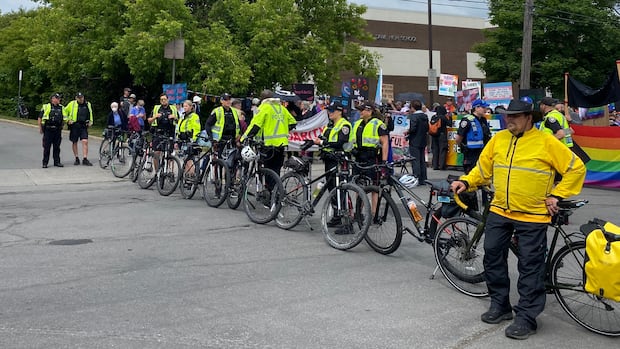
A city committee has voted for a “bubble bylaw” that would restrict protests near schools, hospitals and places of worship, sending it to council for a final decision.
The bylaw would allow those facilities, as well as child care centres and nursing homes, to apply for a safe access zone extending 50 metres from any entrance to the site. It would ban most protests inside that zone, with some exceptions including for labour pickets.
During about seven hours of speakers, questions and debate on Friday, several councillors said they wrestled with the question of how to balance the fundamental freedom to protest with protecting the right to worship or access healthcare.
Somerset Coun. Ariel Troster said she was initially skeptical but feels confident the bylaw includes guardrails to protect rights. She called it “reasonable” and “fair.”
“I don’t believe, fundamentally, that it’s impeding the right to protest,” she said.
Orleans East-Cumberland Coun. Matt Luloff said protesters who want to demonstrate against a school board should take their rally to the administration building, not a school.
“That is how a healthy democracy functions,” he said. “What is not appropriate is targeting children. What is not appropriate is harassing seniors.”
Luloff, Troster and fellow councilors Laura Dudas, Clarke Kelly, Glen Glower, Laine Johnson, Stéphanie Plante, Isabelle Skalski, Steve Desroches, Alan Hubley, Wilson Lo, David Hill, Catherine Kitts, Tim Tierney, and Riley Brockington voted in favour of the bylaw.
Sean Devine and Jessica Bradley voted against it.
‘An Olympic-size pool barrier’
Numerous speakers called the bylaw too broad, however.
Paul Champ, a constitutional lawyer who launched a class action against the 2022 convoy protest, warned it will have a “chilling effect” against protest. He called the convoy an “aberration” and said the pendulum is now swinging too far in a “reactionary” direction.
“I don’t think we have a problem in Ottawa that justifies a sweeping bylaw like this,” he said.
Another speaker, activist and organizer Sam Hersh, said the 50-metre limit is too wide.
“It’s an Olympic-size pool barrier to getting your word out, a significant hindrance to reaching your intended audience,” he said.
“Protest is not just about what you say. It’s about where you say it.”
Knoxdale-Merivale Coun. Sean Devine made a motion to remove the blanket ban on protest inside the bubble zone, while retaining other restrictions against hindering people from accessing the facilities.
Champ said Devine’s motion would have stripped away “the most flagrantly unconstitutional” part of the bylaw.
But the city’s top lawyer, Stuart Huxley, said the bylaw has one big advantage. It doesn’t try to target any specific message.
“The message is not being regulated,” he said “It is content neutral. It is shifting content 50 metres away from the access point.”
Members of the committee shot down Devine’s motion in a 14 to 3 vote, before voting for the whole bylaw 15 to 2. It now goes to a full meeting of council later this month for final approval.
‘A reasonable way to protect people’
The proposed bylaw got support from several religious communities, including from Jewish groups who pointed to a surge in hate crime that makes members of their community feel unsafe.
David Sachs of the Jewish Federation of Ottawa called that an “absolute crisis” and said the bylaw will help prevent protests from escalating into violence.
“This is a reasonable way to protect people, so that we avoid those conflicts and we don’t have people in each others faces,” he said. “And particularly families that have justifiable fears, that they don’t have people wearing masks screaming in their faces and threatening them”
The bylaw was drafted in response to several high-profile incidents in Ottawa, including an anti-trans protest at Broadview Avenue Public School in 2023 and a protest at Soloway Jewish Community Centre in 2024.
Hillel Lodge, a Jewish long-term care home, is at the Soloway site and its CEO, Tom Cohen, told councillors how that protest traumatized residents.
“They used bullhorns, drums and large speakers powerful enough that the vibrations could be felt inside the building,” he said. “Residents with dementia became agitated and disoriented. Holocaust survivors were retraumatized.”
Some exceptions in the bylaw
The bylaw does include exceptions. It doesn’t apply an hour before a facility opens or an hour after it opens. It doesn’t apply to marches that simply pass by a facility.
It has carve outs for embassies or government buildings, and it doesn’t restrict “labour union strikes, information pickets or activities related to a labour dispute.”
But Karin Galldin of the Ontario Coalition of Hospital Unions called that protection “vague.” She said her members don’t have the right to strike and often protest at hospitals against privatization or staffing cuts.
“These protests have nothing to do with collective bargaining or what might be characterized by your draft bylaw very broadly as a labour dispute,” she said. “This bylaw now risks taking even more of these workers’ expressive activity away.”
Troster got a motion passed to fix that and ensure that “the bylaw would not apply to healthcare workers even if they were not in a legal strike position.”
Another delegate, Rob MacDonald, told councillors that religious institutions can be important sites for political protest.
“I have concerns with religious institutions being accorded special status to prevent scrutiny and demonstrations,” he said.
“As an older queer person, I lived through times when churches vehemently opposed any legislation to extend rights to same-sex couples.”