
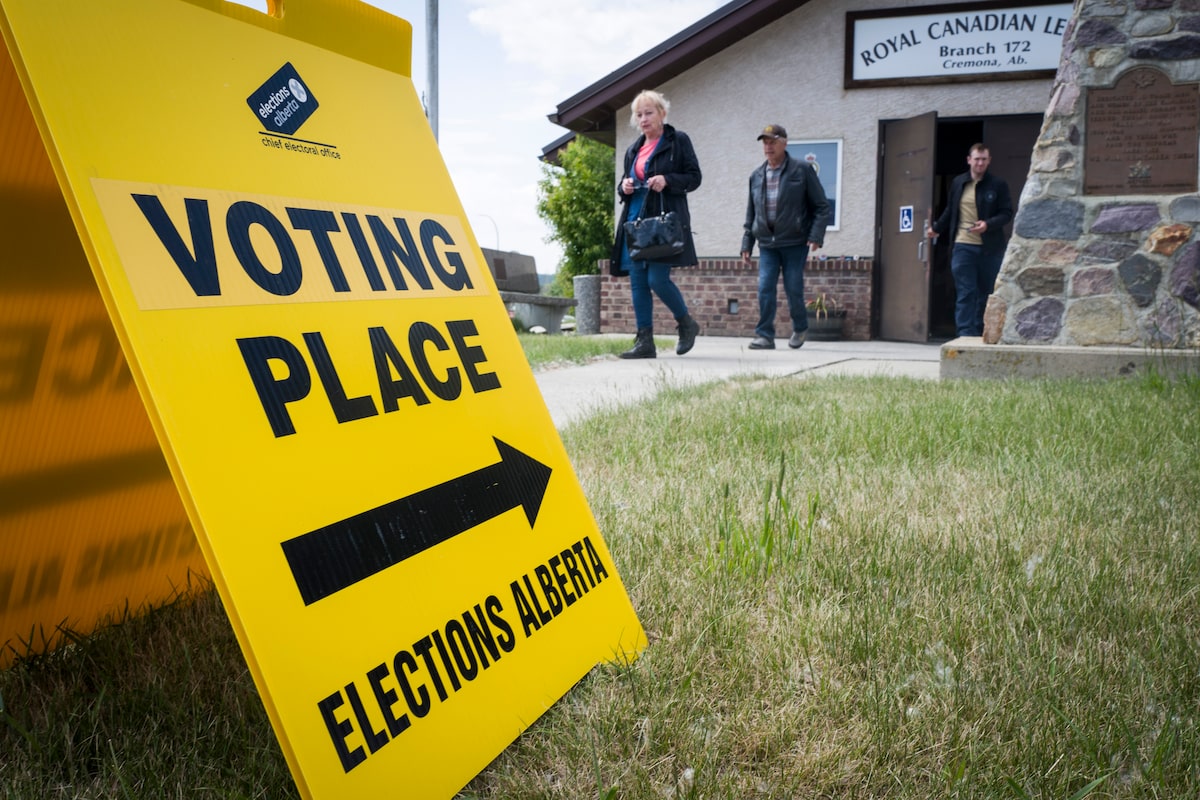
Alberta’s laws require the boundaries commission to create an electoral map using the number of seats set by the provincial government.Jeff McIntosh/The Canadian Press
Later this year, Premier Danielle Smith’s government will present the new electoral map that will define Alberta’s political playing field for the next decade. In the meantime, she’s being forced to wave off accusations of gerrymandering by meddling with a process that has traditionally been kept out of the hands of elected officials.
On Thursday, Ms. Smith triggered political fury from across the aisle when her United Conservative Party government announced it would be rejecting an independent commission’s proposed changes to Alberta’s electoral map and opting to create a UCP-controlled committee of MLAs that will oversee a new effort to redraw the map. A new advisory panel will be chosen by that committee and redraw the map, with an Oct. 22 deadline for its final report.
The move is a significant departure from the non-partisan methods Canadian provinces and territories use to update the boundaries of their constituencies.
Alberta NDP Leader Naheed Nenshi, on Friday, accused Ms. Smith of trying to steal the next provincial election, scheduled for October, 2027. Ms. Smith has batted away those accusations, saying the province plans to largely follow the “clear direction” of the bipartisan commission’s UCP-selected chair by restoring two rural seats that were eliminated in the report.
Opinion: Politicians have recently taken to blaming immigrants. This isn’t a new trend in Canada
“He’s not telling the truth,” Ms. Smith said of Mr. Nenshi at an unrelated Friday news conference.
Elected officials’ involvement in the redistricting process has been restrained in Canada for decades. Alberta established its first independent electoral boundaries commission in 1969.
The commission, in its report submitted last month, remark that while “legislators are free to reject commissions’ recommendations, they do so at their peril.”
Ms. Smith’s decision has injected a charged partisan atmosphere into what’s normally a complex process designed to foster compromise and limit political influence.
Her move follows a recommendation made by Court of King’s Bench Justice Dallas Miller, whom she tapped to chair the commission. He made the recommendation on his own, without the support of the other four panelists.
The government determined two new seats were needed in the province in November, 2024, just as the panel was beginning its work and Alberta’s population boom – particularly in urban centres – was beginning to taper.
Mr. Miller said in the report that if legislators disagree with the commission’s decision to remove the two rural seats, the government should increase the number of electoral districts to 91 from 89 and restore the deleted constituencies.
Alberta’s laws require the boundaries commission to create a map using the number of seats set by the provincial government. In British Columbia and Quebec, commissioners are allowed to set the number of seats as they see fit.
Gary Mason: The separatists on Premier Danielle Smith’s team
Shaun Fluker, a law professor at the University of Calgary, said the government’s justification – that all the commissioners discounted their own work because they wished more seats were in play, and that the UCP is simply following the chair’s recommendation – does not hold water.
“Smith makes it sound like the commission just basically said: ‘This is a piece of junk, I’m sorry but we didn’t have enough seats to work with.’ That’s totally not what they say.”
The government’s motion to strike an all-party committee acknowledges the chair’s parameters but gives the incoming map-makers the green light to modify those “recommendations.”
Mr. Fluker argued that the government is using the proposed advisory panel as a shield against accusations of cheating.
“They like to create these processes that have this façade of independence,” he said. “So, they can say: ‘Oh, well, the Opposition says this is gerrymandering, but this is a fully independent process.’ ” Gerrymandering is a process by which political parties design electoral maps to lock in their electoral advantage.
Hamish Telford, political-science professor at the University of the Fraser Valley, said Ms. Smith’s decision to wrest control over the process has cranked up the temperature on a process that was already hot.
In the final report, two of the commission’s members, both tapped by the UCP, put forward a competing map and report. They proposed more than a dozen merged urban and rural ridings, diluting the power of the urban vote.
Mr. Miller and two NDP-recommended board members called the map unconstitutional and hinted that it was an attempt at U.S.-style gerrymandering.
“They’re taking a process which has become political, and it seems like they’re making it more political,” Prof. Telford said of the government. “And that opens the door, I think, for gerrymandering.”
Talk of separation is hurting Alberta. Why won’t Danielle Smith denounce it?
In the U.S., gerrymandering has become a tit-for-tat battle, with few states inoculated against the practice. In December, California voters passed a measure to redistrict the state in a way that would allow Democrats to flip congressional seats held by Republicans. It was an attempt to counteract Republican moves that President Donald Trump has sought in GOP states like Texas.
Gwen Day, a UCP-selected member of the previous boundaries commission, said the two UCP commissioners’ decision to propose an alternative map was unprecedented. It also put the Smith government in a bind, she said.
“I’m not sure what they were supposed to do with the report that they were given when it was so divided,” Ms. Day said.
“I’m not sure what any other option would be. You can’t really adopt it being so divided. So what do you do?”