
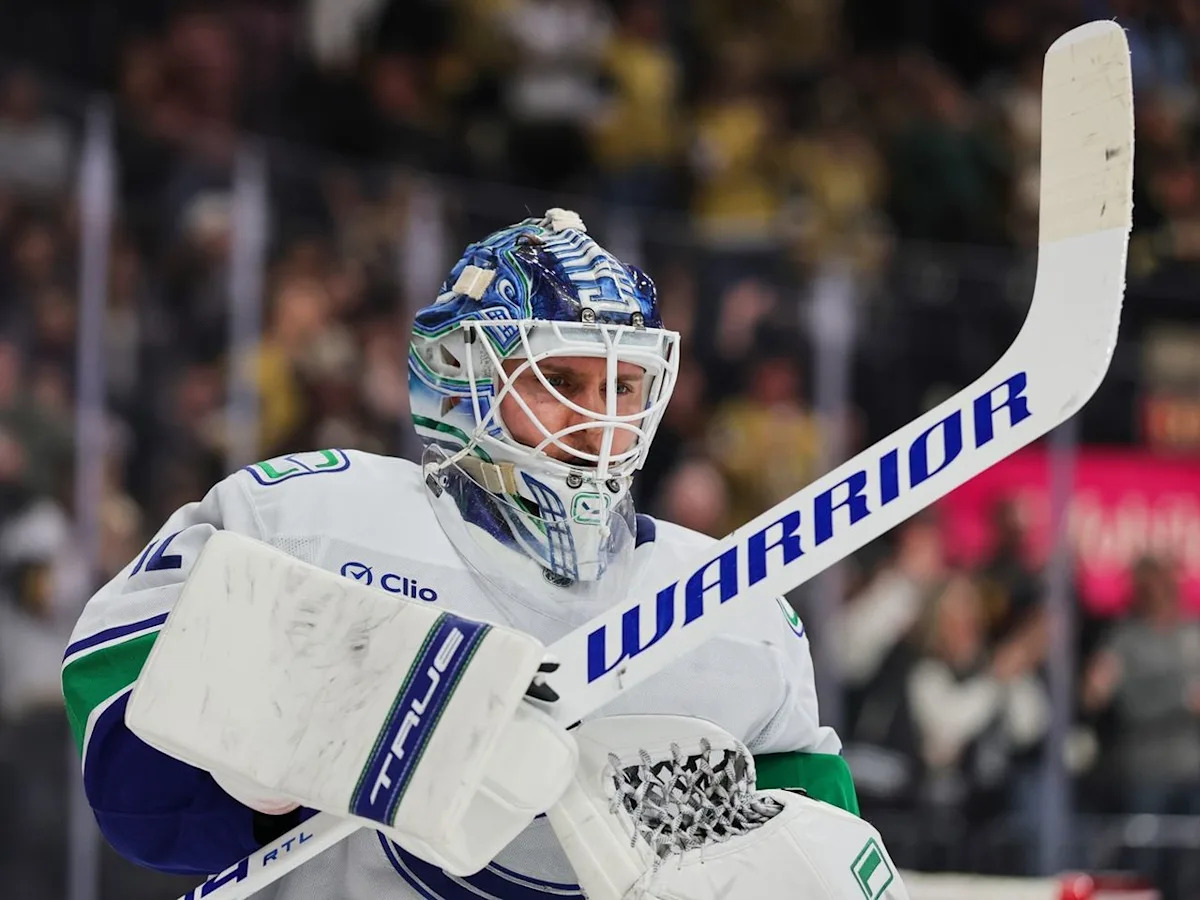
When you look back and try to answer the question: what the heck just happened? — Vancouver Canuck Teddy Blueger figures you actually have to start with the end, because it underscores what had been missing.
The Canucks’ 2025-26 season is one of the worst in club history. Their point win percentage of .354 is tied for third-worst in team history.
And let us remember that when the NHL season started, the target was the playoffs. Canucks president of hockey operations Jim Rutherford said so. Team general manager Patrik Allvin said so. Head coach Adam Foote said so.
Most prognosticators, including this author, said so.
So far only Allvin has paid with his job. Foote, perhaps even Rutherford, may yet still. Yours truly can offer only a mea culpa.
How did it all go wrong? Well, Blueger replied, consider what has been put back into place since the trade deadline.
“Looks at the ins-and-outs of our team dynamics,” he said.
Those dynamics are no longer dominated by a group of experienced, forceful veterans. The team is one of the youngest in the league now. It’s a little more upbeat.
But it’s also in need of guidance. And that, at the end, is a reminder of how lost they were for so much of the season.
Let’s go over what happened and find our way to the present:
The good start
It’s forgotten, but the Canucks opened the season 4-2. They were halfway through a road trip and feeling good.
Now, the underlying statistics suggested the record was a bit of a mirage, but the mark was something for the players and the coaches to point to and say, “Hey, we can tighten things up here and you know our record will keep improving.”
“At the start, we were what, .500? We were in our games and it felt so positive,” Canuck Drew O’Connor said.
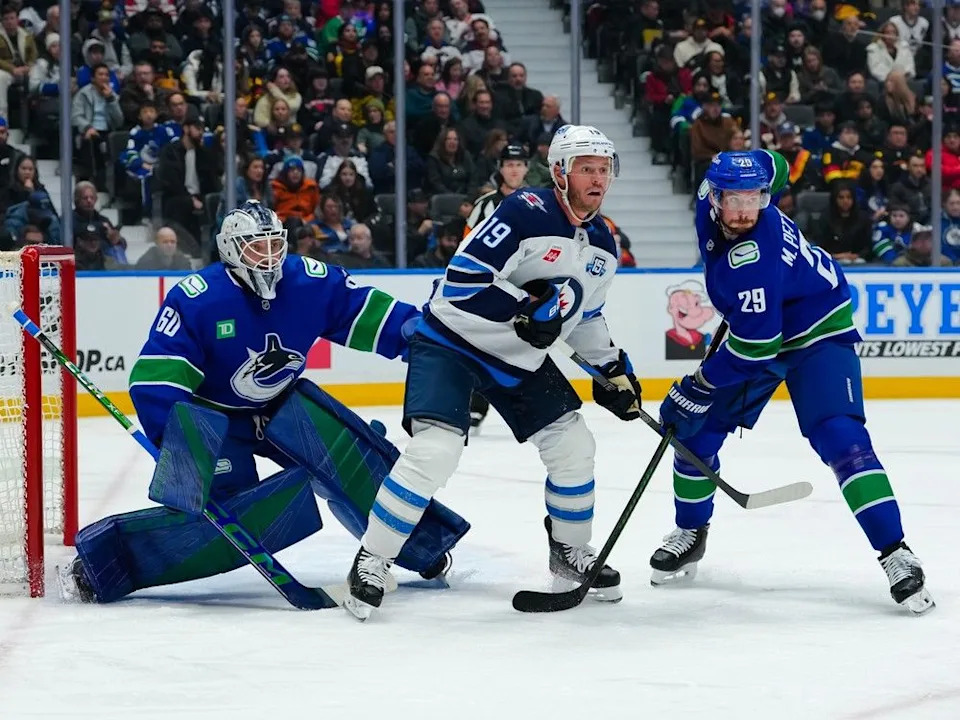
Nikita Tolopilo and Marcus Pettersson defend against Jonathan Toews of the Winnipeg Jets Feb. 25.
Early injuries
“And then we had some injuries,” teammate Marcus Pettersson said.
In one game in Washington, D.C., the Canucks lost Blueger and centre Filip Chytil.
It set everything back. Sure, they were already playing too loose to have long-term success, but at least they were having fun. Chytil was a head injury waiting to happen, most observers believed, but his dynamic skating and his ability to carry the puck into the zone did set him apart from his teammates, and he was playing well and scoring.
Blueger, the vet checking centre, would also be missed. The Canucks had started the year thin at centre and the double-blow in D.C. knocked everything off-kilter.
The team’s playing style proved unable to absorb the loss of the pair.
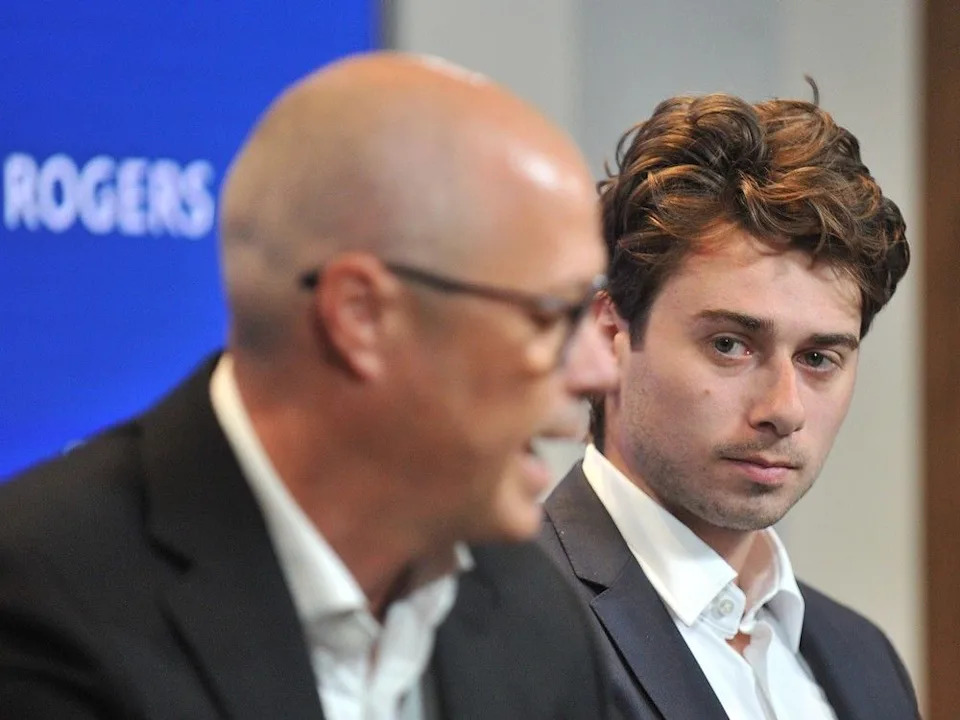
Vancouver Canucks GM Patrik Allvin and Quinn Hughes at the September 11, 2023 press conference when Hughes was named team captain.
Quinn Hughes gets frustrated
The Canucks won just four times in November. They were outshot most nights. They fell behind too often and their second periods were disastrous. Bad decisions were rife.
Quinn Hughes was trying to do everything, sometimes maybe too much, and although he was playing lots, he wasn’t his vintage self.
“You could tell for a while,” O’Connor admitted about the former captain’s frustration.
Everyone saw it in his play, and in his public interactions. The team was struggling and he could see that the exit was approaching. It was tough on Hughes, it was tough on everyone. His teammates still didn’t expect a trade, but in hindsight they can understand what was going on.
Their captain had opened the door to management to start looking for a new landing spot.
Meanwhile, Rutherford told the world that, at the very least, the team’s unrestricted free agents were available for trade. That was the first of several pronouncements to shake up the room.
Hughes gets dealt
After the trade, for a short while it seemed like maybe they would get back in the playoff race, Canuck Max Sasson said.
“These guys came in and we won four games in a row and you start looking at the standings,” he said.
And then the losing started. After Christmas they lost 12 of 13 games. That was grim.
“After the trade, everything went sideways,” O’Connor added.
Somewhere in there, Blueger came to realize, the team just wasn’t at all on the same page. The reasons, he realized later, were complicated.
“I think there are different ways to get guys to match and different things you have to do,” he remarked as the season wound down.
As weird as it sounds for a guy who’s just age 31 but realized that his younger teammates had just come up in a different world from his millennial experience.
“Young guys now are a little bit different than from when we came in. It’s not that it’s good or bad … just how it is,” he explained. “I found one of the things when I came in — and maybe it’s because we were an older team (in Pittsburgh) — it’s like, you just came in, you shut up and you just did your job. It’s not really like that anymore.
“And I think it took us a second to figure that out and find the right approach, to get everyone to be more involved and feel part of it, because, you want it done in the right way so everyone has an understanding of their role, but also everyone feeling a part of it.”
That took time though.
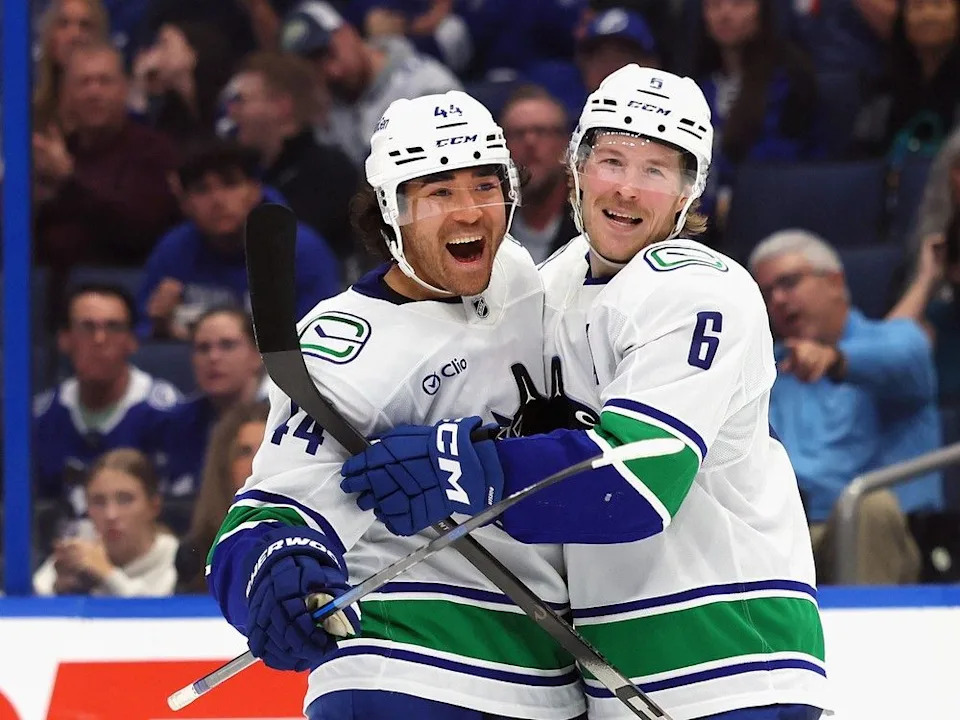
The Canucks’ rebuild grew when winger Kiefer Sherwood, who led the club in goals and hits, was traded Jan. 26 to San Jose
Get us out of here!
“We were so disconnected,” Canuck Brock Boeser said of how badly things were going much of the season.
No time was worse, probably than the stretch after Christmas.
We can see it now, but it’s clear that Rutherford’s talk of a rebuild shook up the room. Vets who had signed on for a playoff chase — Conor Garland and Tyler Myers, for example — started to ponder if maybe their future lay elsewhere. They had signed on for post-season games. Those weren’t coming in Vancouver.
“You start hearing maybe this guy is getting traded. You hear the word rebuild,” Sasson said. “That was a low point in the season.”
And so the team’s play sagged. Mistakes were everywhere.
Kiefer Sherwood was traded, not because he wanted out but because management recognized his style of play would help a team fighting for the playoffs and they could recoup some draft picks for the hustling winger, who had been added, ironically now, after the hard-fought Nashville first-round playoff series in 2024, with playoffs runs in 2025 and 2026 in mind.
Garland and Myers were traded too, which would open doors for others.
The trade deadline
As the first week of March approached, deadline day started bulging from the calendar. Who else would be on their way out? The trade-talk hot stove saw many, many names bandied about. If you played for the Canucks, it seemed a guarantee you would be in the conversation.
“It’s not the trade deadline if my name’s not out there,” Boeser quipped.
And then the deadline was over. Tensions eased. Teammates almost needed to reintroduce themselves to each other, now that they knew who would be around for the finish to the season.
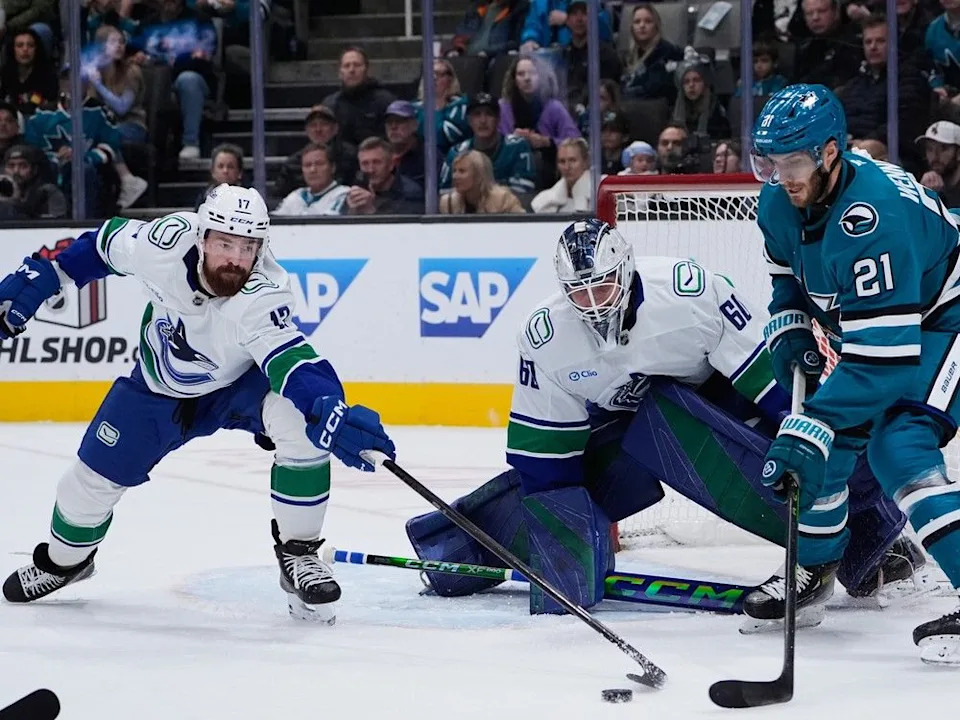
San Jose Sharks center Alexander Wennberg and Vancouver Canucks defenceman Filip Hronek during NHL game Nov. 28, 2025, in San Jose, Calif.
New vibes
After the deadline, the team’s remaining vets looked at each other and said, essentially, enough. The likes of Boeser, Blueger, Marcus Pettersson, Filip Hronek and goalie Kevin Lankinen saw that this was a group that needed to forget its own identity. The younger players needed to feel that this was now their space.
“We thought it was the right time to intervene a little bit and make sure we start building now, instead of letting the season slip away and then coming back, we already kind of set the standard, and hopefully this goes on,” Lankinen said. “There’s still a long ways to go,”
They picked out some topics, then turned to the whole room.
Lately, he said, he had been thinking about how things were in Pittsburgh, where he broke into the league. That team was two years removed from back-to-back Stanley Cups. There were a few things he realized that maybe he had taken for granted, things that he had realized were perhaps a little lacking as the current season wore on.
“Off-ice details,” he began. “The professionalism of timeliness, dress code, respect for training staff, respect for tidiness. All those little things.
“I think I was really lucky when I came into Pittsburgh … all those things were in place, and those were just the expectations. And I think all that discipline carries over and becomes discipline on the ice. It’s not just like getting along in the room, but making sure there’s a healthy respect for each other. And then you don’t have to be best friends, but you got to be willing to give up some of your own ego and wants in order for the team to benefit.”
“We had a meeting as a group, and there was something we talked about, some standards, just habits, what’s OK, what’s not OK,” one of those younger Canuck players, Linus Karlsson, noted. “And I think we’ve done a good job with that. And I think everyone has really, really listened.”
“The last 15 games, that was the closest I’ve felt at least in my time here, that everyone’s pulling the rope,” Sasson concluded.