
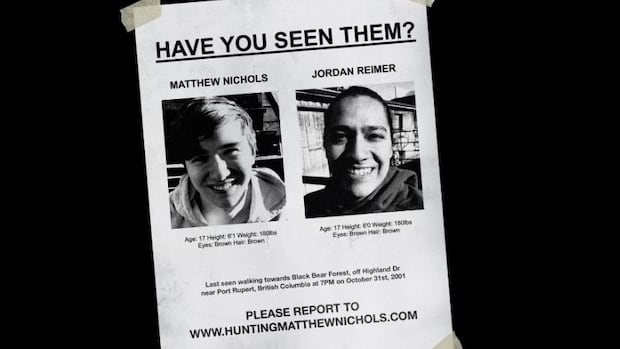
A new, independent B.C.-made mockumentary film is hitting theatre screens in Canada and the U.S.
Hunting Matthew Nichols is a fictional story, shot in the style of a documentary, that leans on the true crime genre, with a splash of horror.
In the story, a filmmaker and her crew follow a woman as she tries to solve the mystery of her brother’s disappearance, which happened two decades earlier.
The mockumentary filmmakers are both from B.C., as were many of the cast and crew.
CBC’s Sarah Penton spoke to Kelowna-raised filmmaker Sean Harris Oliver — one of the film’s producers and writers — to learn what it took to get his small, independent film screened in theatres across North America.
This interview has been edited for length and clarity.
As a mockumentary, this is a fictional film, right?
The premise is a fictional story, it’s about a young woman whose brother went missing 20 years ago on Vancouver Island. And she’s gotten to this point in her life where she feels like she wants to explore what actually could have happened to her brother. And so she gets together with her friends, who are all B.C. documentary filmmakers, and she goes out to Vancouver Island and goes out into the forest and starts to try to figure out what happened to her brother.
The narrative is framed like a documentary and it is a mockumentary. It’s fictional, but it sort of morphs into a found footage, Blair Witch-esque type story.
What made you want to make a movie with found footage, with a documentary feel?
The director Markian Tarasiuk pitched this idea to me. Because we’re so used to it on Netflix nowadays or HBO, we watch these true crime documentaries and we sort of just believe that everything that we’re seeing is real. And so we wanted our movie to start like that. Frame it like it’s a talking head documentary about a girl who’s trying to find her brother and she’s investigating and speaking with police and family.
WATCH | Mockumentary film borrows from true crime genre:
It creates this notion that the narrative is really happening or that it did really happen. It allows audiences to sort of immerse themselves into the world of the story. And question, ‘Is what I’m seeing actually real?’ And it’s such a fun way to be absorbed into a story like this and then to watch it all sort of fall off the rails. And that’s where all the scares start to come in near the end of the film.
The film has a really authentic feel to it, and if people don’t know any better, they might mistake it for a true story. What was it like for you to get that kind of effect?
It’s similar to how The Blair Witch Project did this back in the 1990s, where found footage was this thing that we thought could potentially be real. And of course, the found footage genre has been explored so much now that we know that these aren’t real stories.
But to explore it through this world of the documentary, that was a fun way to do it because people do, they’re more accepting that a documentary might be completely real.
LISTEN | Filmmaker describes inspiration for mockumentary:
Radio West9:53Independent, made-in-B.C. mockumentary now on the big screen across North America
Kelowna-raised filmmaker Sean Harris Oliver describes what it took to get ‘Hunting Matthew Nichols’ his small, independent film screened in theatres across North America.
It allowed us to play in that genre and really crack it open — to lean into this idea of ‘Did this actually really happen?’
I’ve been at screenings of this movie all over the place now. And sometimes I do see people pick up their phone in the theatre and I can see the light go on and I can see that they’re scrolling to see like, is this actually real?
Who’s your intended audience?
It’s not like we’re trying to trick people maliciously, but we want people to be into the world of the story. And anyone that’s into true crime podcasts or stories or investigative journalism or those kind of creepy sort of scary ghost stories, they will love this film.
Now, I understand that you got some pushback from people recommending the film be made in the U.S. Why was it important for you to keep it in B.C., set in a fictional community on Vancouver Island?
As we were going through pre-production and development, some American producers suggested this would be easier to get into the American market if you set it in the United States. But we just felt it was so important to set this story in B.C., we wanted to showcase the province. We wanted to kind of have a little love letter to the province.
How did you manage to get this independent film on the screen in hundreds of theatres across North America?
That’s a huge, huge lift. I mean, this is honestly, this has never really been done before.
We showed the movie at film festivals and generally what happens is movies — some of your listeners might be familiar with the film called Undertone, which was made in Canada, but it got purchased by an American distribution company and then it’s distributed to the United States.
We didn’t get purchased by an American distribution company and we just said, ‘You know what, we can get this movie into theatres on our own.’ And so I travelled all over the United States. I went to Kansas City and Knoxville and Milwaukee, and I met with all of the owners of the major theatrical chains in the U.S. and I got this movie into their theatres.
So it’s really historic. And I’m just so proud that we were able to get this movie across the nation in theatres where it belongs. And you know, it’s playing in Kelowna, and I just encourage people see the movie in theatres where it belongs, where you can really see it up on the big screen and see the picturesque beauty of B.C. and, and see the work of all these B.C. artists.
You’re speaking to us from a massive film convention in the U.S., where you’re promoting your indie film. What’s it like?
It’s wild. It’s a huge conference for the filmmakers and for exhibition companies that have their theatres all over the country. And so we’re here just continuing to promote the movie and asking them to keep us in theatres longer because it’s really hard as an independent movie to stick in theatres.
We don’t have the marketing dollars to make a huge, big splash on opening weekend. But if audiences start to find this movie, we think that they’ll really, really enjoy it. But we need that sort of runway to stay in longer.
We can’t just have three days at the theatre, then, okay, you lose all your screens. We need time for people to discover the movie, to make fans to tell their friends about it. So that’s what we’re down here doing. And it just feels surreal to be like this guy from Kelowna who’s down here in the U.S. trying to advocate to all the biggest theatre chains in the world, really to have them continue to play this movie.
Will there be a sequel?
The narrative does hint at a future larger story, so I’ve written the script. I’m hoping that if this current film gets all of the success that it can have, that we will be able to come back and do another film and get all the artists back together again. And fingers are crossed if we do well enough, then we’ll make the next one.