
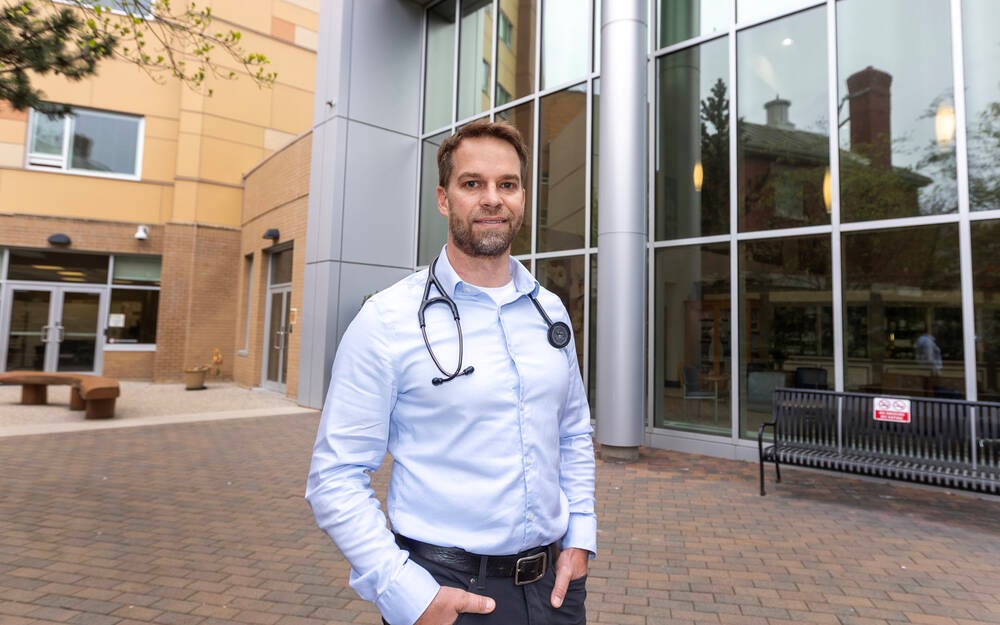
Three previously U.S.-based doctors talk about why they came to Victoria, and how it’s changed their lives.
Of all the books oncologist Kira MacDougall has collected, her favourite is her Canadian passport — it’s allowed her to track gorillas and scale Mount Kilimanjaro in Africa, scuba dive in Iceland, and climb glaciers in Ecuador.
And now, after more than a decade working abroad, most recently in New Mexico, that passport has brought her back to Canada, where she started work at Royal Jubilee Hospital on April 1.
The 33-year-old quit her job in January at a community clinic in Santa Fe, New Mexico, and, with her partner, 35-year-old firefighter Miles Kehr, drove their fully equipped 22-foot Ford Transit van to Vancouver Island, arriving last month.
The move was inspired by fellow physicians who sent news stories about the province’s new fast-tracked process for U.S.-credential recognition and a public relations campaign on the benefits of working in B.C.
MacDougall, who grew up in Hampton, Ont., but whose parents now live on Vancouver Island, said she started the process shortly after learning it was an option, and found the changes have made it “significantly easier and streamlined compared to how it was.”
Since the province launched a campaign in March 2025 to recruit health-care workers from the U.S., just over 2,000 have applied for jobs with the province’s health authorities, and 500 have been hired — nearly 100 in just the last month, Premier David Eby said this past week.
That includes 109 doctors in 25 different specialties, about 25 family doctors, 315 nurses, 51 nurse practitioners and 29 other health professionals.
MacDougall, who did her undergraduate studies at Queen’s University in Kingston, Ont., and went to medical school at the American University of the Caribbean in Saint Martin, has worked in New York, California, Oklahoma, Florida and Louisiana since she graduated. She said she always wanted to return to Canada one day. But when the rules changed in July 2025, and her training and licence were recognized in B.C., she decided the time was right.

Newly arrived oncologist Kira MacDougall, 33, with partner Miles Kehr and their van on Dallas Road. MacDougall began work at Royal Jubilee Hospital on April 1 after years of working in the U.S. ADRIAN LAM, TIMES COLONIST
Moving to Victoria allows her to both maintain the work-life balance she wants — hiking, cycling, scuba diving, climbing, running — and to focus on lung and gastrointestinal cancers. In the U.S., she was practising general oncology, seeing all types of patients with cancer.
“This will allow me to really dive into the literature and become familiar with several specialties within oncology,” said MacDougall, whose clinical research includes co-authoring 21 peer-reviewed articles.
“There are a lot of advancements in oncology right now, better patient outcomes, more patients are being cured now than ever before.”
How and why doctors working in the U.S. end up moving to Canada — and what they find when they get here — is the focus of a podcast called The Interesting MD by Robert Beck, a 47-year-old U.S. internist who came to work in Victoria in December 2020 with his wife Andrea Beck, also an internist.
His podcast explores the differences between the Canadian and U.S. health-care systems, as well as issues around navigating the move, from immigration rules to tax implications.
He said many of the problems in the health-care systems in the U.S. and Canada — such as staff shortages — are the same. Others are unique to the U.S., including the rate of burnout and related work-balance challenges among doctors, political tensions affecting health care and struggles with private insurance companies.
Most approvals for diagnostic tests and medications, for example, are initially turned down by U.S. private insurance companies, Beck said. That requires health-care teams to continuously advocate for coverage, or patients will not get needed tests and treatment.
“It is being overwhelmed by the system, it’s working constantly and never getting caught up, it’s having all this extra work put on them by the insurance companies and having to fight to take good care of your patients,” Beck said. “That is real moral injury.”
Beck met his wife, Andrea, while they were pursuing master’s degrees in public health in New Orleans, and they spent a decade there and another nine years in Nashville, Tennessee.
The couple felt they had a fairly good work-life balance, or as much as a couple could have, raising three kids while in medical school and residence. They ran triathlons, had great vacations and gathered regularly with friends.
But just months into the pandemic in 2020, the politicization of medicine became too much. Health-care workers were demonized for wearing masks or supporting COVID vaccines, and conspiracy theories were everywhere.
“Things just changed, the politics got nasty, and even patient visits and encounters got nasty,” said Beck, who noticed a growing disregard for science and facts.
Doctors were even accused of falsifying death certificates for COVID in an effort to make Donald Trump, then in his first term, look bad, he said, adding physicians were worried about their patients and also about bringing the virus home to their families.
“It was a terrifying time, and I really don’t think that people understand a lot about what doctors were going through,” he said.
On the podcast, he notes that leaving the U.S. and moving to Canada “changed how I think about medicine, money and what a physician’s life can look like.”
“I think that we didn’t really know what we were missing, and now we do,” Beck said, noting that everyone on health-care teams in Greater Victoria, from administrators to patients, expects doctors to look after themselves and take vacations.
“That’s a very different situation,” he said. “Now I am able to go bike riding all the time with my friends, with my colleagues. I go for runs.”
Beck and MacDougall maintain that having a full life beyond medicine is essential to being a good physician, a dramatic shift from how generations of physicians have worked in the past.
Trauma surgeon Dennis Kim, who appeared on Beck’s podcast last month, left the U.S. in 2021 and settled on Vancouver Island.
He became trauma medical director for Island Health on Vancouver Island after serving on the front lines of the busiest trauma centres in the western U.S.
Kim, 50, who was raised in Scarborough, Ont., said he saw both sides of the medical system in the U.S.
At the public Harbor-UCLA teaching hospital near Compton, California, patients weren’t turned away if they didn’t have money, which aligned with his values, but he also worked at the for-profit Ronald Reagan UCLA medical centre in affluent Westwood, near Beverly Hills, with valets, marble walls and pianists in the lobby.
Kim said, despite the drawbacks of the private system, he thinks competition among for-profits drives hospitals and physicians to be better and forces everyone to create efficiencies, produce better outcomes and improve practices.
But violence in the U.S. was a concern — post COVID, firearm-related injuries became the leading cause of death for children and teens in the U.S., surpassing motor vehicle crashes and cancer. “And unfortunately, I haven’t seen that that statistic has changed,” Kim said.
And in the early days of the pandemic, Los Angeles’ death toll from COVID was alarming.
Kim’s wife, who has family on the West Coast, left with the couple’s four kids for Vancouver Island because they felt it was safer and schools were still open, while Kim stayed in Los Angeles.
After 10 years in the city, Kim was climbing the ladder as an associate professor of clinical surgery at one of the top medical schools in the U.S. and publishing a lot of research, but still didn’t have a permanent resident card.
When a job posting for an intensivist — a doctor with advanced training in critical care — came up on Vancouver Island, he was interested.
“I always did envision that one day I’d have my own division of trauma as the chief,” he said.
He tried a couple of rotations in critical care at Victoria General Hospital and Royal Jubilee Hospital, then met Dr. William Orrom, executive medical director of surgery, ambulatory care, and cancer care strategy, who “changed our trajectory.”
“He really pulled at my heartstrings and shared a couple of unfortunate, potentially preventable, bad outcomes among trauma patients in the South Island,” said Kim.
He was offered the position of medical director for trauma services, in addition to working in the ICU.
Kim said when he arrived, Island Health had a mortality rate related to severe trauma of 15 per cent, “the highest mortality of any health authority” and above the provincial average of 10 per cent.
“With time, patience, dedication, and demonstration that the system could work and be fixed and sustained,” within two years, Island Health had “the lowest mortalities in the province at eight per cent,” said Kim, adding teamwork and having the right people in place were key. “Sometimes it just takes someone from the outside, “with a different perspective,” he said.
It was a difficult adjustment moving from a large urban centre such as Los Angeles, with a population of nearly 10 million, to Victoria, Kim said.
“But since the move, neither my spouse, kids or myself, could ever imagine being anywhere else in terms of quality of life,” he said, adding that clinically and administratively, he’s still very busy. “But there’s definitely more of a work-life balance, and these days, I think that’s huge.”
Kim said for generations physicians were told to lean into the profession without consideration for their own well-being or life outside of medicine, “and potentially at the expense of our loved ones, our families and non-medical endeavours and pursuits.”
“That’s just not the way that we’re going to sustain a healthy, forward-thinking workforce,” said Kim. “We need to have that balance.”