
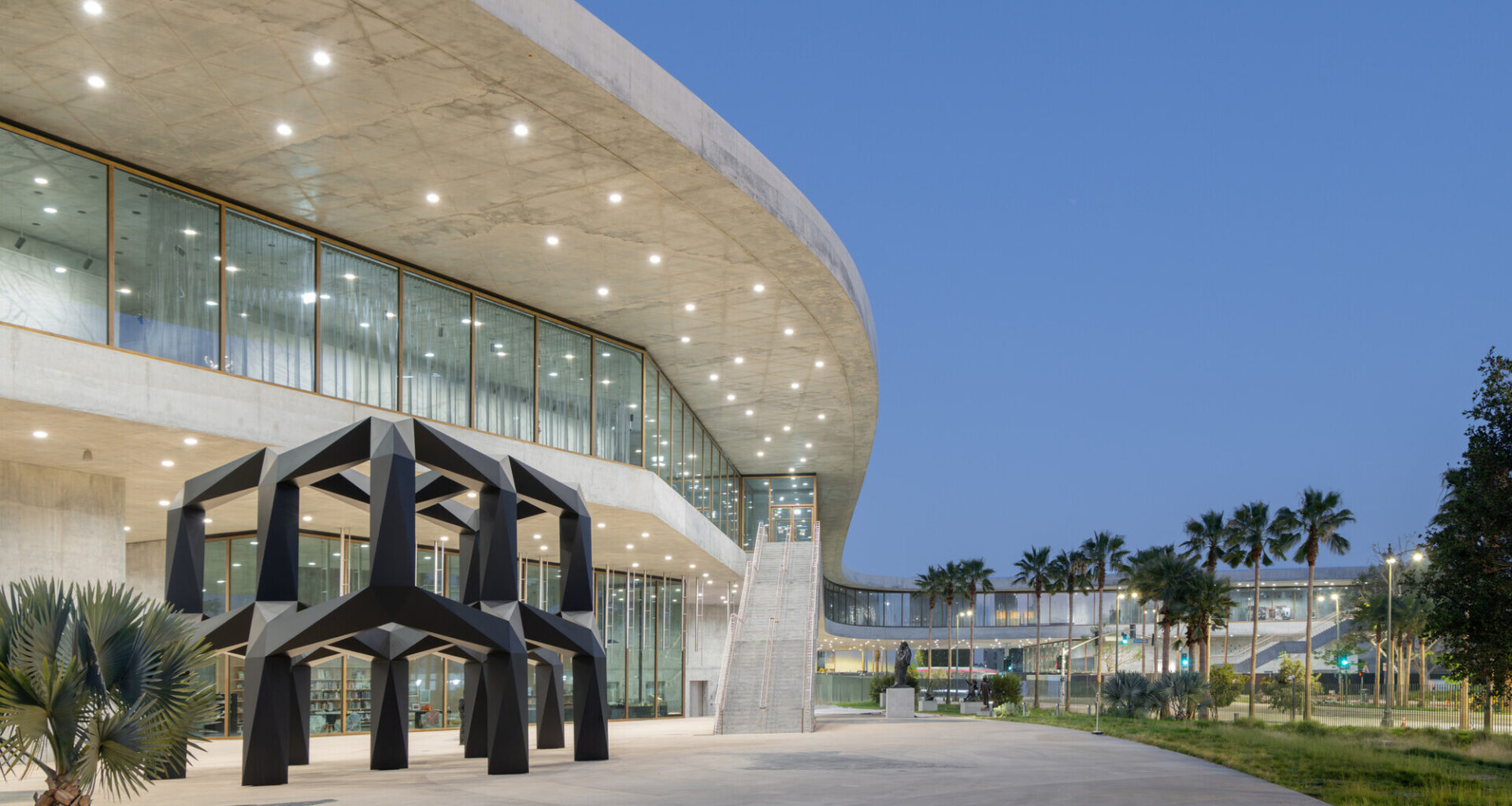
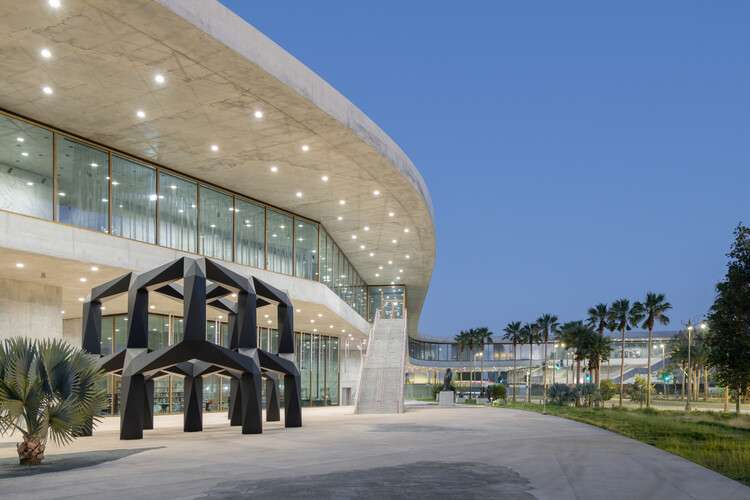
 Exterior view southeast toward Wilshire Boulevard with Tony Smith’s Smoke (1967) in foreground, David Geffen Galleries at LACMA, art © Tony Smith Estate/Artists Rights Society (ARS), New York, photo. Image © Iwan Baan
Share
Or
https://www.archdaily.com/1040778/peter-zumthors-lacma-david-geffen-galleries-open-in-los-angeles
On Sunday, April 19, 2026, the Los Angeles County Museum of Art (LACMA) opened its new David Geffen Galleries to the public. Designed by architect Peter Zumthor, the building offers an elevated exhibition space for the museum’s permanent collection. All artworks are presented in a single-level open space, in a non-hierarchical layout of cultures, traditions, and eras, spanning 6,000 years of art history across approximately 155,000 objects. The space is flexible, accommodating diverse curatorial projects as well as visitors’ individual paths. The project marks a new step in the institution’s two-decade transformation into a global art museum and the most comprehensive in the western United States.

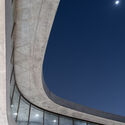
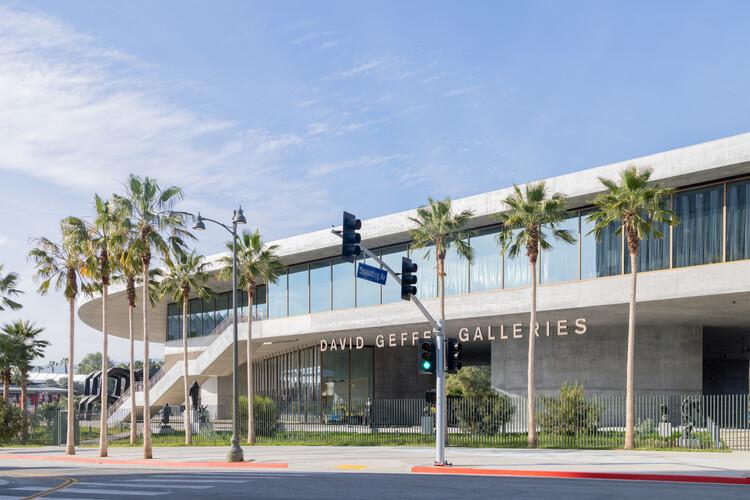 Exterior view northwest from Wilshire Boulevard, David Geffen Galleries at LACMA, photo. Image © Iwan Baan
The new David Geffen Galleries form a cultural complex comprising a 900-foot-long, horizontal glass-and-concrete building with open plazas and new outdoor public spaces. The building curves, and its elevated exhibition floor, set 30 feet above street level, offers views of Los Angeles, including Hancock Park and Wilshire Boulevard. The interior is organized into galleries of varied scales, configurations, and lighting conditions. Exhibition spaces include both sheltered interior galleries and terrace galleries. The floor plan does not dictate a specific route for visitors but instead provides an open environment for exploration, encouraging personal discovery and curatorial freedom. In the tradition of contemporary concrete buildings, the envelope is composed of floor-to-ceiling glass panels with tailored curtains made of sputter-plated chrome textiles. These are transparent with a metallic sheen and protect light-sensitive works.
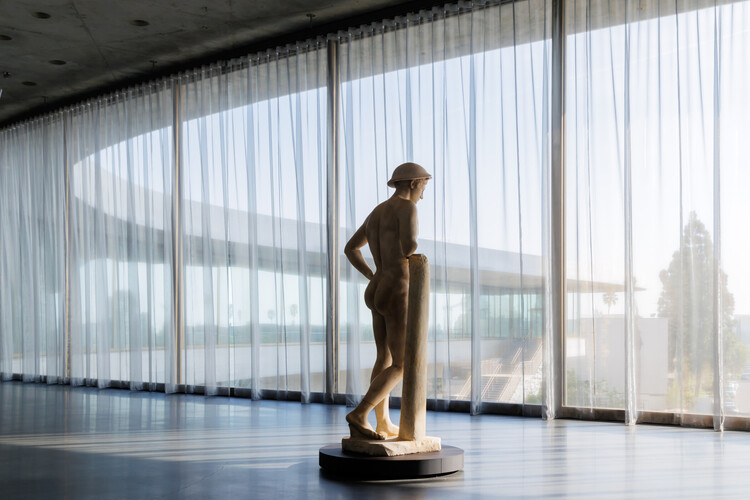 View southeast from exhibition level with The Bateman Mercury (2nd-century copy after a Greek original of the 4th century BCE), David Geffen Galleries at LACMA, photo. Image © Iwan Baan
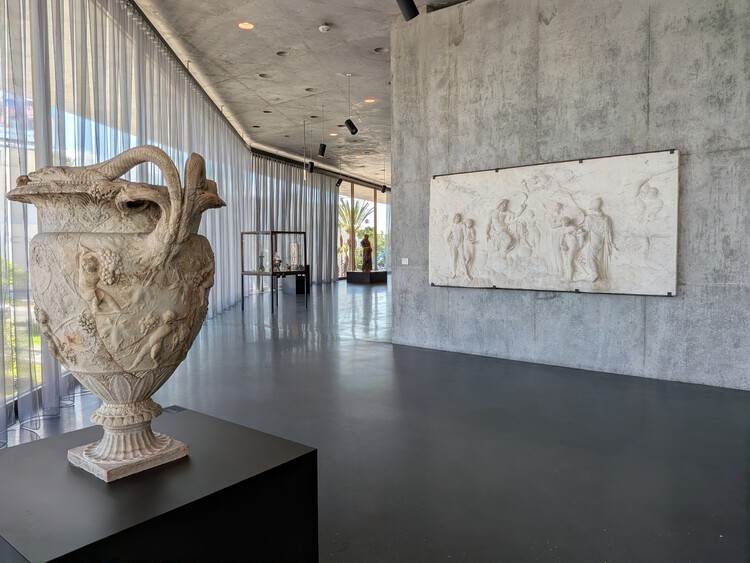 Installation view of the inaugural presentation in the David Geffen Galleries, April 2026, photo. Image © Museum Associates/LACMA
The elevated floor is supported by seven pavilions and shaded open spaces that accommodate public art, education and public programs, a theater, retail, and restaurants. The 207,000-square-foot ground plane is a commissioned artwork by Mariana Castillo Deball titled Feathered Changes, created in collaboration with Peter Zumthor. Other notable works include Pedro Reyes’s Tlalli (2026), an 18-foot-high stone carving set against the backdrop of the museum’s façade; Jeff Koons’s Split-Rocker, a 37-foot-tall living sculpture composed of more than 45,000 flowering plants selected for Southern California’s climate; and Alexander Calder’s Three Quintains (Hello Girls) (1964), a fountain work reimagined within a new pool designed by Zumthor.
Related Article Peter Zumthor’s Vision Takes Shape: Paul Clemence Releases LACMA Progress Photos
The inaugural installation was developed by 45 curators working collaboratively, presenting diverse works from the museum’s collection across 110,000 square feet of gallery space. The installation uses the Pacific, Indian, and Atlantic Oceans, along with the Mediterranean Sea, as a framework to explore connections between cultures and artistic traditions. Works in the Atlantic Ocean galleries examine how artistic traditions developed independently around the Atlantic rim over millennia; the Pacific Ocean galleries explore dynamic exchanges shaped by Indigenous voyaging, imperial expansion, and global trade; the Indian Ocean is presented as one of humankind’s longest-standing maritime exchange networks and home to many of the world’s oldest port cities; and the Mediterranean Sea galleries consider the region’s cultural interconnectedness through shared materials, techniques, and stylistic practices. LACMA has also commissioned four major new artworks to mark the opening of the David Geffen Galleries.
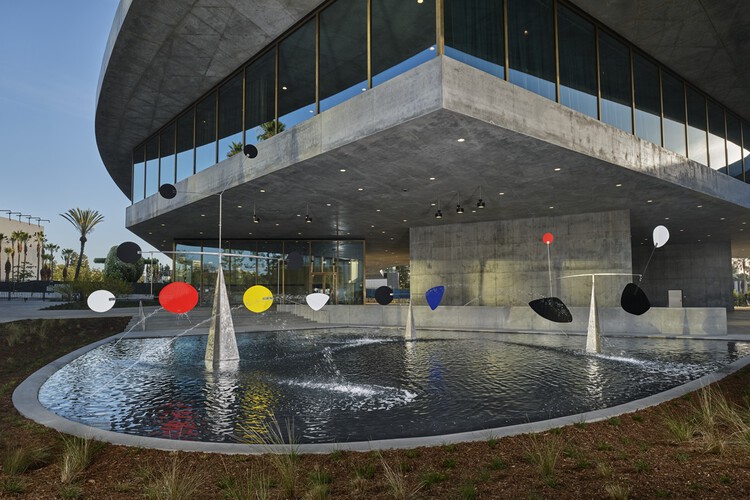 Alexander Calder, Three Quintains (Hello Girls), 1964, Los Angeles County Museum of Art, Art Museum Council Fund, © Calder Foundation, New York. Artists Rights Society (ARS), New York, photo. Image © Fredrik Nielsen Stud
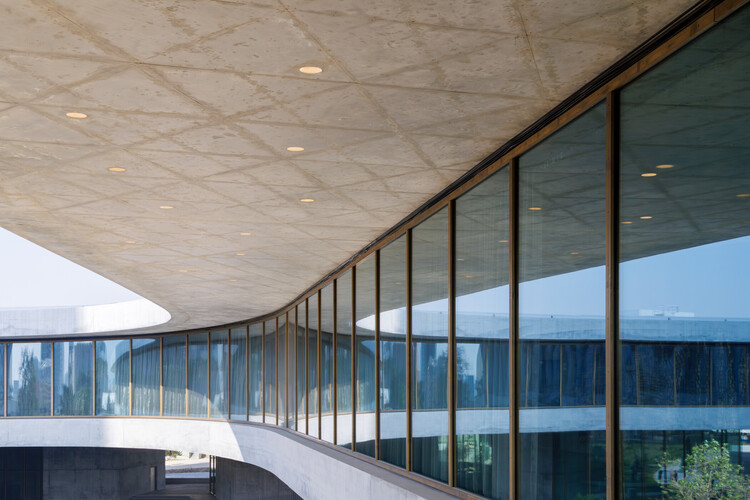 Exterior view of exhibition level, David Geffen Galleries at LACMA, photo. Image © Iwan Baan
Inaugural activities run from April 16 through June 20 and include an opening gala, exclusive access and visits, a full day of programming and activities on May 3 for NexGen LA, a free youth membership for L.A. County residents aged 17 and under, a Block Party accompanied by an Art Parade, and public space activations. Other recent opening announcements include O’Donnell + Tuomey’s V&A East Museum, which opened to the public on April 18, 2026, in East London; the inauguration of Milan Design Week 2026, running from April 20 to 26 as a citywide platform where design operates as both a cultural practice and a form of exploration; and the official opening of Kéré Architecture’s Goethe-Institut in Senegal.