
You can trust Cyclingnews
Our experts spend countless hours testing cycling tech and will always share honest, unbiased advice to help you choose. Find out more about how we test.
Price: £49.99 / $54.95
Weight: 31.5 grams
Screen size: 43x32mm
Connectivity: Wireless internal connection
Waterproof: IPX8
Battery life: 1 year
Over the past few years, I have been experimenting with low-tech ways of tracking my rides and training. I’ve shed myself of Strava, and I’ve increasingly experimented navigating my adventures with actual paper maps over a GPS.
This is where the Cateye Padrone enters the scene. Lightweight, no-frills, sleek and reliable, this cycling computer is designed for those of us that just want the basics.
I’ve been looking forward to testing this unit out, curious to see what it added to my rides and how easily it slotted into my life. Can a low-tech tracker offer the perfect middle ground in the age of data?
Design and aesthetics
Cateye has been in the bike computer game since the early 1980s, so it knows a thing or two about what works. The Padrone range was developed in response to customer feedback asking for a lightweight, more basic wireless bike computer. It’s the stripped-back sibling of the Padrone+ and Padrone Smart, which offer a backlit screen and phone sync respectively.
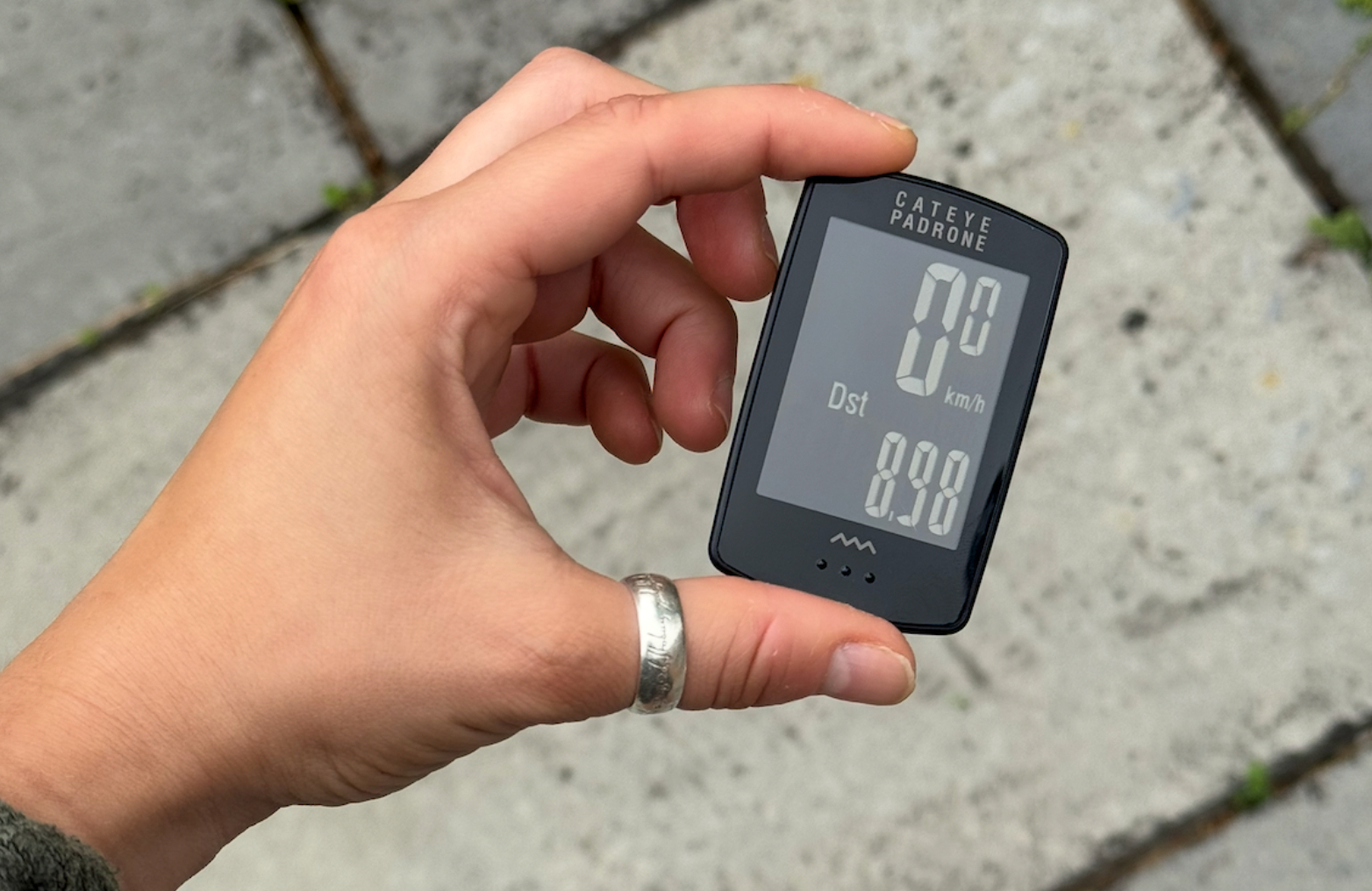
The display is large and easy to read, even in bright sunlight, and it depicts eight measurements: Current, average and maximum speed (in either km/h or mph), trip distance, total distance (or odometer), moving time and clock. There’s an additional option for stop watch, too. In short, pretty much covering everything you’d ever really need to monitor your riding with the exception of any kind of navigation, providing you aren’t into using a heart rate monitor or a power meter.
From an aesthetics point of view, there really isn’t much to it. The Padrone is all black, sleek and with a large analogue screen. The screen is made from a plastic that seems relatively resistant to smeary fingerprints and there is one click button at the bottom of the headset that allows you to cycle through the options. And that’s it. At 67.5 x 43.0 x 14.5mm with a tapered edge, it’s small enough to be discreet, but not too small that you’re having to squint from your position in the saddle. Weight wise, if you’re a weight weenie you’re in for a treat. At only 31.6g, the Padrone is one of the lightest bike computers you’re likely to find.
The Padrone is powered by a small battery with approximately one year of life (at one hour per day) and so there’s no extra charging cables or anything else you’re inevitably going to lose. It’s simple. Straightforward. No fuss.

The Cateye Padrone has a bright enough screen even in sunlight, with a basic display showing only two metrics at one time to keep you distraction free. (Image credit: Immy Sykes)Setup
Ah the set up.
I found quite a pain to be honest. Part of that is my fault; my inherent aversion to actually reading the instructions in combination with a delusional self-belief in a minimal ability to just ‘work it out’ meant that I struggled initially to get things right the first time. The thing with simplicity is that it is often hard to do well and I think you can sometimes make things so simplistic that it u-turns right back around to being complex.
A case in point is the fact that the Padrone has three very tiny buttons on the back of the headset. In order to make any changes to either the time or your wheel size (both highly necessary to actually get any kind of accurate data), you have to push the mode button repeatedly and for varying successive taps. Again, this is where reading the instructions would have been quite helpful and saved me a frustrating 30 minutes of repeatedly pressing MODE and having no idea what I had changed.
Even once I resigned myself to the papery doom of the instruction manual, I was still in for a treat. If you miss the number you need, you’ll need to keep on pressing until you’ve cycled back around. I do remember a more innocent era before touch screens and so I am not entirely unfamiliar with this process, but I have been spoiled in the past two decades of relative button-drought. Consequently, reducing the entire set up to the repetitive pressing of one button does now feel like some sort of hellish torture. It is, of course, the same reason why my oven clock is incorrect for 6 months of the year between daylight savings.
To actually track your journeys, the computer works by attaching a small sensor onto the spokes of your front wheel, and then a receiver on the fork with two supplied zip ties. Minimal. Basic. On brand. However, the receiver does need to be pretty accurately seated no more than 5mm from the sensor on your spokes. With wider forks, as I have on my gravel bike, you do need to play with the positioning to ensure it actually picks up a transmission and requires a bit of bodging to keep the receiver at the correct point.
The headset is attached to your handlebars on a secure bar mount. It needs to be placed at a rough 90 degree angle to pick up the data from the receiver on the fork, and this again becomes a bit fiddly if you’ve already had to bodge the receiver. Furthermore, despite Cateye’s claim that the Padrone uses a ‘Flex Tight Universal Bracket’, I could not get the unit to sit properly on my handlebars without it twisting and then failing to receive any input. Again, bodging ensued, and I had to pack it with some thin pieces of foam. All of this is largely to say that you do need to read the instructions and perhaps expect some level of seating challenges if you want to put it on anything other than a road bike.
Image 1 of 2
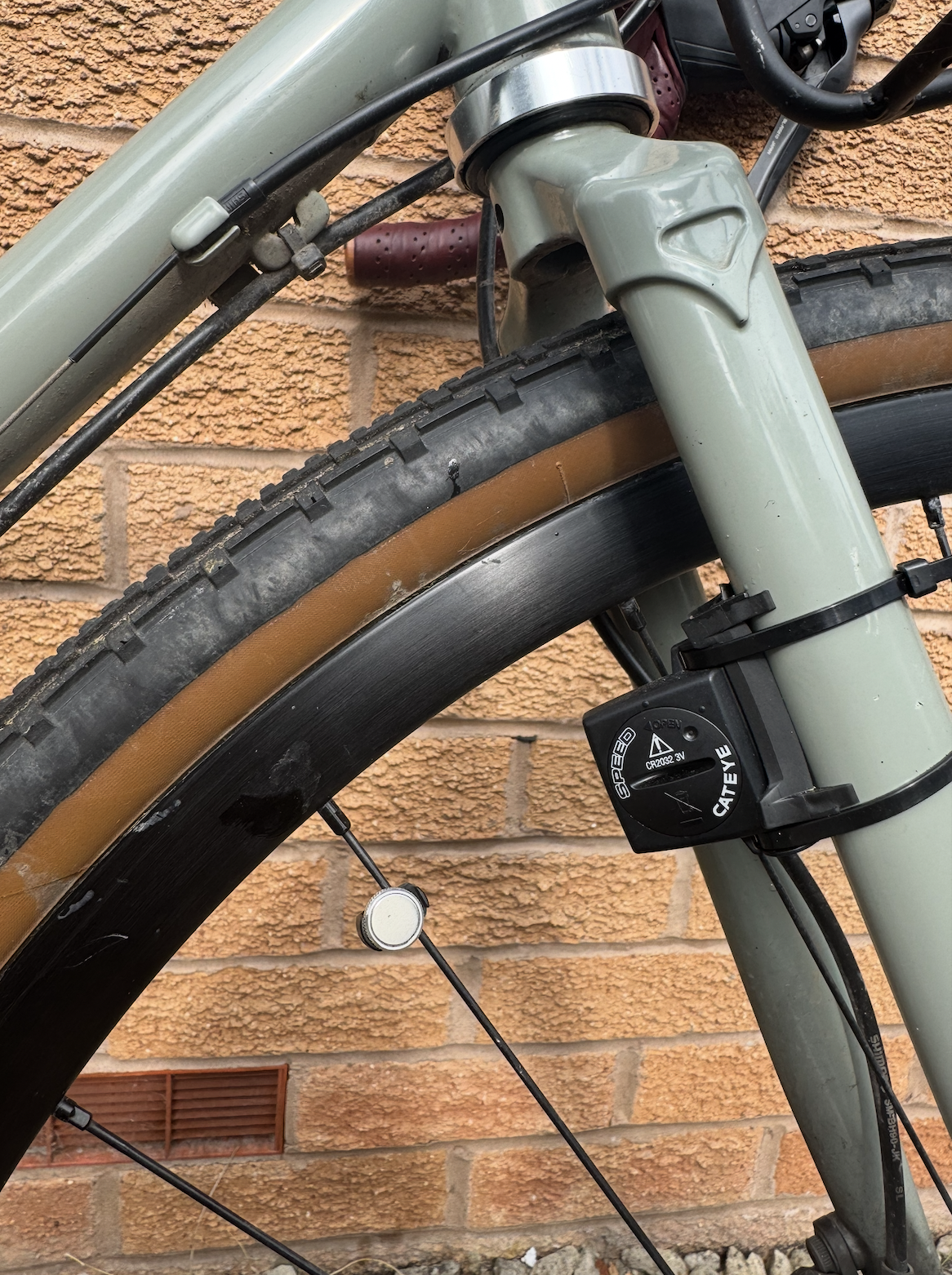 The sensor on the spokes and the receiver need to be about 5mm apart. (Image credit: Immy Sykes)
 The rear of the Cateye Padrone with the button battery slot and the three very small buttons used to navigate and set up the headset.(Image credit: Immy Sykes)Performance
Once everything was in place though, it was a seamless operation, with the Cateye Padrone working reliably and accurately. There is no syncing to your phone with the Padrone, no additional apps, no subscription models. In an unusual and refreshing twist for the review of tech, once the Cateye Padrone is set up, it really is ready to go. There is no way to save your data following your ride, which gives the whole thing a lovely transience, and harkens back to Ye Olde Days before smart devices dominated our lives.
A fun historical fact for you: the very first cyclocomputer was invented in 1895 by American Curtis H Veeder under the catchy marketing strap line ‘It’s Nice to Know How Far You Go’. Curtis H Veeder was right; it really is nice to know how far you go, and honestly one of my favourite aspects of the Padrone is that I can very clearly see my odometer on my bike front and centre every time I get on it. Last weekend I added exactly 100km to my overall distance and felt immensely satisfied. I know that seems like such a small detail, but watching the kilometers steadily tick upwards makes a nice addition to my ride.
The main thing I have noticed most about it is that the Cateye Padrone seamlessly fits into my setup. I genuinely don’t think about it anymore. I am not worried about charging it, connecting things to it, uploading to it, navigating fiddly menu screens (I am looking at you, Garmin), updating software, downloading data, worrying about GPS connectivity. It detects movement and auto-starts and stops, so I don’t even need to remember to switch it on. I’m also not drowning in complex bits of data; it’s so much easier just to glance down and check my current or average speed and feel satisfied with that. In an era of everything-all-at-once clamouring for your attention, it feels oddly meditative.
On one of my longest rides (clocking up eight hours in the saddle) the auto start and stop was impeccable, far more responsive than my Garmin Edge 540, which I was using alongside the Cateye to navigate. I did initially have some concerns over the accuracy of the data produced by the Padrone. The Padrone uses your wheel size and number of rotations to measure the distance travelled and so unlike the Garmin or Wahoo (a standard GPS that uses your location), it remained unaffected by signal dropouts or poor coverage. However, accuracy in sensor-based cycling computers can be severely impacted by sensor misalignment, and as you know, I had bodged the placement on the spokes. Comparing the data back afterwards though was a big surprise. There was very little difference in the two distances and average speed the Garmin and the Padrone reported, and out of the two, I actually suspect the Padrone was more accurate.
The display is surprisingly waterproof too. I took it out (accidentally) in two very-British-summer downpours and it survived both soakings which meant there was even less to worry about – I can keep using it rain or shine. There’s no touch screen, so no issues with it failing in rain or messing up your settings as you navigate through settings.
At risk of boring you stiff, there really isn’t that much to complain about. If I was going to be the tiniest bit picky, I’d argue that as the headset is not backlit, it does become less useful if you’re doing a lot of miles in the dark. This isn’t a deal breaker for me, but could be for you if you’re often commuting or travelling during winter when you’re short on light. Equally, though I can do without a GPS feature in a cycling computer for day to day cycling, I would like to see elevation gain – just because it’s rewarding to see how much you’ve climbed across a ride, but that isn’t possible using just a wheel sensor.
Other than that though, for the price (£49.99), I don’t think you can say that it isn’t delivering. We’ve previously featured Cateye Wireless on our best budget bike computers buyer’s guides before, and I think the Padrone also deserves an honourable mention.
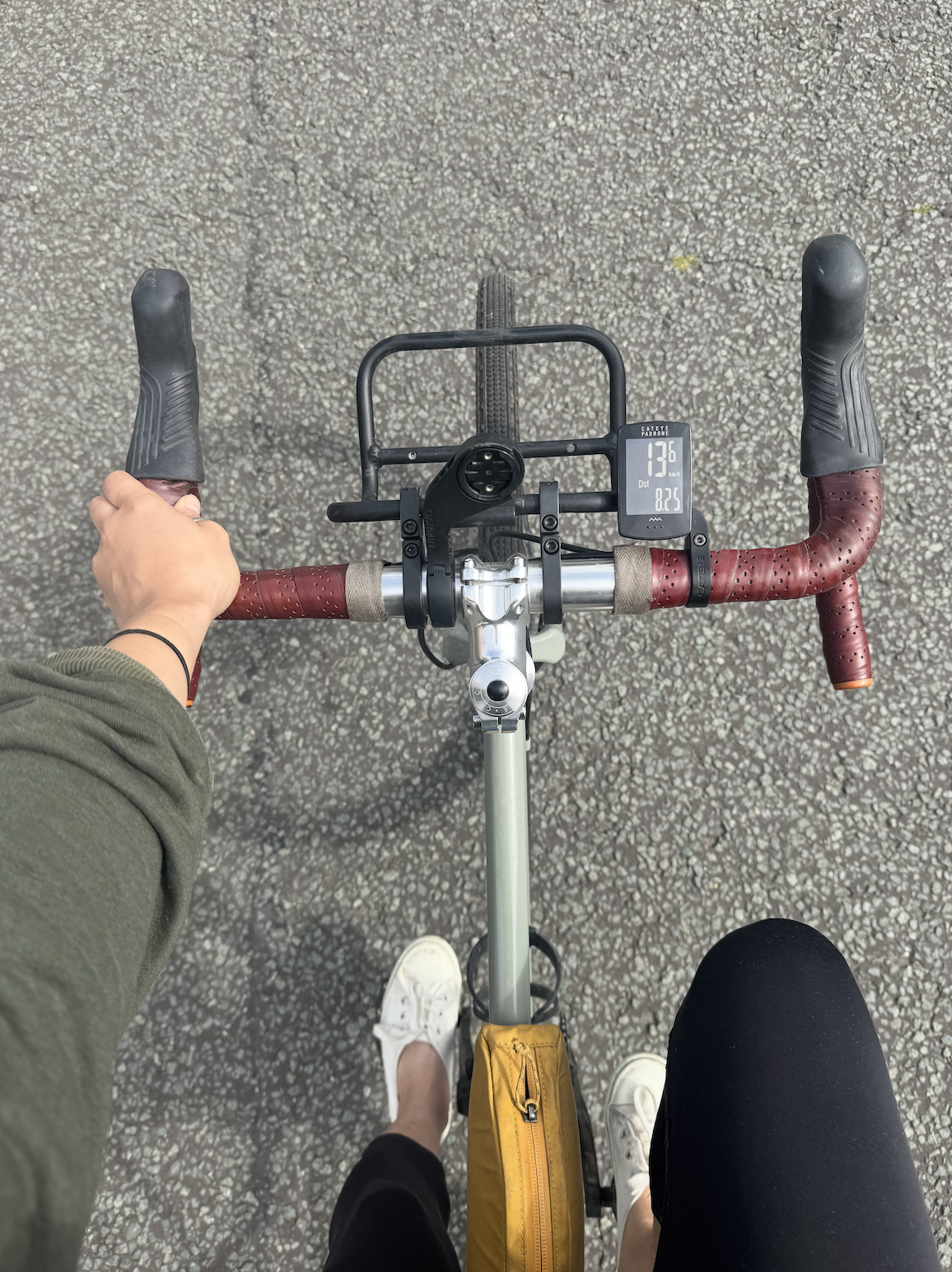
The Cateye Padrone on the handlebars showing current speed and distance. The digits are super clear even in bright sunlight. (Image credit: Immy Sykes)Value
For what it does the price really is excellent, and there’s obviously a marked shift between the RRP of this unit at versus the likes of even a basic Garmin. While the Egde 130 Plus does offer more features like elevation and navigation, power and heart rate compatibility and the like, it is over three times the price, and it’s the most basic unit Garmin makes.
If you don’t need the bells and whistles you really can save yourself a very large chunk of cash.
Verdict
A friend of mine asked recently whether the Cateye Padrone is a little bit pointless. It doesn’t navigate or measure your power output, and you can’t save any of your data to Strava. ‘What’s the point in it then?’ he asked.
I think the answer to this question largely comes down to what kind of a rider you are, and what you’re looking to get out of a cycling computer. If you ride often in unfamiliar places, are massively into your training metrics, or want seamless integration of information across multiple platforms, then I would encourage you to look elsewhere. The market is saturated with options for every need and you’ll easily find something at your price point.
But if you’d like simple metrics for a distraction free ride, with exceptional battery life and a reliable interface, for less weight and a low budget, I honestly don’t think you can go wrong with the Cateye Padrone.
My yardstick for how useful a bit of basic tech is to the common folk is often how much interest my dad pays to it. My dad is a typical middle aged touring cyclist, who shuns most mod-cons as too ‘small’ and ‘difficult’. On a recent touring trip to somewhere in middle England, he eyed the little unit with interest though and seemed distinctly impressed. He’s asked for one for Christmas.
Swipe to scroll horizontallyTesting scorecard and notes
Screen Quality
Lacks a backlight, but otherwise it’s easy to see, partially because you can only have two metrics on screen at any given time
8/10
Setup
A bit of a pain, especially for gravel bikes with wider-set forks. Read the instructions and you’ll be OK though.
7/10
Features
OK it lacks a lot of the things that most modern computers have, but it also doesn’t need turning on or off and really is as close to fit and forget as you’re going to get, which is sort of a feature it itself. It’s basics, but it does the basics well.
7/10
Battery life
It will last a year. You’re not going to struggle to beat that even with the hyper-expensive solar charging flagship models.
10/10
Value
It lacks the features of even basic GPS computers, but it’s as accurate as they are in the metrics it offers and is drastically cheaper.
9/10
Overall
Row 5 – Cell 1
82%