

Scientists from the UBC Faculty of Medicine and University of Cambridge have created the most detailed map to date, comprised of over 3 million cells, showing how breast tissue changes as women age — including dramatic changes during menopause.
The map reveals how, as women age, the number of cells in their breast tissue decreases, and these in turn proliferate less, and the structure of breast tissue changes. This creates a ‘micro-environment’ in which cancer cells can thrive.
Details of the study were recently published today in Nature Aging.
“By understanding how breast tissue environment evolves over time, we can begin to identify new opportunities for earlier cancer detection and more targeted prevention.”
Dr. Samuel Aparicio
“This study reveals how the natural aging of breast tissue fundamentally reshapes its cellular and immune landscape, particularly around menopause,” said co-senior author Dr. Samuel Aparicio, professor of pathology and laboratory medicine at UBC’s Faculty of Medicine and distinguished scientist at BC Cancer. “These changes create conditions that can make it easier for cancer to emerge and progress. By understanding how this environment evolves over time, we can begin to identify new opportunities for earlier detection and more targeted prevention.”
 Dr. Samuel Aparicio
Breast cancer is the most common form of cancer in women. It accounts for 15 per cent of all new cancer cases, with four out of five cases occurring in women over 50. As many as one in seven women will develop breast cancer in their lifetime.
The team used advanced imagining techniques to analyze breast tissue from more than 500 women aged 15 to 86 years old. The tissue included biopsies taken from women for non-cancer-related reasons.
Combining these images with details of the hormone receptors and immune cells present, as well as the tissue architecture, the researchers were able to map how breast tissue changes over time in unprecedented detail.
“We were able to map breast tissue at a level of detail that hasn’t been possible before, capturing not just which cells are present, but how they are organized and interact with each other,” said joint first author Eric Lee, a PhD student in the Aparicio Lab at UBC. “This kind of spatial resolution helps us understand how the tissue environment changes with age, and how those changes may influence the earliest stages of cancer development.”
The map revealed that all types of cells become fewer in number and divide far less often. Milk-producing structures known as lobules shrink or disappear, while the ducts that that carry milk become relatively more common, with the supporting layer around them becoming thicker. Fat cells increase while blood vessels decrease.
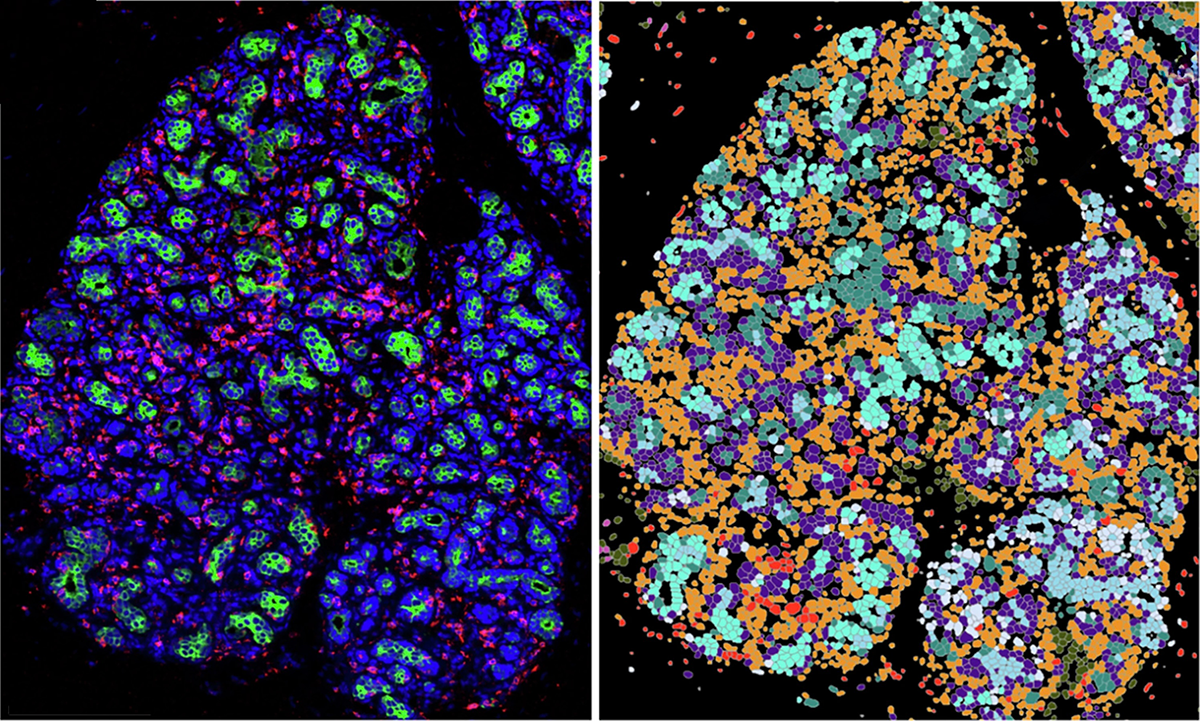
Researchers used high-resolution imaging to show the spatial organization of different cell types as breast tissue ages. (Source: Nature Aging)
Meanwhile, changes occur in the immune environment. Younger breasts have more B cells and active T cells, which helps them identify and kill cancer cells. As tissue ages, these types of cells decline in number, replaced by other types of immune cell that indicate a more inflammatory and potentially less protective immune environment.
“We don’t know for certain why the types of immune cell change,” said co-senior author Dr. Raza Ali from the Cancer Research UK Cambridge Institute at the University of Cambridge. “We can speculate that one reason may be because breast milk contains a high concentration of immunoglobulins, probably to help build the infant’s immunity, and these are produced by B cells.”
At the same time, the cells begin to interact with each other less. Immune cells and stromal cells (those that create a tissue ‘scaffold’) become physically further away from epithelial cells (specialised cells that line the mammary ducts and lobules, forming a structure responsible for milk production and transport). This may make it easier for pre-cancerous cells to escape control.
“We’ve previously seen that age dependent changes in oestrogen activity occur strongly in milk secreting cells of the breast and now we can see the surprising extent of changes in all cell types, including the immune system, with age,” said Dr. Aparicio. “We are now seeking to understand the relationship between changes in immune cells and surveillance of early mutations that can arise in milk secreting cells over time.”
A version of this story was originally published on the University of Cambridge website.