
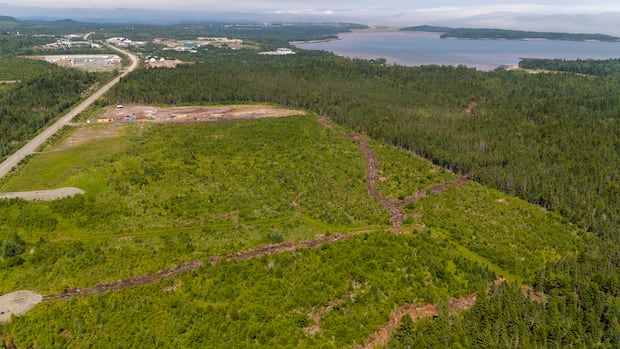
The water needed for a proposed data centre in west Saint John wouldn’t be a significant drain on the city’s Spruce Lake industrial supply, according to the registration document filed as part of the environmental impact assessment process.
But the centre, which would have a natural-gas power-generation plant for some of its needs, would require a significant amount of power at 390 megawatts.
It would also produce enough greenhouse gases to make it one of the top emitters in the province, according to the environmental impact assessment, or EIA, documents registered last week.
In their filing, Alberta-based Beacon New Brunswick and Texas-based VoltaGrid say the data centre will use a “closed‑loop” water‑based cooling system, “significantly reducing overall water consumption compared to open‑loop or evaporative cooling designs.”
Beacon AI and VoltaGrid say they expect to have a commercial agreement with a customer that will last 15 to 20 years.
They don’t identify a specific customer, but data centres host large computer systems that do things such as store massive amounts of data for businesses and governments, and operate websites and apps such as video streaming services and AI search engines.
WATCH | ‘Do not put a hyperscale data centre … on top of land like this’: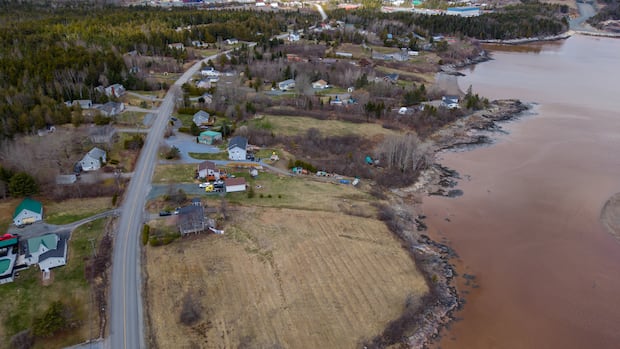
Saint John data centre would go easy on water supply, less so on air quality, documents show
A data centre proposed for the Lorneville area will go through the environmental impact assessment process and face questions on issues such as industrial water and greenhouse gas emissions.
The amount of water needed to cool the computer systems in data centres has been a concern of communities that could host them, but the companies estimate that the initial infill for the system will only be around 3.5 million litres.
That is a small fraction of what other industrial users in the city consume.
The Irving Pulp and Paper mill and N.B. Power’s Coleson Cove generating station pulled a combined average of more than 110 million litres of water a day from Spruce Lake in 2024 for their operations, according to the city’s water utility.
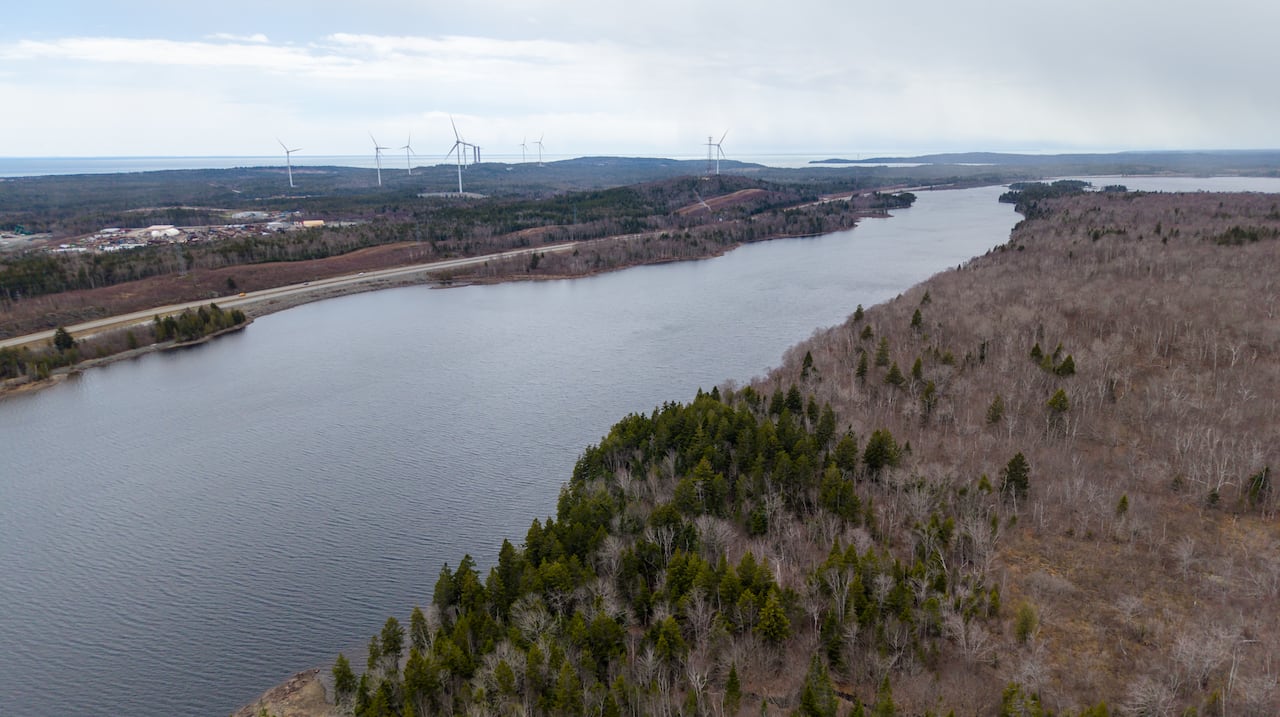 The proposed data centre would require an initial intake of 3.5 million litres of water, less than other industries in the area. (Roger Cosman/CBC News)
Saint John Mayor Donna Reardon said the closed-loop system eliminates excessive water use, likening the process to a household heating system.
“The water consumption is manageable,” she said.
“[It’s] similar to if you have cast-iron radiators in your house. Once they’re filled up, that’s it. They stay full, and the water just circulates around through … [the companies] apparently will use a fairly extensive system of water that will be running through their water pipes that will cool the system down.”
 Saint John Mayor Donna Reardon said the proposed data centre wouldn’t use much water compared to other industrial operations. (Roger Cosman/CBC)
At a public meeting last fall, residents had expressed concerns about the volume of water required for its cooling system. At the time, Nathan Ough, the VoltaGrid CEO and Saint John native, said the water needs would be negligible.
Ough also said a natural-gas-fired power-generation plant on the site would be “the cleanest burning natural gas power plant in Canada.” The companies estimate the gas plant would release about 755,187 tonnes of greenhouse gases a year.
 VoltaGrid CEO Nathan Ough, born and raised in the Saint John area, said the data centre’s water use would be negligible. (Nipun Tiwari/CBC)
Even still, according to information in the companies’ environmental impact assessment filing, the plant would become one of the top industrial emitters of greenhouse gas emissions in New Brunswick.
According to the National Carbon Inventory for 2024, that would put the data centre’s natural gas plant among the province’s top 10 emitters, in third place behind the Irving Oil Refinery in Saint John and N.B. Power’s coal-burning generating station in Belledune.
Green Party Leader David Coon said data centres are like adding “small cities” that are power hungry. They put a strain on the existing grid and greatly increase greenhouse gas emissions if they’re not powered by renewable energy.
“We’ve got targets to meet, and you add those kinds of large greenhouse gas emissions into the system, it’s going to make it difficult to meet the targets in our climate Change Act in the law,” Coon said.
“That’s why some jurisdictions, when they’re negotiating with data centres, they will favour the ones that largely supply their electricity from renewable sources.”
 Green Party Leader David Coon said the province should only look at data centre projects powered by renewable energy. (CBC News)
The data centre would be a sizable operation requiring 390 megawatts of power generation.
The on-site natural gas facility, to be constructed and operated by Texas-based VoltaGrid, would supply 190 MW, with the expectation that N.B. Power would supply 200 MW.
It would be constructed on a 120-hectare parcel in the Lorneville Industrial Park.
Last September, Saint John city council voted unanimously to rezone the land needed to expand the industrial park.
Chris Watson, a Lorneville area resident and one of the leaders of the Save Lorneville group, remains opposed to the development because of its size and impact on the area.
“This project is being placed on some of the worst possible land for this kind of development, he said. “The EIA itself shows it would destroy a massive area of high-functioning wetlands and forest, and this includes forest that meets the definition of old growth.
 Lorneville resident Chris Watson said a data centre and natural gas plant would destroy wetlands and old growth forest that should be preserved. (Shane Fowler/CBC)
“You simply don’t put a hyperscale data centre and gas plant on top of land like this, next to people’s homes and water wells.”
Reardon said she supports the environmental impact assessment process and trusts that restrictions will be put in place on the proponents so the environment is protected.
“If there’s a 400-year-old tree there, save it,” she said.
She said Saint John needs new business development to cover the growing costs of operating the city, but not at any cost.
“We want to do this in a way that that benefits everyone,” she said. “We want to make sure that we’re doing it so that we’re not destroying anything. That’s our goal and that’s why there is an EIA process and that’s why it’s out of our hands and it’s in the province’s hands.”
As part of the assessment process, there will be a technical review of the submitted environmental impact document and more public consultations.
The companies plan to begin construction sometime this year, if they get the required approvals to move ahead that soon.
They expect the centre and supporting energy-generation infrastructure to take 18 to 24 months to complete, with commercial operations beginning in 2028.
The filing says the minimum operating life of the data centre would be 25 to 30 years.