

Listen to this article
Estimated 3 minutes
The audio version of this article is generated by AI-based technology. Mispronunciations can occur. We are working with our partners to continually review and improve the results.
Lawyers for the City of Montreal asked the Court of Appeal on Tuesday to overturn a landmark class-action ruling on racial profiling by police, saying it’s too complicated to determine how much each member is eligible to receive.
The city is appealing a 2024 Superior Court ruling that determined Montreal police had a systemic racial profiling problem. Racialized citizens had alleged they were unfairly stopped, arrested, detained, and profiled by police between mid-August 2017 and January 2019.
Superior Court Justice Dominique Poulin held the city responsible for violating class-action members’ Charter rights, ordering the city to pay each of them up to $5,000 in damages.
On Tuesday, Raphael Lescop, a lawyer representing the city, told a panel of Court of Appeal justices that Poulin should not have ordered damages to an unspecified number of victims, when the trial judge heard testimony from only one member of the class action: lead plaintiff Alexandre Lamontagne.
Lamontagne is a Black man who was stopped by Montreal police while leaving an Old Montreal bar in August 2017. During his arrest he was pinned to the ground, handcuffed and taken to the station. He was then issued three statements of offence and charged with obstructing police work and assaulting a police officer, but most proceedings against him were eventually dropped.
Lescop said the trial judge’s decision was based on insufficient proof because it relied on one witness and on statistics from the police department.
“Are we saying all racialized people who are stopped by police are victims of racial profiling that should be compensated?” Lescop asked the three Court of Appeal judges.
Justice Christian Immer pushed back, saying Poulin had imposed a ceiling on the amount that can be claimed in compensation. Immer also questioned whether Lescop was arguing that all those who could be eligible would have to come plead their cases individually, which he said goes against the spirit of the class action.
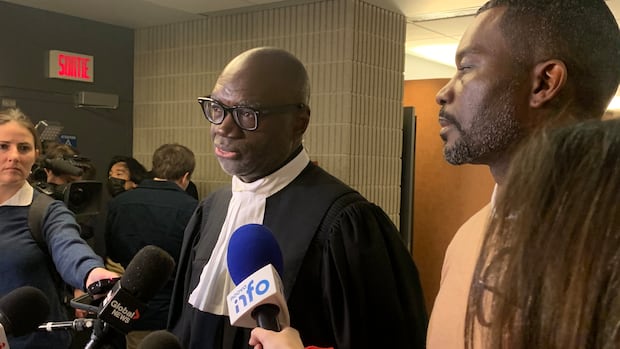
Lawyers for the Black Coalition of Quebec, which had brought the class action, said Lescop was implicitly asking for a retrial. They said Poulin’s judgment already covers the city’s concerns. Mike Diomande, one of the two lawyers representing the coalition, urged the court to focus on whether Poulin made legal errors in her ruling.
Diomande said the Superior Court judge laid out clear criteria for people who could be eligible for compensation: individuals who were stopped, arrested or detained without justification and who had their personal information recorded by police.