
The Montreal Canadiens already had the game they needed in Tampa Bay, but a second one would completely put them in charge of the best-of-seven series. However, the Lightning knew they absolutely had to have this one, and they played like it.

Tampa Bay came back for a 3-2 win in overtime.
Wilde Horses
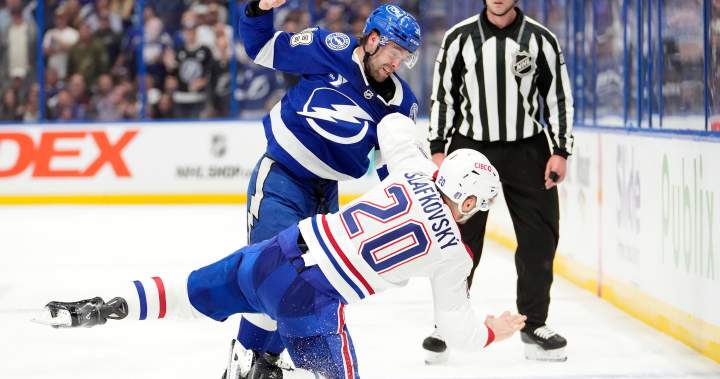
Former versions of the Canadiens would have wilted like aged flowers at the violence that the Lightning tried to create in the contest. Montreal has in the last decade been a small team that didn’t have an answer for physical play. They didn’t want to shy away from it, but they simply didn’t have the players to be bold.
Even last season, against the Washington Capitals, the Canadiens weren’t bold enough as Tom Wilson charged around the ice without being challenged. Starting against the Lightning two weeks ago at the Bell Centre, it all began to change. Montreal answered every bit of intimidation the Lightning tried — while winning the game as well.
Story continues below advertisement
Head Coach Martin St. Louis was asked about that intimidation in the playoffs. St. Louis said he felt that it wasn’t that his club didn’t want to answer to it, but wasn’t prepared for it. Now, they are prepared. They have an expectation that every whistle will be a scrum; that every player will face violence. In the first intermission, Kaiden Guhle described it as a war out there.
The way to beat the violence is to answer to it, give your own, and then score on the power play to make them pay for it. The Lightning were the most penalized team in the league this season, but when four goals have already been scored on the power play against them, they have a problem.
After three goals with the extra-man in game one, the Canadiens started the scoring with yet another power-play goal. It was Lane Hutson from the point with the shot that found its way. Cole Caufield and Nick Suzuki counted the assists.
Story continues below advertisement
To win a series, the best players have to be the best players. For the Canadiens, there are no passengers at all among the best. The stars are contributing. Four goals on six power-play opportunities after the first period tally.
The stars also contributed five-on-five. The top line got caved in during game one with an Expected Goals of only five per cent. It’s the first time in ages that the Suzuki line was dominated like that. They responded in a big way with a vastly different night. After two periods, the Expected Goals for the Suzuki line was 80 per cent. They completely flipped the script.

Get daily National news
Get daily Canada news delivered to your inbox so you’ll never miss the day’s top stories.
When considering the violence that the Lightning want to bring and are bringing, and the way that has been popular to beat the Canadiens, it’s absolutely vital, and a massive bonus, that the third pair on defence is playing so well.
Story continues below advertisement
Montreal wants to have the intimidation power of Arber Xhekaj and Jayden Struble on the ice, but if they couldn’t handle the actual pace of the play, they couldn’t enjoy the benefits of their physical presence. Xhekaj is one of the best fighters in the league, and his double-edged game is massive to the fortunes of the team during playoff hockey.
General Manager Marc Bergevin got it right when he said some guys get you to the playoffs, and some guys get you through the playoffs, because the value of Josh Anderson, Xhekaj, Struble, and Kaiden Guhle goes up when tempers go up. That they can also contribute to the actual hockey is of immense value. The partnership of Struble and Xhekaj had an Expected goals share of 96 per cent through two periods.
In fact, it was one of those ‘get you through the playoffs’ players who contributed to the go-ahead goal late in the second period. Anderson continued his strong play with his second tally of the series. Anderson won the battle for space in front of the net, and pocketed a two-footer.
Story continues below advertisement
As the game wore on, it began to trend toward Tampa, so credit to Jakub Dobes. He was strong. In the overtime, Dobes kept his concentration up to make excellent stops and keep Montreal in it until he couldn’t.
Wilde Goats
The lessons continue for Ivan Demidov. In only his second playoff, he hasn’t quite figured out how to use his skill-set to advantage yet. It’s too early to know whether the problem is the pace of the play, or the physicality of the play, but it’s not happening positively for him.
It’s more likely that this is a physicality issue. He’s never been troubled for speed, and other players who don’t process quickly aren’t struggling for speed, so it seems that Demidov is too aware of the violence, and is rushing his plays because of it.
A good example is with nine minutes left in the third period, Demidov was six feet before centre, and he wanted to clear it into the Tampa zone, but he saw the check coming at him, so he dumped it early causing an icing. He knows that he needs to get to centre first, but he rushed it because he didn’t want to take a hit.
Story continues below advertisement
It will come for Demidov, but, for now, this is a player who has not yet figured it out at the playoff level in the NHL. However, he is comfortable on the power play, and this is natural, because no one is going to run him during an extra-man advantage. It will be interesting to watch the progression of Demidov as the playoffs continue. He has to wrap his mind around making plays at whatever the cost. He has to wrap his mind around that he is the difference-maker. The more he grabs the puck, and the moment, the more he will understand that he can. It’s a process.
More on Sports
More videos
The Canadiens played nearly flawless hockey in the third period, but a turnover by Slafkovsky changed the game. He made a no-look pass for a breakout, but there was only a Tampa player there. That led to Nikita Kucherov with the tally for 2-2 with seven minutes left.
The overtime was bizarre. For 60 minutes, the Canadiens were strong, but they played poorly in the extra frame. Suddenly, Tampa Bay had plenty of free space. The Canadiens couldn’t even muster a shot for the 11 minutes. They had no pressure at all in the Tampa zone.
Montreal was making mistakes all over the ice. They lost all the battles. They didn’t seem to have the same number of players on the ice. It was odd — to be so even for so long, but then have no footprint at all.
Story continues below advertisement
It was a small mistake that cost the game. Kirby Dach had a chance to skate to centre, then dump it in, but he didn’t skate to centre. It led to a face-off in Montreal’s zone, and that led to the game winner. Dach was the man who lost his check on the overtime goal as well.
Wilde Cards
It’s too early to know who will take this Lightning-Canadiens series. It’s highly competitive, and the breaks could still fall to either team to decide it in the next week to ten days.
However, it is becoming apparent that the winds of change are moving vastly in the Canadiens direction already. When it becomes obvious that the Canadiens are the team of the future and the Lightning are the team of the past is still unknown, but that moment is on the horizon.
The Lightning have an average age of 29.5 while the Canadiens have an average of 25.5. The Canadiens are the youngest, and the Lightning are among the oldest.
It’s more than just the age of 20 players, though, that matters. It’s the age of the key players that tells the tale of the tape. The Canadiens will dominate for many years to come.
The nucleus of the Canadiens is young. Nick Suzuki is 26. Cole Caufield just turned 25. Juraj Slafkovsky just turned 22. Lane Hutson is 22. Ivan Demidov is 20. That’s the first power play unit for the next close to a decade.
Story continues below advertisement
In net, the best goaltender in the NHL in the last 20 games of the season, Jakub Dobes, is 24. Admittedly, goaltending is a bit of voodoo and Dobes maintaining a high level is somewhat of a mystery because of his position. However, should he falter, Jacob Fowler is 21.
These are players who have already proven to be among the league’s best and brightest young stars, and who have not shown their ceilings talent-wise. In some cases, like Demidov, they are just scratching the surface of what greatness they can bring.
On the other hand, the legendary nucleus of the Lightning, while still playing strong hockey, will soon find that Father Time is catching up to them, and will eventually pull out a late victory. Victor Hedman is 35. Ryan McDonagh is 36. Nikita Kucherov is 32. Brayden Point is 30. Jake Guentzel is 31. Andrei Vasilesvkiy is 31.
Of their stars and top players who will carry them into the next generation, only Brandon Hagel is young at 27.
When it becomes obvious the Canadiens are the future and the Lightning are the past may not be this playoffs. It may not even be next playoffs, but if you’re a fan, there’s so much more to be excited about cheering for Montreal.
The underdog won’t be the Canadiens for much longer.
Story continues below advertisement
Brian Wilde, a Montreal-based sports writer, brings you Call of the Wilde on globalnews.ca after each Canadiens game.