
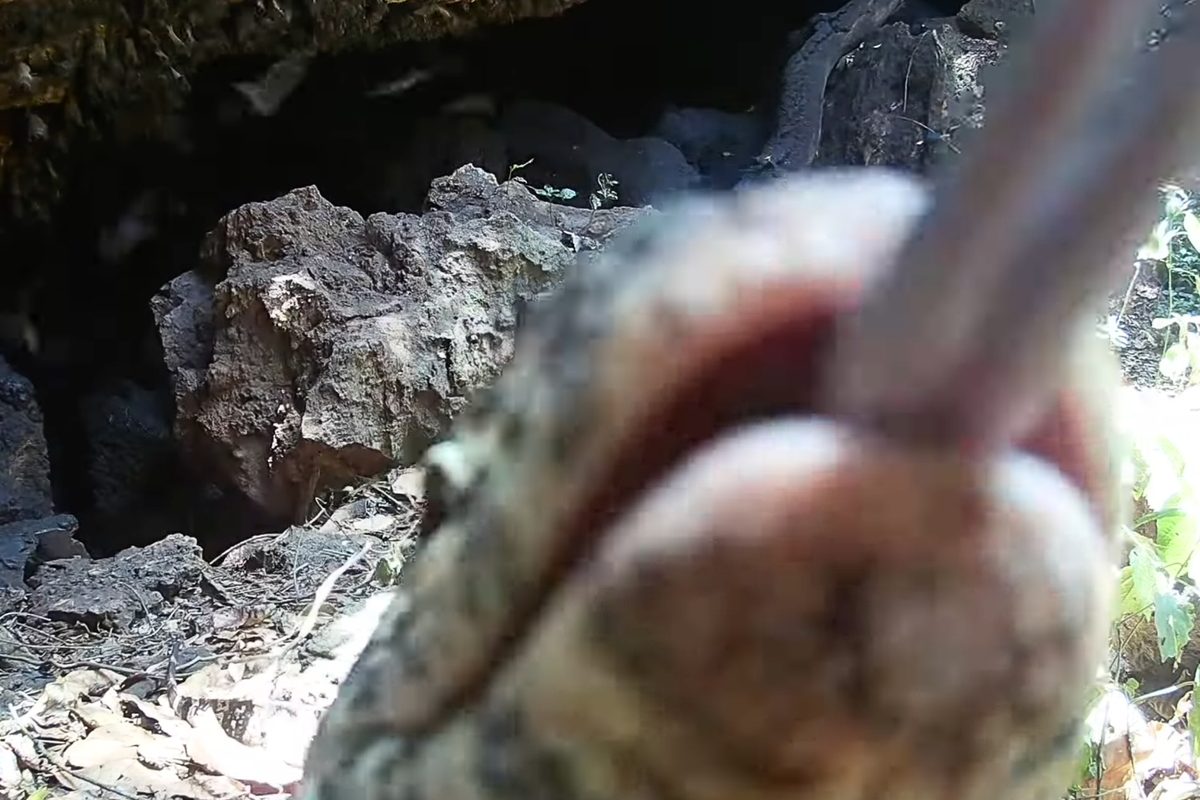
Scientists in Uganda have released remarkable footage of a cave of Egyptian fruit bats being raided by 14 different predators, including leopards, blue monkeys and eagles.
Python Cave in Queen Elizabeth National Park, Uganda, is home to around 40,000 Egyptian fruit bats. The roost is a known reservoir of the deadly Marburg virus, so studying these interactions could help researchers understand how viruses move between species and how some animals build immunity.
The findings, which include never-before-seen behaviours of African leopards and blue monkeys raiding the roost, are published in the Cell Press journal Current Biology.
“Our cameras recorded 14 predators preying on Egyptian fruit bats,” says study author Alexander Braczkowski, scientific director at the Kyambura Lion Project. Braczkowski points out that this bat colony is infected with Marburg virus, which can be transmitted to humans and cause an often-fatal haemorrhagic fever similar to Ebola. Despite this, the researchers saw “leopards, blue monkeys, even Nile monitors and crowned eagles all hunting bats,” he says.
The team use camera traps to observe the animals. “This minimises impacts on behaviour,” Braczkowski explains. Since they started monitoring Python Cave in February 2025, they have spent 360 nights recording footage of the cave.
Incredible footage shows predation of fruit bats at Python Cave in Uganda. Credit: Bosco Atukwatse/Kyambura Lion Project
During their monitoring, the researchers saw a host of different predators descending on the bat cave to hunt. Their video montage shows a leopard bounding out of the cave with a bat in its mouth, a monkey grabbing a bat in its hands and making off with it, and an eagle holding a struggling bat down with one foot, grasping it with its talons as the victim tries to wriggle free.
The scientists believe this footage could be the first example of several different predators hunting a species that carries a deadly filovirus.
The researchers knew they were witnessing something significant. “We were very excited as a team capturing those behaviours,” says Braczkowski. “This is the most comprehensive visual dataset of animals anywhere in the world interacting with a filovirus of critical human concern.”
Python Cave is different from many other roosts because bats can’t hide away high out of reach. “Large guano mounds and sections of the cave roof have fallen, collapsing the spatial buffer between predators and bats,” write the study authors. “We recorded instances of overcrowded bats falling, crawling, or occupying crevices,” they add.
The team saw different species hunting at the cave together, suggesting that prey was so abundant that predators didn’t need to be as territorial as they might typically be. “We even documented a fight between a crowned eagle and Nile monitor over bat prey,” say the authors.
The researchers highlight that predation could be a means for the dangerous virus to spill over into other animals. That’s why studying these interactions “could be critical in helping us understand how a virus might jump from one species – in this case [an] Egyptian fruit bat – to an intermediate host like a blue monkey or leopard,” says Braczkowski, adding that it could also provide vital information about how some animals build immunity that prevents them from becoming infected.
Marburg virus can be transmitted directly to humans from bats (or via intermediate animals who have become contaminated with the virus). So, it’s particularly worrying, say the authors, that the cameras also filmed 214 people (including school groups) visiting the cave, potentially putting themselves at risk of infection.
“Only one person wore a mask (a tourist) and many came within metres of the cave mouth – violating park rules and bypassing a designated observation platform located ∼30 metres from the cave,” add the authors. “This represents a significant opportunity for human exposure at this known Marburg-virus bat reservoir.”
The authors stress the need for stricter regulation around bat ecotourism, recommending protective gear, enforced distancing and locally trained guides.
Image and video credit: Bosco Atukwatse/Kyambura Lion Project
More wildlife stories from around the world