
Photo: Scott Yamano/Netflix
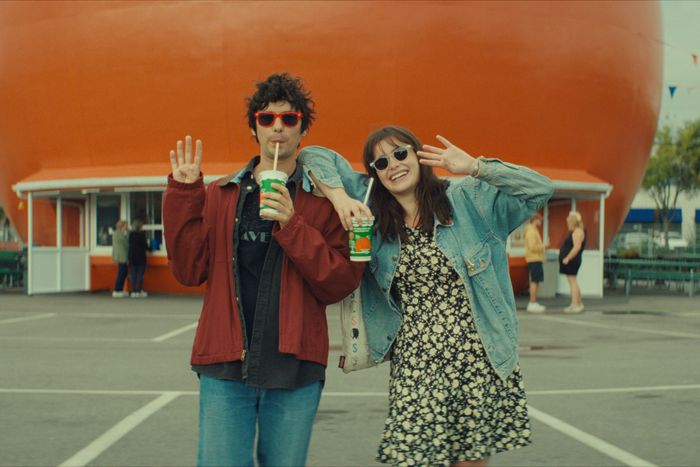
It’s not often that a director has two films out in one year, and it’s exceedingly rare for a filmmaker to have two films released on the very same day. But last Friday, Canadian director Chandler Levack birthed cinematic twins. Mile End Kicks, the semi-autobiographical follow-up to her coming-of-age 2022 indie, I Like Movies, stars Barbie Ferreira as a young music critic trying to write a book about Jagged Little Pill while finding her place in the circa 2011 Montreal music scene that gave the world Grimes and Mac DeMarco. (Levack jokes that it could’ve been called I Like Music.) It’s a period piece awash in closely observed details that double as jokes, from the pair of Toms wedges she buys from a crush, to love interest Archie’s (Devon Bostick) mechanical vape, to the loft parties where a band called Bone Patrol plays.
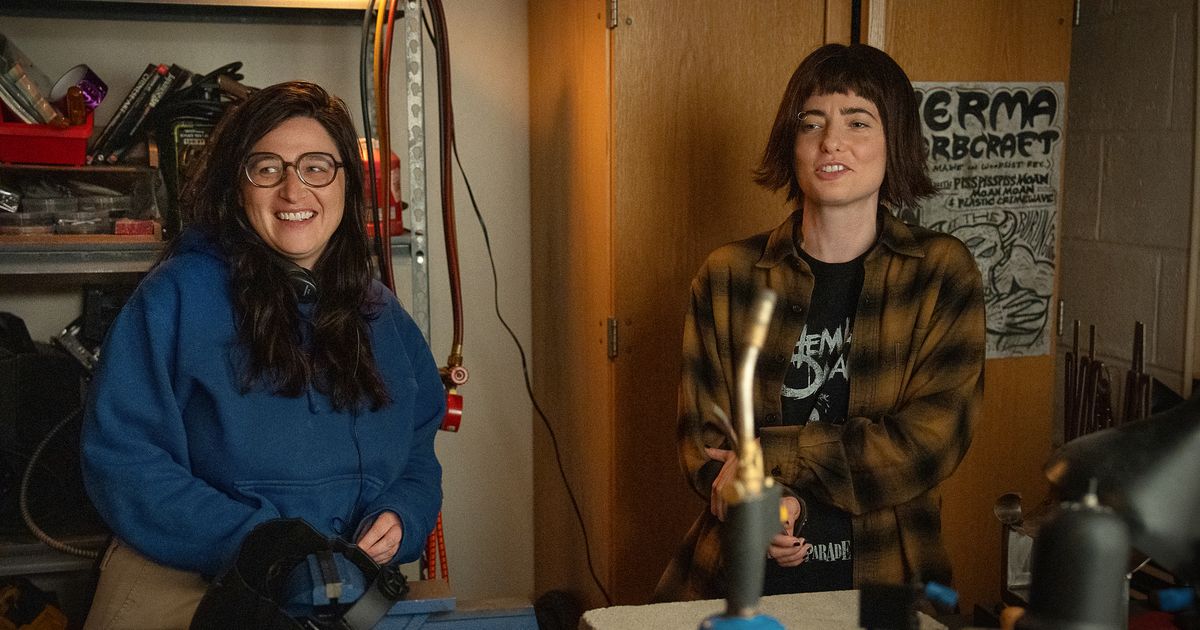
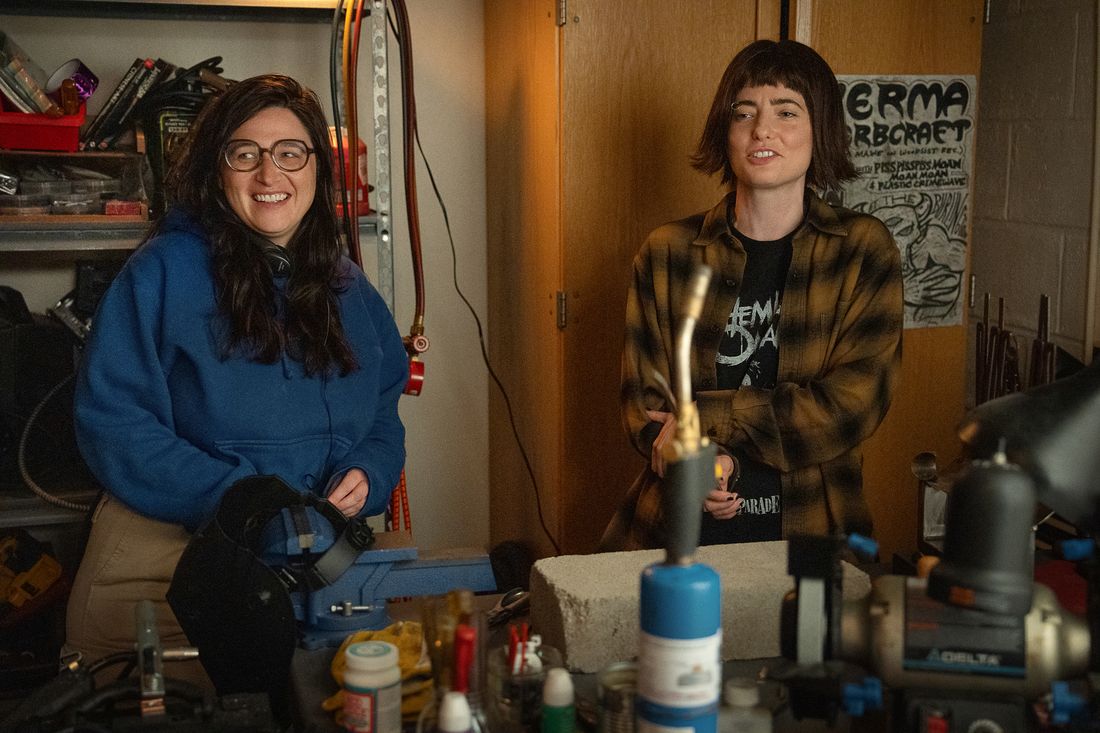
As her Canadian indie rom-com rolled out in theaters, Levack’s big, bawdy, American-campus comedy Roommates dropped on Netflix. Executive-produced by Adam Sandler, it stars his 19-year-old daughter, Sadie Sandler, as an introverted college freshman engaging in psychological warfare with her unhinged roomie (Chloe East). It has the familiar calling cards of a Happy Madison production: explosive physical comedy (Carol Kane almost gets blown to bits by a turkey), a smattering of gross-out humor, and a Steve Buscemi cameo. Working off a script from SNL’s “Domingo” creators, Jimmy Fowlie and Ceara O’Sullivan, Levack easily transposes these Sandlerian beats for an audience of Gen-Z girls, commanding a sprawling cast including Nick Kroll, Natasha Lyonne, Sarah Sherman, Ivy Wolk, and Megan Thee Stallion. “It felt like I crossed over into a new multiverse I was never supposed to be in,” Levack says.
How did you conceive of Mile End Kicks?
I started writing this screenplay in November 2015. My friend was going on his honeymoon and needed someone to look after a very elderly cat in Montreal. I wasn’t really working and had the time and space to do something creatively for myself for the first time in my life. So I was like, I’m not going to write any articles. I’m not going to go on social media. I’m just gonna try and write a screenplay. And that was the impetus of Mile End Kicks. I thought a lot about the kinds of movies I loved, films like Frances Ha, Dazed and Confused, Bridget Jones’s Diary, and Almost Famous. And I tried to put them all in a blender.
A lot of modern rom-coms try to nod to those ’90s classics, but they get caught up in being too referential.
I think people like these codified tropes of the meet-cute, and the race through the airport, and the ill-timed romantic confession. When I was writing the script, I was really analyzing all the rom-coms I loved and trying to put those beats into the film, but as I kept revising, it became more organic. But I do love all that stuff. I love when someone makes a romantic confession at the worst possible moment and the other person can’t handle it yet. So I did that but, like, What if it happens while he’s holding a weird sex toy I remember having to review for an alt-weekly in 2009? It was a strange kind of screenwriting process of taking things that had personally happened to me or in-jokes with my friends and trying to map them onto the plot of Bridget Jones’s Diary.
What did you want to make sure you captured about this moment in life, about working at this alt-weekly and these music outlets?
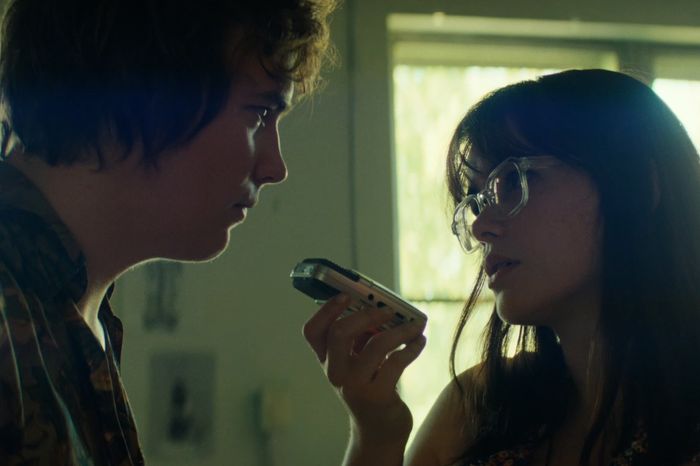
I think about myself at that time, when I was 20 years old and writing for Spin and standing backstage waiting to interview Wayne Coyne or Sharon Jones. I was this weird little professional with my tape recorder and my Urban Outfitters blazer, and it was such a strange dichotomy of being a young music critic and having all of this access and critical authority but at the same time feeling like the most powerless person who was constantly just wanting to be seen and recognized and heard. I think, for me, the truest image in the movie is that cluster of guys in their matching plaid and graphic band T-shirts having these conversations that don’t include you. They’re almost aggressively shutting you out with their body posture. I worked at another publication, and I could see these guys physically trying to shut me out with their bodies, and I was like, “Hey, man, I got opinions about Hüsker Dü too!” I remember getting the name of an album wrong by accident, and the pleasure that guy took in correcting me was almost sadomasochistic.
I’m guessing this wasn’t conceived as a period piece when you started working on it in 2015.
Because it took me ten years to make this movie, it has become a period piece. My producer Matt Miller, who produced Nirvanna the Band the Show, his and Matt Johnson’s company, Zapruder Films, optioned the script in 2016. They had a contest for female Canadian screenwriters to help them develop their first feature script, and I won. They gave me $12 grand Canadian, which was the most money I’d ever had at any time in my life, to develop the script. So I worked with a really fantastic story editor, Jill Golick, and I wrote and rewrote the script for two years straight. In 2018, we tried to get it made through Telefilm for about a million dollars, and I couldn’t get anybody to read it. I couldn’t get any actors interested. And all the advice I was getting was like, “You’ll never be able to make this in Montreal. You’ll never be able to shoot there. You should shoot this in Sudbury with a Northern Ontario tax credit and make it look like Montreal.” It was making me so fundamentally depressed and sad.
It would be more expensive to try to make Sudbury look like Montreal.
I know. We would spend our entire tax production budget on one street corner. But there was this primal urge that I had; I was desperate to make a movie. I would watch behind-the-scenes footage of Greta Gerwig directing Lady Bird and I would just weep. So Matt Miller was like, “You should make another movie first, and if that film’s successful, then we can make this one.” He suggested I apply to Telefilm Talent to Watch, and that’s how I Like Movies happened. I’m really happy that he and Matt Johnson honored their decadelong commitment to me, because they really didn’t have to, and that this film got to exist, but it was a really long time coming.
What do you think of this movie coming out now in this time of Gen-Z “indie sleaze” fandom?
It’s strange to see your adolescence codified on TikTok as “indie sleaze,” and it’s really interesting how this generation is now curious about us elder millennials and what we experienced. I’ve had a lot of young people come up to me and be like, “This film is so millennial-optimism coded! Like, post-Obama!” And I’m like, “I guess?” But I’m thrilled that they’re interested in it, and, of course, Barbie Ferreira is a Tumblr icon forever and ever. What I think was fascinating to them is it was kind of the last point in culture before everything was online. No one was documenting anything. You were just kind of at the show; you didn’t need to make an Instagram video about being at the show. And now there’s this weird self-referential layer to everything. We’re always half in our phones.
Your other movie Roommates is also out now. How did you make the jump from the indie to a big Netflix comedy with Adam Sandler?
It happened when I was editing Mile End Kicks and I was in a bit of a funk. I wanted that movie to be done. And while that was happening, I got this unexpected call from my agents. They were like, “Chandler, when we signed you, who was the person you said you most wanted to work with in the entire world?” I was like, “Adam Sandler.” And they were like, “He saw I Like Movies, and he really loved it, and he’s got this project. Read it tonight, and if you like it, he’s going to call you on the phone tomorrow. We don’t know what number he’s going to call you from, so just be by your phone, and if you don’t recognize the number, pick up because it could be Adam Sandler.” So I didn’t sleep at all that night and then I woke up the next morning to my phone ringing with an L.A. number. My heart was racing so much I was in a fugue state. I talked to Adam on the phone for an hour and a half. Two days later, I was flying first-class to Beverly Hills to meet him at a hotel to pitch the movie to Netflix. I was frantically making a look book for the movie in a day. Then throughout the whole preproduction process, I had to keep finishing Mile End Kicks, so I’d be location scouting at a frat house in Hoboken and then crouching in some weird dude’s bedroom trying to get a Wi-Fi signal so I could approve a VFX shot. It’s fitting that both movies are coming out on the same day because I sort of finished them at the same time.
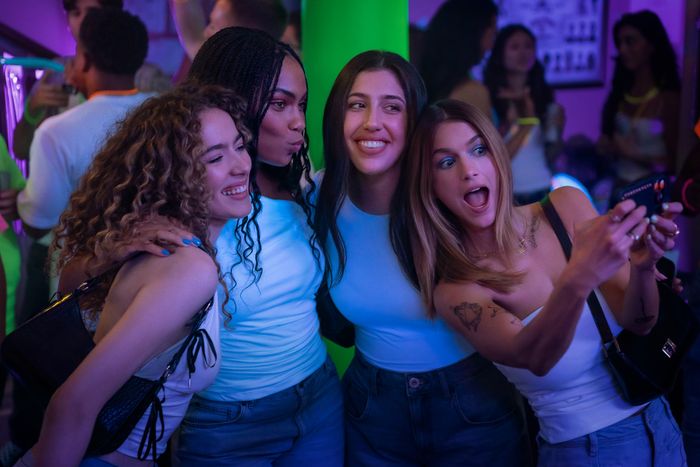
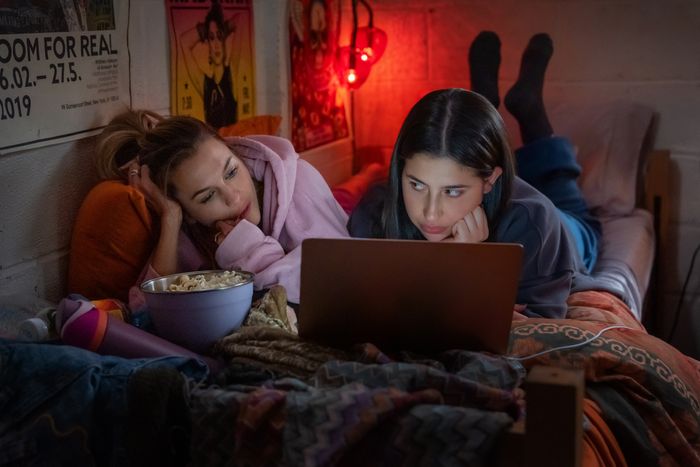
Roommates has huge party scenes, rope-course stunts, a fire. Coming from the indie world, what are the unique challenges of making a movie at this scale?
There are so many set pieces and stunts and pyrotechnics and famous people; I had no idea what I was getting myself into. I think because of the surreal, insane way I got the job, it felt like I crossed over into a multiverse I was never supposed to be in. I was living in the Canadian indie-filmmaker universe and then I somehow transcended into this other weird dimension. I didn’t have imposter syndrome because I was like, I’m probably in a coma dying on a hospital bed in Burlington, Ontario, right now, so I don’t even have to worry about how I’m going to block this crazy stunt scene because it’s not my real life. That was a good coping mechanism.
What’s interesting about making a studio movie with Adam is that he really is the studio. He’s calling the shots. And that makes him an incredible advocate for filmmakers because, if he loves your idea, he’ll make it happen. One thing I really want to impress upon people is when you make a movie with Adam, he is really the auteur. I think people think Happy Madison movies are just these effortless hangout films, like he just wants to go to Hawaii with the cast of Grown Ups 2 and make a comedy, but he’s up at night stressing about making every joke the funniest it can be. I’ve gotten into conversations where we’re arguing about one frame of a shot. He cares about every single detail, and he has such a brilliant sense for rhythm and timing and blocking of a scene and how to communicate something visually. He sees the movie in his head, almost like a piece of music, what the rhythm of every joke should be. That’s why he’s the best there’s ever been; it’s in his bones, and his love language is comedy and collaboration. He lives to make art, and he really cares about what his daughters think is funny and interesting and cool, and he wants to make movies they can see themselves in. It’s really exciting to work with someone who genuinely thinks women are funny.
Was there a unique kind of pressure to making a movie with Adam Sandler for his daughter?
I felt a lot for Sadie because she’s just finishing her last year of NYU and all of a sudden she’s the lead of a $30 million feature and a film that demands a lot from her. She’s in every shot of the movie and has to lead it and be the audience surrogate. She made it look easy. I remember she had really bad bronchitis when she did that whole karaoke scene and had to sing “Mr. Brightside” over and over. If I’d been in her position, I would not have been as professional and kind and committed as a performer as she was that day.
What is it about Sandler’s work that made you say he’s the person you most wanted to work with?
Adam Sandler is our childhoods. There are lines from Billy Madison and The Wedding Singer that run in a loop in my head. His performance in Punch-Drunk Love completely changed my life when I was 15. And I Like Movies in some ways is a love letter to Punch-Drunk Love. The first film he ever made was with a female director, Tamra Davis. I don’t know a lot of men in his position who are that interested in creating comedy vehicles for women and inviting emerging female directors into that process. In the ’80s and ’90s, you had a lot of female directors, like Penny Marshall and Amy Heckerling and Penelope Spheeris, who would do these tentpole comedies, and that’s completely been erased. It’s very rare that women get to make movies for over $10 million, let alone a hard comedy.
How was it directing someone else’s script rather than your own for the first time?
My first two movies are so modeled on my personal experience, and I’d been writing both films for a really long time so I felt like I knew the meaning of every comma inflection. When it came to production design and costume design, I had this innate understanding of what it should be. With Roommates, it was my first time really learning the art of collaboration instead of being militant about my own voice. It’s more collective, like improv, fulfilling a vision that’s all of ours. It’s a Chandler-Sandler baby.
You just had the premiere for Roommates in L.A. How was that?
All my friends came to my house, and I rented a limo because maybe I’ll never have this opportunity again to have a movie play at the Egyptian Theatre. I wanted to go full Entourage. The most random and exciting combination of people was there. Laura Dern hugged me, so I can die.
What does a hug from Laura Dern feel like?
It feels like pure sun. Like David Lynch is kissing you from beyond the grave.
Sign up for the Vulture Daily
An entertainment newsletter for the pop-culture obsessed.
Vox Media, LLC Terms and Privacy Notice