
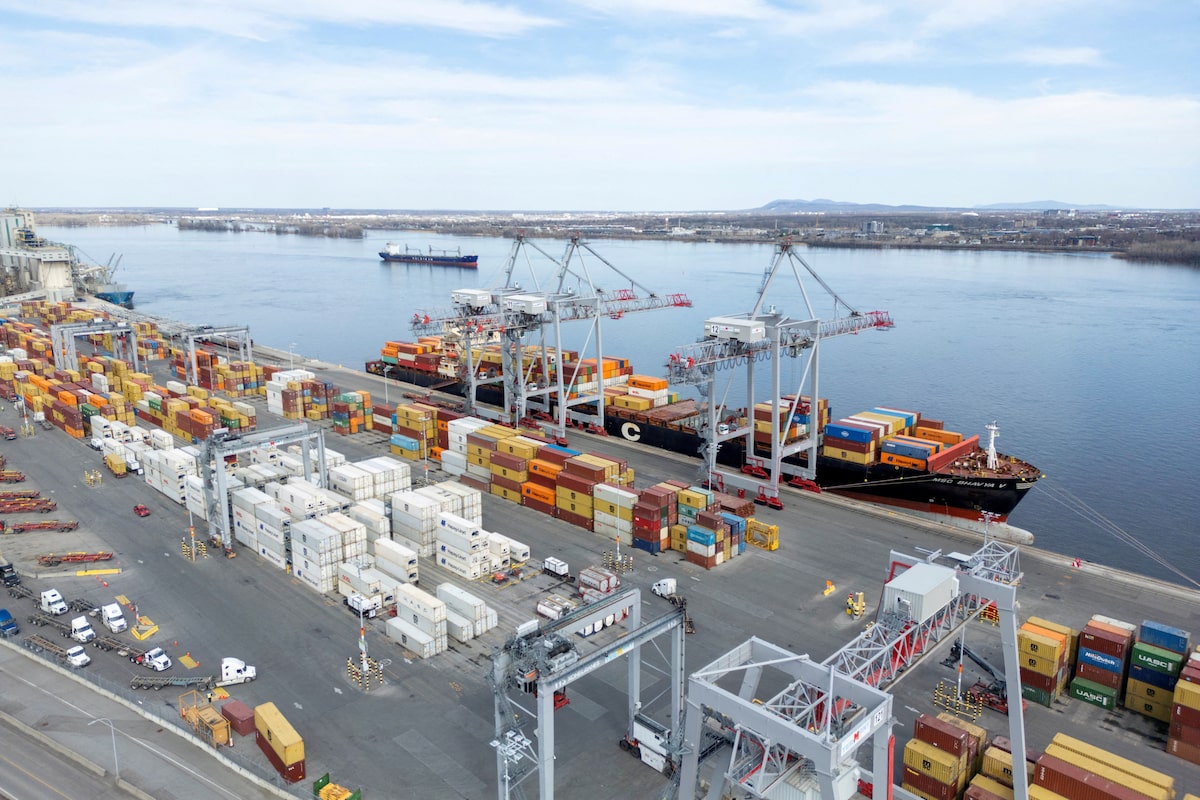
Shipping containers and transport trucks at the Port of Montreal on April 14, 2025.Carlos Osorio/Reuters
The federal agency overseeing the Port of Montreal is set to undergo a major shakeup of its board of directors, causing further upheaval in the organization after the mysterious departure of its chief executive earlier this month.
Four of the six directors currently sitting on the Montreal Port Authority board will reach the end of their maximum nine-year terms this summer and make way for new recruits, according to information shared with reporters after the organization’s annual meeting Thursday. Chairwoman Nathalie Pilon is among those departing the board, set to leave in July. A seventh board seat is vacant.
That board turnover is happening as the port authority deals with a sudden stream of senior executive departures and works to finalize a commercial agreement for a new container port terminal in nearby Contrecoeur, Que. Prime Minister Mark Carney recently broke ground on the site, calling it “a big, ambitious” project that will be key to boosting Canada’s non-U.S. exports.
Last month, Paul Bird, the port’s chief commercial officer, left to join Alto, the Crown corporation developing Canada’s first high-speed train. Then, late on Good Friday, the port authority published a news release announcing that then-chief executive Julie Gascon had “ceased her position” effective immediately. It gave no reason for the departure and no thanks for her service – a courtesy that’s typically granted to executives.
Montreal Port Authority finance chief the latest executive to exit
Just days later, the port authority confirmed that Alban Fournier, chief financial and technology officer, was leaving for a post in the private sector after just 17 months on the job. He is joining 5N Plus Inc., a maker of semiconductors and performance materials.
Port officials continue to cite contract confidentiality when asked why Ms. Gascon left, but insist there was no wrongdoing involved or misuse of public funds. They also reject the notion there is a leadership vacuum.
“This organization is bigger than a few individuals,” Ms. Pilon told reporters during a news briefing Thursday, noting the port authority employs 270 people. “I have full confidence in the team and in our ability to work together to pursue our mission.”
Ms. Pilon said finding a new CEO is the board’s top priority at the moment, adding it could take several months. When Ms. Gascon left, the port authority said a special board committee is now ensuring leadership of the organization on an interim basis in collaboration with other senior executives.
The process of finding a new CEO could be complicated by the board changes, said François Dauphin, president of Montreal’s Institute for Governance of Private and Public Organizations. That’s a lot of “institutional memory” leaving at one time, he said.
Port expansion near Montreal gets $1.16-billion loan in Ottawa’s first fast-tracked project
The wave of leadership departures at the Port of Montreal is worrying, said Bloc Québécois transport critic Xavier Barsalou-Duval. The party “wants to know what’s happening there” and obtain access to the financial analyses underpinning the Contrecoeur project before Ottawa sinks public money into it, he said in an e-mail.
Mr. Carney announced earlier this month that the Canada Infrastructure Bank would provide a $1.16-billion loan to the Montreal Port Authority for the Contrecoeur project, significantly increasing the amount of its previous $300-million loan commitment. Transport Canada has also pledged $150-million and Quebec $130-million, with the balance to come from the port authority and the terminal operator.
As the first fast-tracked project to launch under Mr. Carney’s government, Contrecoeur will more than double the current container-handling capacity for the port. Plans call for a 675-metre-wide docking platform with berths for two ships, eight loading cranes and a container storage yard linked to a rail line.
Skeptics have said the project is a big bet that traffic at the terminal will justify the investment. But Julien Baudry, who heads the port authority’s communications and external affairs, counters that it should be seen as new infrastructure that’s essential for the trade shifts that Canada wants to accomplish.
“Contrecoeur is not a bet,” Mr. Baudry said. “It’s an insurance policy to guarantee that our companies will have the ability to export.”