
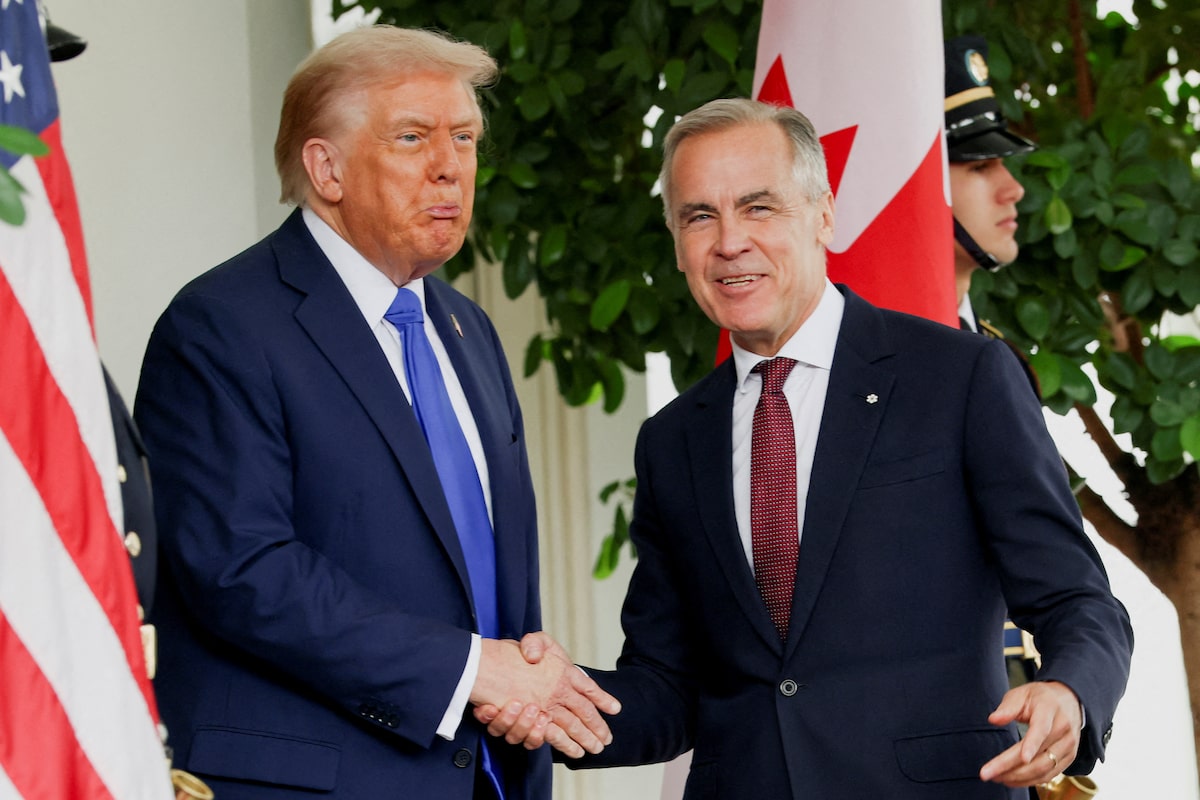
U.S. President Donald Trump welcomes Prime Minister Mark Carney to the White House in Washington in October, 2025.Evelyn Hockstein/Reuters
Donald Trump is impulsive. He’s impatient. He’s a fantasist who always needs to win, but will happily settle for victories that exist only in his imagination.
And the only thing he disrespects more than a country that doesn’t give in to his demands is a country that does.
Bear this in mind as Canada negotiates with the U.S. President and his minions over the future of the United States-Mexico-Canada Agreement. Bear this in mind as you consider the news, widely reported this week, that the White House has insisted that, prior to talks to end the trade war against Canada, we should make pre-emptive concessions. Basically pay an entry fee for the privilege of getting into the room with the people attacking us.
It’s classic Trump.
U.S. trade irritants can be resolved if Canada’s grievances are addressed, Carney says
To view theory in practice, look at the fiasco he’s authored in the Persian Gulf, and how weakly he’s responded to pushback from what he thought was a pushover adversary.
On Wednesday, after Iranian forces blocking the Strait of Hormuz boarded ships trying to traverse it, White House press secretary Karoline Leavitt was asked whether Mr. Trump considered this to be a ceasefire violation. No, she said, he did not.
That feeble answer measures the size of the gap between Mr. Trump’s imagination and objective reality. As part of the ceasefire in the war between the U.S. and Iran, the Americans are no longer bombing Iran, but Iran continues to make full use of its most powerful weapon, a blockade of the world’s most important energy waterway.
When the two-week ceasefire expired earlier this week, Mr. Trump meekly extended it, indefinitely. In return for nothing.
The U.S. is at least finally stopping the flow of Iranian oil through the strait, to the same degree that Iran is blocking the exports of its American-allied neighbours. It’s the only sensible decision that Mr. Trump has made in this war, but he made it after weeks of allowing Iran to export as much oil as possible, at higher prices than ever, even as Iran put a chokehold on its neighbours.
Editorial: Ottawa needs to keep its trade-talk chips
This self-defeating indulgence was the result of Mr. Trump‘s impatience and aversion to pain, in this case the domestic political pain of higher global oil prices.
He has claimed since the start of the war that Iran is defeated, that its navy is sunk, that a changed regime is begging for a deal and that it has no cards. It turns out that Iran now holds the stronger hand.
Unless Mr. Trump shows unexpected patience, and unless Congress and voters indulge him in maintaining the pressure of a blockade for months, the regime in Tehran is poised to emerge from this war more powerful and more threatening than before Feb. 28.
On the other side of the Persian Gulf, America’s allies find themselves left in the lurch. Saudi Arabia, the United Arab Emirates and Qatar thought they had charmed and bribed Mr. Trump into their good graces with everything from promises of massive new investments in the U.S. to gifting him a 747. Instead, he has turned out to be a far less reliable ally than previous occupants of the White House.
They told him not to attack Iran, but he did; they have suffered catastrophic consequences. Once he launched his mistaken war, they hoped he would at least press on until he finished the job, or severely weakened Iran. He betrayed them on that score as well.
The Gulf states have to prepare for a future of coping with Mr. Trump’s Frankenstein accident: an emboldened, empowered, radicalized Iran that has discovered it holds a weapon far more useful than the nuclear bomb.
We should not celebrate Iran’s achievement, which I hope will not be allowed to stand. But Canada can learn from it.
A president of the United States comes to every table with a strong hand, by virtue of the heft of the country and economy he represents. But the other side always has cards, too. In the case of Canada, that includes the fact that we buy hundreds of billions of dollars of U.S. goods and services, that trade barriers can affect employment and prices in ways American voters do not appreciate, and that the U.S. is still a democracy, with Mr. Trump’s party on track to lose control of at least one chamber of Congress this fall.
Canada need not preconcede anything to a president who is long in the tooth, short on time, detached from reality, constrained by law – he can’t unilaterally erase trade treaties – and otherwise occupied.
Keep talking. Keep negotiating. Keep ragging the puck.