
Here’s a sentence you’ve never seen me write before: Replay review is good.
And a few more: Replay review works. It’s doing what it’s supposed to do. I’m glad it’s there, because it’s making the game better.
Just not in the NHL.
Tomorrow will mark the one-month anniversary of Major League Baseball’s introduction of the automated ball-strike system, also known as ABS and/or our new robo-ump overlords. For the first time, balls and strikes can now be challenged, subjecting the fundamental building block of the game to review.
And it’s working. It’s working so well, in fact, that some fans and media are asking for more.
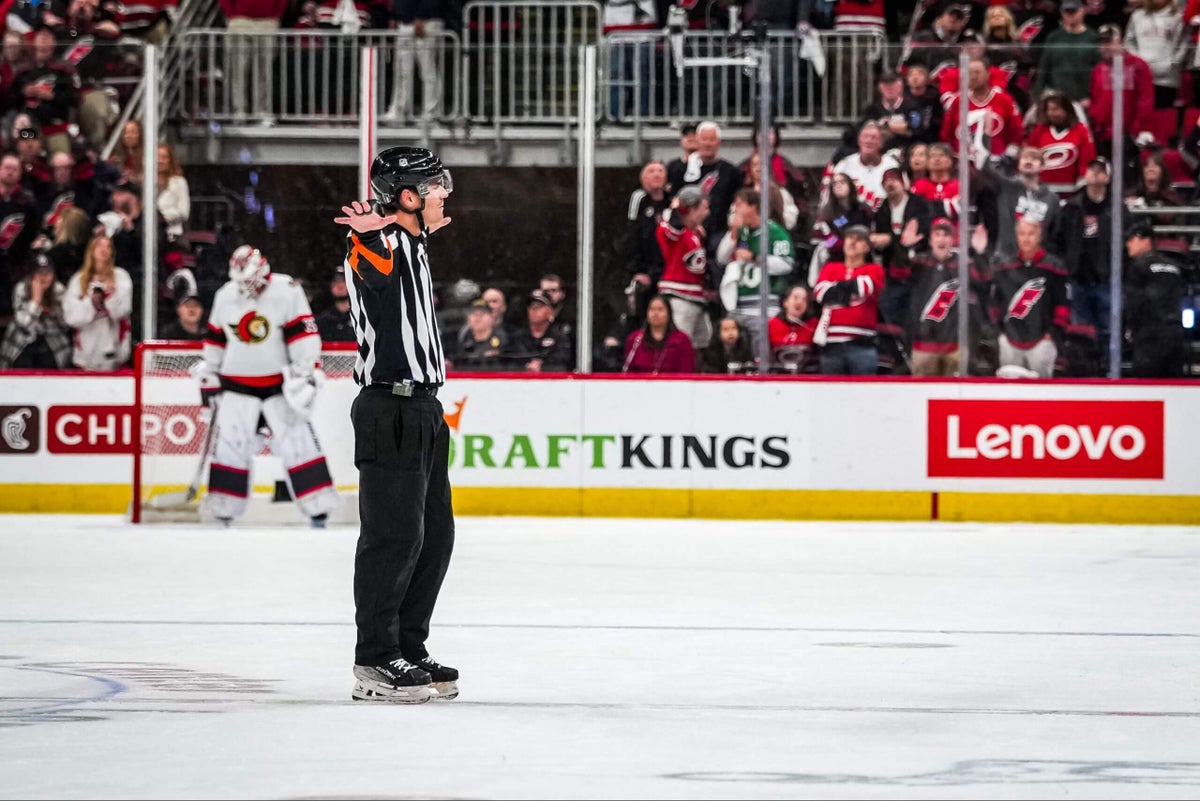
And then there’s hockey. On Monday, the NHL served up a mess of a scenario in Carolina, where an overtime goal was subjected to a long review despite nobody knowing exactly what was being looked at. The call was overturned, and when we eventually found out why, it turned out to be a judgment call based on an extremely ill-defined section of the rulebook, one that didn’t seem to be as “clear and obvious” as the rulebook demands.
In other words, yet another NHL replay mess, one that ends with fans arguing over what the system is even supposed to do. Throw it on the pile. The NHL has a system based on the holy tenet of “just get it right” that never seems to get it right, at least not to everyone’s satisfaction. As I’ve written before, nobody thinks this is working.
And sure, you’ve heard this before, from me and many others, plenty of times. Maybe you’re numb to it by now.
And then, here comes MLB with its fancy new replay system, and everyone loves it. That suggests the problem here can’t be that the entire concept of replay review is bad. It seems like it can indeed work. The devil is in the details.
OK. So instead of just complaining about the NHL’s broken system, let’s look at a better one and see if there’s anything we can learn. Here are seven reasons why baseball’s ABS seems to be working so well, and whether there are any lessons we could apply to improving hockey’s review system.
Reason 1: ABS is fast
No, really. If you’re not a baseball fan and haven’t seen the ABS system in action, you might be caught off-guard by how fast it works.
The system cuts out all the pageantry we’re used to seeing when replay is invoked, in hockey and just about every other sport. There’s no consulting with the bench. No officials huddling up and putting on headphones. No time for the broadcast to sort through multiple replays and try to guess the result while we wait patiently for a verdict.
There’s a challenge, and then there’s a result. It’s about as close to instant as you could imagine a system being. And that means that as far as disrupting the flow of the game, ABS is basically within a rounding error to no impact at all.
The lesson: Get it over with.
Could it work in the NHL? Not in the same way. Balls and strikes are simple, at least compared to the mysteries of goalie interference. Even on relatively straightforward calls, such as offside or whether a puck crossed the goal line, you’re just never going to get a review done in seconds. That’s not realistic.
What is possible, though, is for the NHL to learn the bigger lesson here, which is that shorter reviews are better. One of the biggest complaints from hockey fans is that the reviews often feel like they take forever, which kills the game’s momentum and sucks the life out of the building.
The NHL might not be able to replicate the incredible speed of an ABS review, but it can look at its success as a reminder to always be asking: What can we do to make this process faster?
Reason 2: ABS is automated
How is ABS so fast? One reason is that once a challenge happens, there’s no room for human subjectivity. Instead, we get a quick 3D rendering that instantly reveals the result. You could argue it’s not even a replay review at all, because the robots aren’t watching replays. They don’t need to.
It’s not quite perfect — the system occasionally isn’t available, and there’s still a very small margin for error. But perfection should be the goal; improvement is.
The lesson: If you don’t trust the human factor, take it out completely.
Could it work in the NHL? Not yet. And not at all for certain types of challenges — again, goalie interference will just never work with any kind of ABS-inspired system, which is yet another reason why we shouldn’t have it at all.
But when it comes to a puck being over a line, and perhaps offside and high sticks, it’s not hard to imagine a world where hockey could use its puck and player tracking to get the same sort of automated result we see in baseball (and other sports).
When that day arrives, the NHL should move as quickly as it can. An automated system will need to be tested and maybe tweaked, but once it’s ready, get it on the ice.
Reason 3: ABS doesn’t do judgment calls
If the ball catches any piece of the strike zone, it’s a strike. If not, it’s a ball. We’re not making judgment calls or opinions, and certainly not game management.
The lesson: Replay works on objective, yes-or-no calls … and not necessarily anything else.
Could it work in the NHL? I don’t know, everyone seems really thrilled with how the almost entirely subjective interference reviews are going, right?
Reason 4: ABS is easy to understand
We can’t give baseball much credit, because the whole concept of balls and strikes is relatively straightforward and hard to mess up. (We’ll pause here so you can all get your C.B. Bucknor jokes in.)
That simplicity is an advantage that baseball has over hockey, where everything moves so much faster and the plays don’t happen in discrete chunks. We can complain about hockey’s replay system all we want, but let’s acknowledge that the degree of difficulty is nowhere near the same.
That said, it’s hard to watch an ABS challenge play out in front of 40,000 fans who all seem to understand exactly what’s going on without comparing it to a typical NHL review. If we’re lucky, a referee might mumble something into a broken microphone to give us some hint about what’s being looked at. More often, we’re all guessing — fans, media, broadcasters, all of us. In that Hurricanes overtime, nobody even figured out which part of the play was at issue until it was too late. There’s no defending that.
The lesson: It’s crucially important that fans understand exactly what’s happening and why.
Could it work in the NHL? Again, not anywhere near as easily as it does with ABS. That’s clear. But the bigger lesson here still applies: Fans need to understand what’s being reviewed. And when the call is made, they need to understand that too. The NFL is a closer comparison, and they typically do a good job communicating about most reviews. Not a great job, mind you, and certainly not an infallible one. But better than hockey? By a mile.
If the NHL is going to go on having this much replay review, the very least they can do is insist that referees make a clear announcement about what’s being looked at, and then another about what they saw and why it did or didn’t change the call on the ice. If the refs hate that, too bad. This part of the job is too important to keep messing it up as badly as the NHL does.
Reason 5: ABS is … kind of fun?
I didn’t see this part coming, but as a fan, I kind of like ABS reviews. Not the concept — I mean the actual review, where the ump announces a challenge and then you get to sit back and watch that little animation that pops up on the TV (and simultaneously on the ballpark scoreboard). It’s super fast, but you still get that brief moment of suspense. And hearing the crowd react in real time as they see what you’re seeing is a nice touch.
The lesson: Sports are still entertainment.
Could it work in the NHL? Yes, in two ways. First, when we eventually get that tracking technology in place for certain cut-and-dry reviews, let’s copy the baseball approach. Let’s see a little animation of a zone entry, with the camera zooming in on whichever player’s skate is in question. Have the blade turn green if they’re OK, red if they’re offside.
But the bigger point here is to never forget the fun factor. Hockey is serious business. But it’s all for fun. The NHL is an entertainment product. And the next time some sore-loser GM tries to insist that we absolutely need a new type of review for whatever obscure rules scenario he thinks his team got detrimentally affected by most recently, the league should ask itself: Would this make our product more fun, or less?
Reason 6: ABS doesn’t wait around
This is maybe my favorite wrinkle of baseball’s system. And luckily, it’s the easiest one to borrow for the NHL.
To initiate a review, the pitcher, catcher or hitter must signal their challenge immediately. Practically speaking, that translates to a few seconds. That’s it. There’s no standing around, and certainly no waiting for the broadcast to show a few replays first.
There’s another key detail about ABS, and you may have caught it in the last paragraph: The challenges can only come from pitchers, catchers and hitters — not from the bench. In fact, if a player even looks over to the bench for some guidance, the umpire can deny their challenge.
Needless to say, baseball teams do not have video coaches sitting in a room somewhere desperately clicking through tape for anything that looks like a do-over. And they don’t feel the need to grind the game to a halt after every close call, just in case somebody somewhere might want to challenge.
The lesson: You think the official missed a call? Say so, right away, so we can get a review done quickly. Speak now or forever hold your peace.
Could it work in the NHL?: To an extent, absolutely. I’m not sure if hockey should borrow the entire concept and make challenges the exclusive domain of players on the ice, although I’m open to being convinced. But the current way of doing things, where everyone is constantly standing around, waiting for a coach to finish staring at an iPad or hear from a video guy who’s literally the only person in an entire building who noticed a play was offside? It’s awful.
In the past, I’ve suggested that coaches get exactly five seconds after a goal to challenge. The referee in the offensive zone signals a goal, and the trailing ref turns to the bench of the team that was just scored on and holds up five fingers. Count it down, then demand a yes or no. Are you not sure yet? Too late, good goal.
That would virtually spell the end of the video coaches and the iPads. It would speed the game up. And most importantly of all, it would (over time) retrain fans to get fully excited about goals again, without that lingering “Wait, maybe this will all get called back, I’d better wait before I celebrate too much” feeling we all know so well.
Is that the best way to do it? I think so, but I could be wrong. The key point here is to be fast, be clear and treat challenges as rare events for obvious misses, not some sort of default setting for nitpicking. If the ump misses a strike but the catcher and pitcher do too, well, that’s baseball, isn’t it? And if nobody watching a play in real time noticed a missed stoppage on the rink, we shouldn’t care what some freeze-frame pixel tells us 10 minutes later.
Reason 7: ABS is still new
Now that I’ve spent most of this column pumping the tires of a different sport and dumping on the NHL, we should end with an important dose of reality: ABS is brand-new at the MLB level. It’s very possible that over time, as teams and players get used to the new system, problems will emerge.
When it comes to hockey and replay review, the law of unintended consequences is pretty much undefeated. Maybe baseball falls victim as well and at some point down the line, we look back at pieces like this and wonder how anyone ever thought ABS was working.
That’s largely what happened with offside review, after all. Matt Duchene went offside by 10 feet, the officials missed it, we all agreed that of course we didn’t want to see that happen again, and replay review seemed like an obvious fix to the problem. Did you object at the time? I don’t think I did.
It wasn’t until the system had been around for a while that we realized we’d messed up. In the decade since offside review came into effect, we’ve yet to catch even a single Duchene-level miss. Instead, teams have turned the rule into a get-out-of-jail-free card to be used against goals that would never have been considered controversial for the first century of NHL history.
Maybe something like that, or worse, ends up happening in baseball. We’ll find out.
The lesson: Don’t go hanging “mission accomplished” banners just because something works for the first few weeks.
Could it work in the NHL? Wait, is this a reason to kick the can down the road and choose the status quo over something that could be better? Now we’re talking the NHL’s language.