
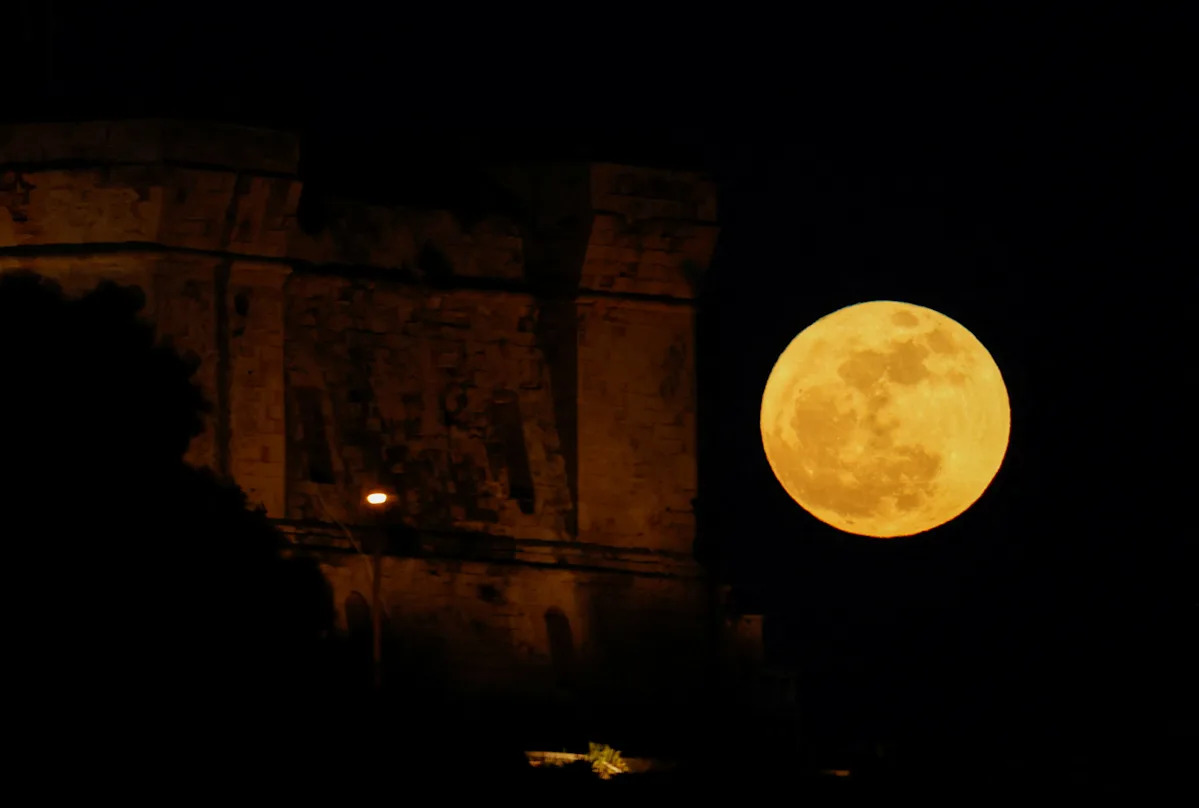
The Flower Moon will light up the night sky on the first day of May, which marks the midpoint between summer and spring.
May’s full moon, known as the Flower Moon, will peak on Friday, May 1.
The Flower Moon was given that name because it falls in the middle of spring, when flowers, trees and bushes bloom throughout nature.
Like other full moons, May’s full moon is known by multiple names given to it by different cultures throughout history, including Frog Moon, Milk Moon and Hare’s Moon, according to the Farmer’s Almanac.
Here’s what to know about the Flower Moon.
A look at Artemis around the far side of the moon
1 of 9
This handout image released by NASA shows a fully illuminated Moon, with the near side at top, dark lava plains, and the Orientale basin, with parts of the far side visible, on April 6, 2026. The four astronauts embarking on NASA’s lunar flyby became on April 6 the humans to travel furthest from our planet, as they get set to view areas of the Moon never before seen by the naked eye. The Artemis II team broke the previous record set by 1970’s Apollo 13 mission, which they are expected to surpass by approximately 4,105 miles (6,606 kilometers) when they reach this journey’s anticipated furthest distance from Earth — 252,760 miles — later today.
When can you see the Flower Moon?
The Flower Moon will peak on May 1, at 1:23 p.m. ET, according to the Farmer’s Almanac. While it peaks in the afternoon, the moon will still look full at night and for a few days after.
The full moon will be visible around the globe, but cloudy skies might obscure backyard astronomers’ views, so be sure to check the weather in your area before going out to check the night sky.
More news: As America turns 250, how the moon is testing our ambition again
Why is it called a Flower Moon?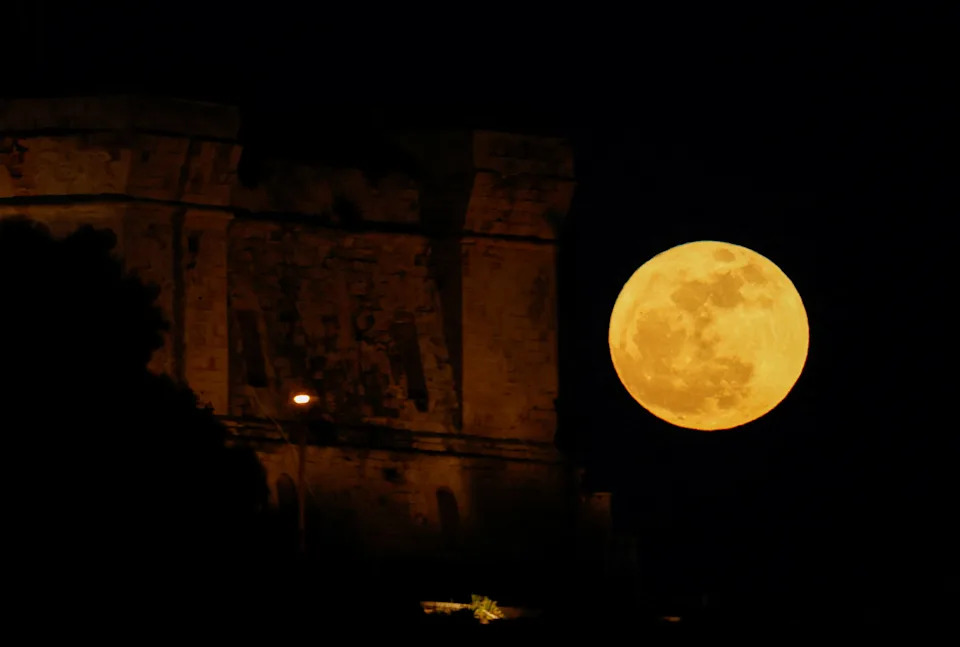
A full moon known as the “Flower Moon” rises behind the 17th century Fort St Lucian, as seen from Birzebbuga, Malta, May 12, 2025.
May’s full moon is called many things, according to the Old Farmer’s Almanac, including:
Corn, or Corn Planting Moon
Vesak, Buddha Jayanti, or Buddha Purnima
Once in a blue moon
The Flower Moon won’t be the only full moon we can expect this month! A blue moon will also take place on May 31, giving us two full moons, one on the first day of the month and another on the last day of the month.
A blue moon is not a common occurrence, hence the expression “once in a blue moon,” and only occurs every 2.5 years, according to NASA.
The last blue moon occurred on Aug. 19, 2024, when the moon was a super blue moon, meaning it was the closest it had been to Earth that month and appeared brighter and larger.
The blue moon occurring later in the month will appear smaller than usual, a phenomenon known as a micromoon. According to NASA, this occurs when the celestial body is at its farthest point from Earth, about 251,000 miles away.
List of full moons in 2026
The moon will be full on the following dates, according to the Farmer’s Almanac:
Flower Moon: Peaks May 1, at 1:23 p.m. ET
Blue Moon: Peaks May 31, at 4:45 a.m. ET. The blue moon occurs when two full moons occur in the same month. The last blue moon occurred on Aug. 19, 2024, according to Space.com.
Strawberry Moon: Peaks June 29, at 7:57 p.m. ET
Buck Moon: Peaks July 29, at 10:36 a.m. ET
Sturgeon Moon (partial lunar eclipse): Peaks Aug. 28, at 12:18 a.m. ET
Harvest Moon: Peaks Sept. 26, at 12:49 p.m. ET
Hunter’s Moon: Peaks Oct. 26, at 12:12 a.m. ET
Beaver Moon (super moon): Peaks Nov. 24, at 9:53 a.m. ET
Cold Moon (super moon): Peaks Dec. 23, at 8:28 p.m.
Julia Gomez is a Trending reporter for USA TODAY and covers popular toys, space phenomena, scientific studies, natural disasters, holidays, and trending news. Connect with her on LinkedIn, X, Instagram, and TikTok: @juliamariegz, or email her at jgomez@gannett.com.
This article originally appeared on USA TODAY: May full moon 2026, Flower Moon, is coming soon. Here’s what to know