
There’s a sentence that keeps coming back in photography circles: street photography is dead.
Most people say it with nostalgia. Some say it with frustration. A few say it like a provocation.
They’re all wrong. And right.
Street photography isn’t dead because people stopped doing it. It’s “dead” because everyone started.
The Real Problem Isn’t Death. It’s Saturation.
We are producing more images today than at any other point in history. Every street corner, every passing gesture, every accidental juxtaposition: it’s all being photographed, constantly.
Scroll for five minutes and you’ll see it:
the same silhouettesthe same reflectionsthe same lonely figures framed in light
The visual language of street photography hasn’t evolved nearly as fast as the tools we use to produce it.
That’s the real shift.
It’s not that meaningful images disappeared. It’s that they are now buried under an avalanche of competent, repetitive, and instantly forgettable photographs.
Today, making a “good” street photo is easy.
Making a necessary one is not.
Smartphones Didn’t Ruin Photography. They Removed Your Excuses.
For years, photographers hid behind gear.
Better cameras. Faster lenses. Sharper optics. The illusion was simple: better tools would eventually lead to better images.
Then smartphones happened.
Suddenly:
everyone has a cameraeveryone is always readyeveryone can shoot without thinking twiceeveryone is going to share every single picture on social media
And most importantly: the technical barrier disappeared.
So what’s left?
If your work doesn’t stand out today, it’s not because you don’t own the right camera. It’s because the camera is no longer the limiting factor.
That’s uncomfortable. But it’s also liberating.
Virtually everyone today is able to make a decent photograph, and that is where the misunderstanding starts. Without a real visual culture — amplified by the mediocrity that wins at festivals and photography awards — many today don’t understand what makes a good photograph.
The Collapse of the Photographer Myth
There was a time when being a photographer meant something very specific.
It implied access, intention, and a certain level of dedication. It took effort just to be there, camera in hand, ready to capture something. It was like being a writer — to be a writer means being intentional about what you make.
Now?
Everyone is there. All the time.
The act of photographing is no longer rare. It’s constant. It is, often, a mindless thing.
Which means the value has shifted.
It’s no longer about who takes the picture. It’s about who is actually seeing something others overlook.
And that’s a much harder game.
Aesthetic Has Replaced Experience
A lot of what passes as street photography today is just visual pattern recognition.
People learn the look:
hard lightstrong contrastlayered compositions
And then they reproduce it.
Perfectly.
Endlessly.
Maybe with a filter. A film simulation.
But something is missing.
Because street photography was never just about what things look like. It was about what it feels like to be there.
And that part can’t be downloaded, copied, or automated.
It requires time. Presence. Friction. It requires that your life is involved — that you are participating in the game, that you are really in the scene.
It requires being in the street not as a content collector, but as someone genuinely engaged with reality. That is not something that comes with the camera or smartphone you purchased.
So What’s Left?
If everyone can take pictures, and most pictures look the same, what actually matters?
Very little — and that’s exactly the point.
What’s left is:
your ability to stay longer than othersyour willingness to observe without immediately shootingyour capacity to recognize when something is truly worth photographing
Not because it looks good. But because it means something.
Street photography today is harder than ever. Not technically — that part is solved.
It’s harder because the only thing that makes a difference now is you. Your understanding of the world around you. Or, maybe, the questions you raise through your observation. Yes, because sometimes it can be “photographing with a big question mark in the head” with respect to what you are observing in front of you.
Maybe It Had to Die
If you think street photography is dead, you’re not entirely wrong.
A certain version of it is gone:
the aesthetic formulasthe repetitionthe idea that a visually pleasing frame is enough
That version? Yes, it’s exhausted — even though many persist in repeating it still.
But let’s be clear: this entire argument is a provocation.
Because something else never died.
What we often call “street photography” today is just a fragment of a much broader tradition — one that existed long before the label itself. A way of working rooted in observation, patience, and a deep engagement with reality.
Call it documentary. Call it reportage. Call it simply photography.
Photographers like Henri Cartier-Bresson were working in the streets without needing to define themselves as “street photographers.” They weren’t chasing an aesthetic. They were trying to understand and frame the world.
And that approach is still alive.
It just doesn’t shout.
It doesn’t rely on trends. It doesn’t depend on recognition. And it doesn’t need the label to exist.
So yes, a certain idea of street photography is dead.
But the real one?
It’s still there. Exactly where it has always been.
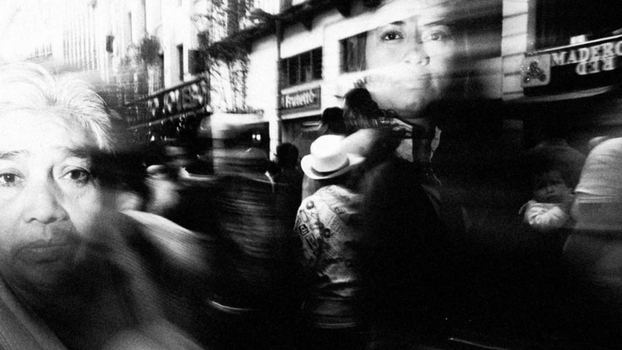
And the provocation of this article is underscored by the choice to accompany it with photos taken with a “real camera” and the creation of flash-based images. Reality Remade was a project conceived in 2011 with the intention of addressing, through a street photography approach, the volatility of existence, of life and death.