
Canada’s economic picture may not be all that bright, but given the challenges of recent years, it could be much worse.
Since the pandemic began six years ago, the economy has been anything but stable. Pandemic-era low interest rates fuelled a surge in spending, which helped drive inflation higher and, in turn, pushed interest rates sharply upward.
 Derek Burleton, TD Economics
Just as inflation and interest rates began to settle, trade tensions with Canada’s largest trading partner resurfaced. Now, higher fuel prices driven by conflict in the Middle East are fuelling renewed inflation concerns, while the growing impact of AI is casting a shadow over the labour market.
And yet, through it all, Canada’s economy seems relatively unscathed, according to TD vice president and Deputy Chief Economist Derek Burleton.
“We are dealing, as an economy, with a series of shocks,” he said at a mortgage industry event in Toronto. “Yet, our economy has shown some resilience.” According to recent data, consumer spending ticked up by a 0.8% in February, with employment holding relatively steady, according to Statistics Canada. While gas prices remain high, Burleton says the impact is being offset by stronger gains in the oil and gas sector.
He agrees with most Big Six forecasts calling for a steady 2026. But if the Bank does move, he sees cuts as more likely than hikes.
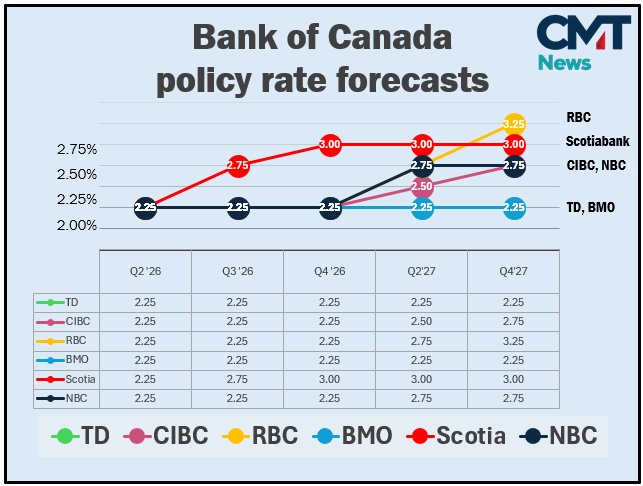
“Next week is a slam dunk, no rate change, two-and-a-quarter, the question is what happens next,” he says. “Even pre-war we expected to stay at 2.25% and ride that out, and I do believe if the bank is going to move off it, it’s more likely they cut rates than raise.”
Burleton explains that post-pandemic inflation was driven by sky-high demand and a series of supply shocks, which forced the Bank of Canada to move aggressively in raising rates. This time, he said, inflation is being driven by a single supply-side event. Unless the war drags into the summer, he doesn’t expect the Bank to step in.
“I think the bar for a rate hike is relatively high,” he says. “If the shock proves bigger, oil prices grow higher, energy prices impact demand in provinces like Ontario more than expected, then they’ll have to adjust downward.”
The Canadian dollar inches up
Canada’s resilience may be most evident in its currency, which held relatively steady over the past year and strengthened in April. “It’s a very nuanced story in Canada, but I am cautiously optimistic, and I think the Canadian dollar’s strength reflects that,” Burleton says.
One factor keeping the dollar relatively stable is foreign direct investment, which dropped significantly on the other side of the border last year, but “soared” here at home.
“We’re seeing strength in some of the pension flows into Canada,” Burleton says. “[Prime Minister Mark Carney] has been doing his best running around trying to generate interest in Canada, focusing on our strengths in minerals and oil and other areas, so we’re starting to see that play out.”
Drop in employment offset by a drop in immigration
The job market has also remained relatively resilient, which Burleton attributes to a pullback in immigration. After several years of steady increases, Canada’s population declined last year for the first time since Confederation.
“The silver lining of that is with fewer people flooding into the job market, which drove up the unemployment rate, that tap is turned off, so here we are in a very stable unemployment rate environment,” he says. “Usually, you need strong job growth to see unemployment come down, but not in this environment.”
Though the job market has experienced some challenges as of late, in part due to AI-driven job displacement, its impact has been relatively muted.
“The AI-driven push is not really showing hard-core up in the data, but I imagine it will at some point,” Burleton says. “At this point we’re kind of wondering how much disruption there will be versus transformation, versus just making people more efficient. I think it’s going to be a mix of everything.”
Higher gas prices hit consumers, boost producers
Another major point of economic uncertainty is the ongoing conflict in the Middle East, which has disrupted the flow of resources and driven up fuel costs around the world. While the supply shock might be causing some pain at the pumps, Burleton says oil, gas and resource producers are seeing higher profits and making big investments, which is having a positive impact on employment and tax revenue.
“Oil prices are certainly going to hit Ontario as a consuming province, but they’re offset by Alberta and other oil producing provinces,” he says. “The Federal Government also benefits from higher [tax] revenue, which they redistribute through a grocery GST credit, or a temporary tax reduction for energy.”
The main risk to the Canadian economy is that the conflict drives up production and transportation costs for imported goods. Burleton, however, doesn’t expect it to last long enough for that to materialize.
“The rule of thumb is that an oil shock like this has to last three to six months before that big impact on underlying prices,” he says. “We think by early May there will be some kind of diplomatic solution, and if that’s the case oil will peak and begin to drop.”
With duelling blockades in the Strait of Hormuz impacting the economies of all parties involved, Burleton said there is little appetite to let the conflict drag on. “If we get another round of conflict and the strait remains closed well into May, then you’re dealing with a much more severe outcome,” he warns. “Not a recession, just weaker growth and higher inflation.”
Has the housing market reached a bottom?
One area where Canada hasn’t shown the same resilience is housing, particularly in Ontario and even more so in the GTA, where prices continue to fall and sales remain subdued.
Burleton said the correction has followed a similar path to the city’s last major downturn in the 1990s, which lasted more than seven years. Four years after prices began falling in 2002, he believes the GTA is now on the cusp of a gradual recovery.
“Condo inventories are still high, and it’s still got to come down quite a bit, and that’s going to be the story over the next year and into 2027,” he said. “But I do see transactions picking up in the second half of the year, prices stabilizing as the 2027 story, broadly in the GTA and Ontario, and then developers [building again] as a 2028 story.”
Burleton’s bullishness on a housing market recovery is due to the high levels of immigration seen in the years leading up to the downturn.
“It takes time for immigrants to jump into the housing market, and I think that will start to happen,” he says. “Even though immigration has been shut off, past immigration will show up in the form of pent-up demand.”
Burleton says the housing situation in Ontario has proven to be more of a gradual correction than a full-blown crisis, at least from a macroeconomic standpoint, though he acknowledges some in the industry might disagree.
“It’s not ideal, but [the market was] too hot, something had to give, the bad side is it’s taking longer and we’re still not there yet,” he says. “I think the worst of it is probably behind us, we’re kind of scraping along the bottom on a longer-term basis, and I think when you come down to it, we’re looking at a six-year correction in the resale market.”
When the market does bounce back, Burleton says it likely won’t be driven by investors, who may be too spooked to return, but by first-time and move-up buyers waiting on the sidelines for prices to bottom out.
The renewal shock that never materialized
One final example of the country’s economic resilience is in the renewal market, where many forecasters warned Canadians were in for a major shock.
“This was going to tank the Canadian and Ontario economy, yet we’ve managed to avoid catastrophe,” Burleton said. “The economy has been able to weather it partly because renewals happened over time, partly because incomes grew.”
Despite the many external shocks to the economy in recent years, Burleton says the macroeconomic picture is much brighter than many would expect.
Assuming the war in Iran doesn’t drag on long enough to put inflationary pressure on Canada, Burleton is confident that interest rates will remain steady through 2026, and that if there is any movement, it will be downward, not up.
“In an economy where the population is growing, an economy where housing has stopped, in an economy where trade is adjusting, that’s about as good as we can do,” he says. “It’s about as resilient as we could be given the structural constraints on economic growth.”
Visited 3 times, 3 visit(s) today
Bank of Canada bank of canada forecast bank of canada rate forecast BoC BoC rate forecast Derek Burleton rate cut forecasts td
Last modified: April 24, 2026