
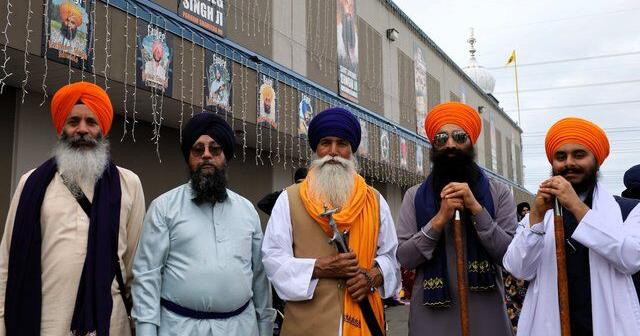
Nearly half a million people flooded the streets of Surrey on April 18 to celebrate Vaisakhi, as the city’s annual Khalsa Day parade drew one of the largest crowds in the world for the festival, according to organizers.
Martial arts displays, art installations, free food stalls, live music, dance performances and amusement rides filled the grounds with vibrance.
At the heart of the procession was a grand golden palanquin carrying the Sikh holy scripture, the Guru Granth Sahib, as masses walked alongside in devotion.
“Sikhs are commanded to be saint soldiers, to protect the weak and destroy the tyrants,” said Harbin Singh, a Surrey resident who has been learning martial arts for three years. “In Sikh culture, it’s ordered for us to be armed and protect the weak.”
“If somebody comes to us humbly, we give them food. And if somebody comes attacking us, we give them the sword. That is our motto, ‘Degho Tegho Fateh’.”
The day carries dual significance: it marks the ancient harvest festival celebrated by farmers across Punjab.
It also commemorates a pivotal moment in Sikh history when, in 1699, the tenth Guru, Guru Gobind Singh Ji, established the Khalsa, the community of initiated Sikhs who embody the faith’s warrior spirit and devotion.
Hamandeep Singh, who has followed the Khalsa way of life for 23 years, explains that this was when the Guru blessed the Panj Pyare (the Five Beloved Ones) who opted to take Amrit, the sacred nectar of initiation. This marked their commitment to a life of spiritual and physical discipline.
The Khalsa code prescribes daily Paath (prayer), meditation, and the five articles of faith: the Kirpan (a sword carried for self-defence and the protection of others), Kanga (comb), Kara (iron bracelet), Kesh (uncut hair) and Kachera (undergarments).
“The essence of this is visible at every Nagar Kirtan,” said Singh.
He encourages the younger generation to participate and take away something lasting, either from the akhade (traditional martial arts schools) that teach Gatka (a Sikh martial art), or from people who recite Gurbani (divine hymns) to learn the vidya (knowledge) passed down for generations.