

*This story has been updated with a response from Nova Scotia Health (NHS).
On Saturday morning I spent two hours at the mobile primary care clinic at the Cobequid Community Health Centre in Lower Sackville.
On Friday, I recognized I had symptoms of a urinary tract infection (UTI) and while I’m fortunate enough to have an excellent family doctor, I couldn’t wait to get an appointment with her. So, I went to the mobile primary care clinic to get immediate care.
These clinics treat patients with “non-urgent, low acuity health issues,” including the health conditions that are listed here. UTIs are on that list.
I was last at this clinic in 2025 for the same reason. That was my first visit to a mobile primary clinic, which I expected to be, well, mobile.
A few years ago, these clinics were operated out of small vans that moved to community health centres across the province.
Now the clinics are stationary and operate out of several locations: Dartmouth South Primary Care Clinic, Harbour South Medical Clinic in Yarmouth, Lunenburg Family Health, South Shore Medical Arts Centre in Bridgewater, and the Cobequid Community Health Centre where I went.
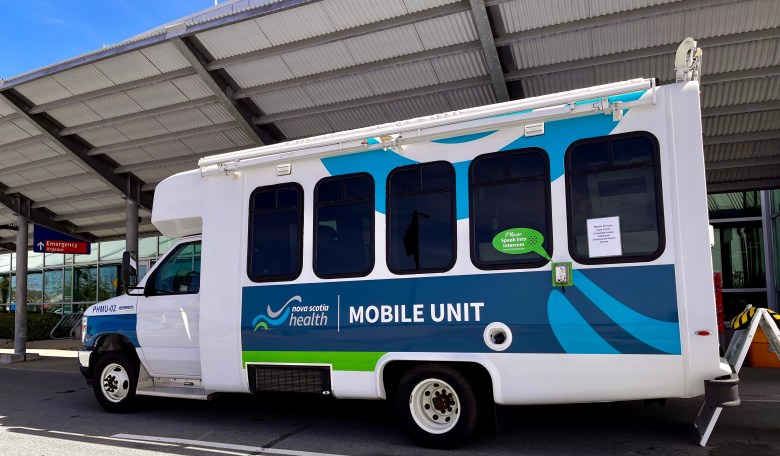 A mobile health unit parked outside the Cobequid Community Health Centre in April, 2023. Credit: Yvette d’Entremont
The hours of operation for these clinics vary by location and week. This week, the mobile primary care clinics at Cobequid and Dartmouth South operate on Saturdays and Sundays from 8:30am to 4pm. The clinic in Yarmouth is open Wednesday from 5pm to 8:30pm.
On Monday, April 27, the clinic in Lunenburg is open from 5:30pm to 8:40pm, and the clinic in Bridgewater is open Sunday, April 26 from 9am to 3pm.
You don’t need an appointment to go to these clinics; you just show up with your Nova Scotia health card and wait your turn.
When I arrived at the Cobequid site on Saturday morning, there were about 25 people in front of me. At the entrance, two health care workers greeted arriving patients and asked how they could help them. Those who were at the health centre for the mobile clinic were given a number and told to wait for the registration clerk.
The registration clerk called out the numbers and asked patients about their symptoms. In some cases, she directed patients to go to the emergency department down the hall.
The clerk filled out names on a paper on a clipboard. On another sheet of paper, she filled in the names of the patients and put a checkmark in a box with the estimated time they’d see a doctor.
That clerk gave patients a sheet of paper and told them to go to another part of the clinic to wait until their name was called. In that area, another health care worker greeted patients with a clipboard, pen, and form to fill out.
Patients were told to return the form when they finished filling it out and then wait for the doctor to call their names. At this point, there were no computers involved in the process. Just people, paper forms on clipboards, and pens.
While I had a two-hour wait, it seemed to go by efficiently. People in the waiting room seemed relaxed and patient, even though an ad on the large screen TV in the room told patients that abuse or harassment of health care staff wouldn’t be tolerated.
Some patients left the area and were given an approximate time of when their appointment would be.
I spent some of my time in the waiting room researching what people with UTIs did before the advent of antibiotics. UTIs, while certainly annoying at first, can get worse without treatment and in some cases the infection can spread to the kidneys and cause sepsis. I know people who have ended up in emergency rooms because of UTIs.
I saw at least three doctors working at the clinic. The doctor who saw me that day told me he works the mobile clinics on Saturday and Sunday, and also three days a week at the clinic where my family doctor practices.
That doctor scrolled through my medical records online. My actual time with the doctor was less than 15 minutes and I was out the door with a prescription in hand.
My first trip to the mobile clinic last year took all of 15 minutes from the time I walked in to the time I walked out the door. That visit was at the end of the day. I suspect more people stop in during morning hours.
These mobile clinics are an excellent solution for the Nova Scotia health care system. They help keep some patients out of emergency rooms that need to deal with more serious health issues and injuries.
I contacted media relations at Nova Scotia Health (NSH) to see if there were plans for more mobile primary care clinics across Nova Scotia. Keith Corcoran, a communications advisor with NSH, told me he’d try to get a response for me by my deadline of end of day yesterday. However, he said everyone was working mostly on responses to the rollout of OPOR in NSH’s Central Zone (Halifax area, Eastern Shore, and West Hants).
I never got a response.
Part of the success of these clinics is that patients can self-select. Since I knew I had a UTI, I knew exactly where to go for treatment. While this visit took two hours, it was far shorter than if I had waited until my symptoms got worse.
Medicine and patients greatly benefit from research and technology. Consider the antibiotic I’m taking for the UTI, as an example.
But other tech such as AI is just causing more concern in health care. As Yvette d’Entremont reported in February, one citizens’ group called Protect Our Province Nova Scotia (PoPNS) is worried about the accuracy of information being provided to patients from a chatbot called Nova. Chatbots can’t replace health care workers, even if those workers use simple processes with pens and paper.
This doesn’t just apply to our health care system.
On Friday, we published this story about staff at the Cumberland Public Libraries voting to unionize. For that story, I spoke with Leslie Allen, who is the librarian at the branch in Oxford, a small town of about 1,100 people.
I forgot to include this bit in the story, but Allen talked about $4.4 million the Houston government is spending to teach public servants how to use AI. Marielle Godfrey wrote about the issue in this April 3 article.
Allen said the entire public libraries system in Nova Scotia doesn’t even need $4.4 million to benefit the branches and their communities.
“We have this tool for educating the public on information, which is libraries,” Allen said. “One of the things we’re experts on is information authentication. That’s part of what libraries do. Yet we’re wasting money on something [AI] that does the opposite of that.”
Tech bros can invent all the AI they want and push it on us to use, but libraries, like the health care system, will always need humans to run those systems well and with empathy. There’s nothing artificial about those processes.
That’s because some of the best solutions for Nova Scotia health care and other system woes are the simplest and most human.
On Wednesday afternoon, I received this response from Keith Corcoran at Nova Scotia Health:
Mobile clinics are a great primary care option for Nova Scotians with or without a family doctor or nurse practitioner, alongside the many other care options available, including VirtualCareNS, pharmacy clinics, primary care clinics, Virtual Urgent Care, and urgent treatment centres.
We are committed to continuous improvement, and we regularly evaluate our programs and services to ensure they meet the needs of Nova Scotians today and into the future. The goal is to provide services that can be easily adjusted in terms of their location, scope, and how they respond to the needs of their community.
We don’t have any new location plans to share right now. The most up to date list is always available on the Nova Scotia Health website, and if any new locations develop, we’ll share them publicly through public service advisories.
(To send or post this item, copy the website address at the top of this page.)
NOTICED
1. Nova Scotia tourism generated $3.7 billion in revenues in 2025
 A tour guide at Citadel Hill explaining the noon gun firing on Sept. 30, 2025. Credit: Suzanne Rent
In a move that indicates a shocking lack of awareness, the Department of Communities, Culture, Tourism and Heritage on Tuesday issued this press release saying the tourism sector in Nova Scotia generated $3.7 billion in tourism revenues in 2025. That figure is up 8% compared with 2024.
From the release:
Nova Scotia welcomed 2.1 million visitors, an increase of four per cent, or 79,000 more visitors, compared with 2024. There were more visitors from Atlantic Canada, Quebec, Western Canada and overseas, while there were fewer from Ontario and the United States. However, more flight connections resulted in more Americans arriving in the province by air.
Accommodation operators reported three million room nights sold in 2025, a slight increase of one per cent, or 29,000 more than in 2024.
The press release includes a quote from Minister of Communities, Culture, Tourism and Heritage Dave Ritcey, although I don’t need to add that quote here.
You may recall Ritcey couldn’t answer questions about why and how the cuts to arts, culture, and heritage were made.
Tourism in Nova Scotia is arts, culture, heritage, nature, and more. The tourism sector makes billions of dollars without fracking the earth.
The Houston government also closed some visitor information centres (VICs) in the province, including the centre in the Halifax Stanfield International Airport and the centre in Peggy’s Cove.
In February, the Tourism Industry Association of Nova Scotia (TIANS) released this statement about the closures of VICs, which are often the first places where visitors get more information on what to see and do in the province. Here’s what TIANS wrote about the revenue the tourism sector makes:
Tourism is a revenue center for government. Tourism generated $3.5 billion dollars last year and employed 59,000 Nova Scotians. It does not just happen!
For every dollar invested in tourism, $3.20 is generated on main street. The tourism sector has the highest multiplier effect on the economy. Eliminating infrastructure that helps sell tourism product and experiences and moves people around is counter-intuitive to our stated and shared goals. Working together, we could have found solutions that served Nova Scotia’s interests – this is what we thought commitment to the Tourism Strategy meant.
(Send this item: right click and copy this link)
2. Civic Searchlight
 Halifax Public Gardens. Credit: National Observer
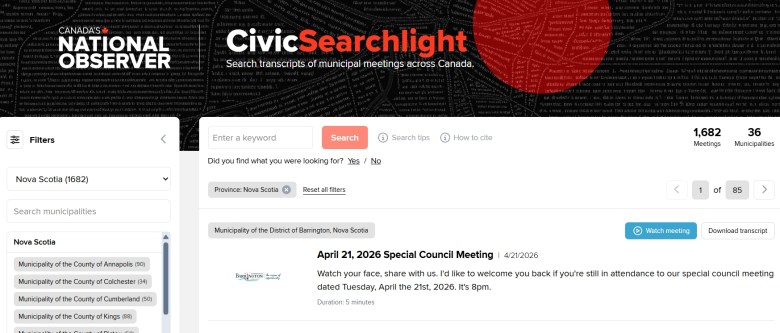
Yesterday afternoon, I had a phone call with Jimmy Thomson, editor in chief with Canada’s National Observer. Thomson was walking me through the Civic Searchlight, a research tool the Observer launched last year.
Civic Searchlight was created by Rory White, a technology and democracy reporter with Canada’s National Observer. Civic Searchlight allows journalists to search the transcripts of public meetings from hundreds of municipalities across Canada for free. For his work, White was nominated in the Innovation in Journalism category of the National Newspaper Awards.
I plan on using Civic Searchlight to learn more about story ideas and issues I’m hearing through my interviews with Nova Scotia mayors.
Since many communities have lost their local newspapers, there are not nearly as many reporters keeping track of what’s happening with local councils (Facebook doesn’t count). Many communities share similar concerns, particularly around the impacts of climate change on their towns and municipalities.
Certainly, there needs to be accountability for local elected officials, but also some mayors have told me they feel cut off from what’s happening at Province House in Halifax.
I like combining this kind of tech with good old-fashioned conversations with people, plus a good dose of curiosity and grit.
Of course, I’m only one person and there’s no way I can cover everything happening in every municipality. However, I hope I can use Civic Searchlight to dig deeper into some stories that I already have in mind.
(Send this item: right click and copy this link)
3. Jane’s Walks Halifax
 A song sparrow rests on a shrub in the Halifax Public Gardens in July 2024. Credit: Suzanne Rent
Jane’s Walk Halifax has posted its schedule of walks in the Halifax Regional Municipality (HRM) for May 1 to 3.
Jane’s Walks are free and community-led walking conversations held in communities around the world each spring. The festival is inspired by Jane Jacobs, an urban writer and activist and champion of thriving cities.
This year’s festival in Halifax has a really interesting lineup of walks, including walks in the Public Gardens, the Salt Marsh Trail, and in cemeteries across HRM.
Karen McKendry with the Ecology Action Centre (EAC) is leading the Urban Feathered Friends (Bird Walk) in the Public Gardens on Sunday, May 3 at 9am. I have riding lessons that morning, otherwise you know I’d be there.
I’ve written about other Jane’s Walks, including a walk led by author and journalist Lezlie Lowe inspired by her book, Unsung: The north end outpost where women volunteers fought the Second World War.
I hope to attend at least one of these walks, so maybe I’ll see some of our readers around the city.
(Send this item: right click and copy this link)
RECENTLY IN THE HALIFAX EXAMINER:
1. More time needed to set stage for N.S. offshore wind farms, new report says
 Offshore wind turbines in Denmark. Credit: lange x/Pexels
Jennifer Henderson reports:
A new report released by the federal-provincial body responsible for regulating the development of oil, gas, and wind resources off the coast of Nova Scotia reveals many key decisions must be made before proceeding with a call for bids to kickstart the country’s first offshore wind farms.
While Prime Minister Mark Carney and Premier Tim Houston are eager to get going on ‘Wind West’ — a proposed $60 billion megaproject to develop 5 gigawatts of offshore renewable energy that could be sold in Canada and the United States — the report from the Canada Nova Scotia Offshore Energy Regulator (CNSOER) says the process shouldn’t proceed without first nailing down a definition for co-existence among fishermen, First Nations, and wind development corporations.
These are competing interests when it comes to sharing the ocean, and on that point there is consensus, as well as the need for clear criteria on how multi-million dollar bids will be evaluated.
In her story, Henderson gets into details of the “What We Heard” report, including who offered feedback, where the new wind farms will be placed, costs and benefits, and compensation for fisheries.
Click or tap here to read “More time needed to set stage for N.S. offshore wind farms, new report says.”
(Send this item: right click and copy this link)
2. Province launches new skilled trades strategy for African Nova Scotians despite previous budget cuts
 (From left to right) Akeel Sterling, Ashley Hill, Minister of African Nova Scotian Affairs, Twila Grosse, Minister of Labour, Skills and Immigration, Nolan Young, Amberina Beals, and Karen Provo at The African Nova Scotian Skilled Trades Strategy announcement on April 21, 2026.
Marielle Godfrey reports:
The province is allocating funds to a new strategy aimed at recruiting and supporting African Nova Scotian youth in the skilled trades by partnering with The PREP Academy to deliver training and mentorship.
Announced Tuesday in Dartmouth, the African Nova Scotian Skilled Trades Strategy will be supported by $480,000 over two years. The initiative is a collaboration between the provincial government, The PREP Academy, and the Nova Scotia Apprenticeship Agency. It is designed to strengthen the workforce by supporting more African Nova Scotians wanting to enter trades careers.
“Today is really about what becomes possible when we work together with intention,” said Ashley Hill, founder and executive director of The PREP Academy.
The announcement took place at The PREP Academy, a non-profit group that prepares African Nova Scotian high school students for university, college, or other possible post-secondary routes.
Click or tap here to read “Province launches new skilled trades strategy for African Nova Scotians despite previous budget cuts.”
(Send this item: right click and copy this link)
IN OTHER NEWS
1. Lionel Desmond inquiry
 Shanna and Lionel Desmond with their daughter Aaliyah in a photo from the Shanna Desmond’s Facebook page.
Lyndsay Armstrong at The Canadian Press has this story about progress on the recommendations from the Lionel Desmond Inquiry.
Desmond was an infantryman who shot and killed his wife, Shanna, their daughter, Aaliyah, his mother, Brenda, and then himself in their home in Upper Big Tracadie on Jan. 3, 2017.
Armstrong reports:
Opposition parties say government owes it to Nova Scotians to be more transparent on its progress in implementing recommendations from an inquiry into a former soldier who killed his family and himself in 2017.
They made the comments Tuesday after a veterans affairs committee meeting that looked into the government’s progress following the inquiry into the Lionel Desmond tragedy. In January 2024, the inquiry issued 25 recommendations including for the province to improve health access for Black Nova Scotians and ramp up funding to address intimate-partner violence.
A government-run website aimed at tracking progress on this work launched this past January and says efforts are underway on 12 of the 25 recommendations. But Kim Stewart, associate deputy minister of the Department of Mental Health, told the committee that the government is actually working to address all 25.
Opposition members say this isn’t enough.
Armstrong writes that NDP’s African Nova Scotian affairs critic Suzy Hansen said that the Houston government needs to show the progress that’s being made on the recommendations. Interim Liberal Leader Iain Rankin said the model that’s being used to track progress on the recommendations is insufficient.
(Send this item: right click and copy this link)
2. Women mayors changing how people get around cities
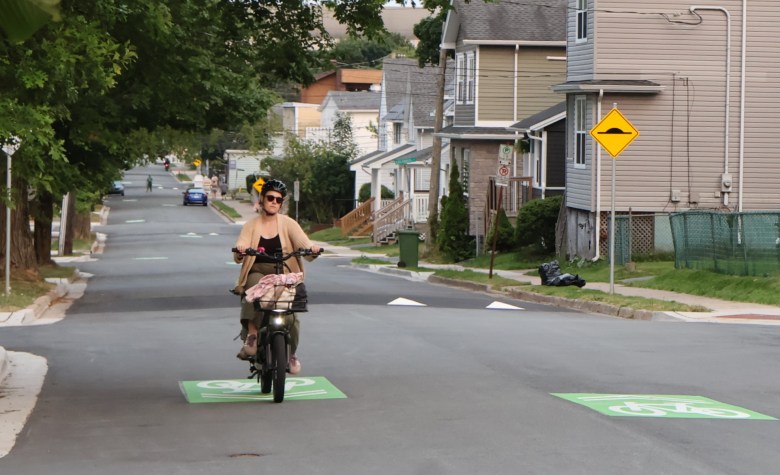 A woman rides her bike down Isleville Street in Halifax on Aug. 4, 2025. Two young children are in seats on the back of the bike but can’t be seen in this photo. Credit: Suzanne Rent
Melissa Bruntlett and Chris Bruntlett have this story in The Guardian about how cities with women mayors have greater success in making transportation better for everyone.
The Bruntletts are authors of the book Women Changing Cities: Global Stories of Urban Transformation. In The Guardian article, the Bruntletts write that because of their experiences navigating the world as girls and women as well as caregivers, and because women are left out of urban planning processes, women know that the transportation status quo doesn’t work for everyone.
Here’s what they write about the work done by the women mayors in Barcelona and Montreal:
In Barcelona, during Ada Colau’s recent mayoralty, the administration reclaimed a million square metres of pedestrian space, using solutions like the “superblock”, a revelatory intervention that swaps the city’s asphalt expanses for neighbourhood plazas with paint, planters and political will. Over an eight-year period, she tripled the length of cycle lanes to 273km (170 miles), putting 90% of the population within 300 metres of at least one route. The results have been quite dramatic, with city officials citing the creation of 80 new hectares of green space, a reduction in car traffic of 50% and a cut in air pollution by 20% between 2019 and 2023.
In Montréal, Canada, Valérie Plante, who served as mayor from 2017 to 2025, rolled out the most ambitious car-free scheme on the American continent, investing C$12m (£6.5m) to pedestrianise more than 9km along 11 different commercial arteries each summer; opening the streets in front of 2,100 local businesses, and improving their bottom lines. She is also the driving force behind the city’s Réseau express vélo (Express cycling network), which, when complete, will consist of 17 routes spanning 191km of protected lanes maintained throughout the year. Alongside improving how Montréalers move and enjoy their streets, Plante’s “sponge streets” programme is helping to create permeable and absorbent surfaces to offset flooding by introducing green in place of grey asphalt.
While Halifax doesn’t have a woman mayor, we are fortunate to have women and men on council who push for better transportation options, including transit, bike lanes, and even working from home. We’re all better for it, even if some people don’t realize it now.
(Send this item: right click and copy this link)
3. Shannon Park
 Shannon Park in Dartmouth on Monday, Jan. 9, 2023. Credit: Zane Woodford
Ben Dornan at CBC has this story on 100 new units of housing being built in Shannon Park. On Tuesday the province issued this press release about the housing.
Dornan writes:
The province didn’t say when it expects the first 100 units at the former military site near the A. Murray MacKay Bridge to be move-in ready. It has not yet issued a tender for the construction work, Build Nova Scotia spokesperson Beverley Kays said.
Three hundred of the 930 units will be built on provincially owned land, according to the December announcement.
The province purchased around one hectare of land in 2025 from Canada Lands Company, a federal Crown corporation, which purchased more than 34 hectares at Shannon Park from the Department of National Defence in 2014.
The other 630 units will be built on federal land.
As for the affordability of this housing, the province said tenants will pay no more than 30% of their pre-tax income for rent.
(Send this item: right click and copy this link)
Government
City
Wednesday
Grants Committee (Wednesday, 10am, virtual) — agenda
Heritage Advisory Committee (Wednesday, 3pm, virtual) — agenda
ZURB MPSA-2025-01629- Public Open House (Wednesday, 6pm, Dartmouth) — details
Thursday
Transportation Standing Committee (Thursday, 1pm, hybrid) — agenda
Province
No events
On campus
Dalhousie
Wednesday
PhD Defence: Chemistry (Wednesday, 9:30am, virtual) — Saad Azam will present “Improving Lifetime of Lithium-ion Cells with Electrolyte Additives”
Free workshop: Make a Red Dress Pin for Red Dress Day (Wednesday, 10:30am, details)
PhD Defence: English (Wednesday, 1:30pm, hybrid) — Jay Boyes will present “Remediating Writing of the Settler nation: Stories and Histories of Gender, Race, and Indigeneity in Digital Literature about Canada”
Thursday
PhD Defence: Agriculture (Thursday, 9:30am, virtual) — Humphrey Maambo will defend “Evaluation of a Novel Spraying Mechanism Assembly for Machine Vision-based Real-time Target Application of Pesticides on Boom Sprayers”
Group Read – Reclaiming Power + Place: The Final Report (Thursday, 12pm, hybrid) — details
Physiology and Biology Seminar (Thursday, 1pm, virtual) — Amy Lee from The University of Texas at Austin presents “Non-canonical roles of Ca2+ channels in photoreceptor synapse assembly”
PhD Defence: French (Thursday, 1:30pm, virtual) — Dieudonné Toukam will defend “Traduire dans le domaine des technologies transformatrices: enjeux et difficultés, théorie et méthodologie”
Mount Saint Vincent
Hannah Epstein: Plato’s Goon Cave (Wednesday to Sunday, 12pm, MSVU Art Gallery) — until May 17
NSCAD
Wednesday
No events
Thursday
2026 Student Art Award Gala (Thursday, 6:30pm, Anna Leonowens Gallery) — reception and award ceremony
In the harbour
Halifax
05:30: Tannhauser, car carrier, arrives at Autoport from Southampton, England
08:00: James Cook, research/survey vessel, sails from BIO for sea
10:00: US submarine sails from Shearwater
10:00: Oceanex Sanderling, ro-ro container, arrives at Fairview Cove from St. John’s
11:00: Vistula Maersk, container ship, arrives at Pier 42 from Montréal
13:00: Tannhauser sails for Baltimore
15:00: Contship Cup, container ship, arrives at Fairview Cove from New York
15:00: Atlantic Sun, container ship, arrives at Fairview Cove from Liverpool, England
16:30: Oceanex Sanderling moves to Autoport
21:45: Vistula Maersk sails for Antwerp, Belgium
22:30: Atlantic Sun sails for New York
Cape Breton
12:00: Niagara Spirit, barge, sails from Sydport for sea
16:30: SFL Trinity, oil tanker, sails from EverWind for New York
17:30: Dolphin Pearl, oil tanker, arrives at EverWind from Bejaia, Algeria
Footnotes
I want to share a very proud Aunt Suzanne moment: My niece Madison Arsenault is one of the “city’s most promising and proven” stand-up talents chosen for the Just for Laughs Comedy Showcase presented by Halifax Live Comedy Club.
Madison and other local comedians are competing for a spot at the Just for Laughs Festival, which takes place in Montreal this summer. The showcase is on Friday night and you can learn more here.
Good luck to everyone! We all need a good laugh these days.