
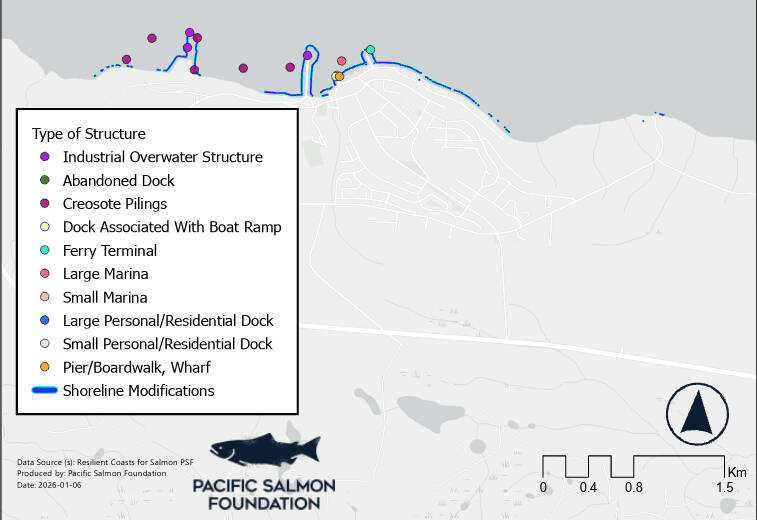
New research shows high levels of shoreline modifications in communities on Vancouver Island’s east coast
Published 1:30 am Saturday, April 25, 2026
The Pacific Salmon Foundation (PSF) found that decades of coastal development have altered approximately 35 per cent of nearshore habitats critical for juvenile salmon and other coastal wildlife on a large portion of the east coast of Vancouver Island.
Between 2022 and 2025, PSF mapped the coastline from Victoria to Campbell River including the town of Port McNeill, in a small 16-foot boat called Wilbur. The vessel recorded high-resolution imagery before researchers digitized the structures they captured into the first publicly accessible interactive shoreline map of its kind.
Researchers found shoreline modification in Vancouver Island’s largest coastal cities was significant. These modifications include marinas, vehicle bridges, breakwaters, boardwalks and seawalls.
“The east coast of Vancouver Island is a vital corridor for fish habitat and a nutrient powerhouse for other species in the Salish Sea, but much of its shoreline is now modified with unnatural structures,” says Kyla Sheehan, project manager of PSF’s Resilient Coasts for Salmon project.
These structures, according to the PSF, while often built to protect shoreline infrastructure, can make erosion worse by redirecting wave energy to nearby areas and contribute to coastal squeeze. This squeeze is a phenomenon where habitat can be lost over time when the shoreline is not able to adapt to changing sea level. This can also threaten key spawning and rearing habitat for forage fish.
Sheehan says research shows that human-made structures like seawalls and excessive log buildup can disrupt natural coastal processes, degrade habitat quality and impact species that rely on nearshore environments, including Pacific salmon.
“These findings highlight the importance of prioritizing shoreline health as Vancouver Island’s population grows and coastal development increases,” she noted.
In the spring, juvenile Pacific salmon rely on nearshore areas for shelter and food as they adjust to the ocean after exiting river systems up and down Vancouver Island. Healthy shorelines are also essential for the survival of other species, such as Pacific herring, Pacific sand lance, and surf smelt.
Data shows that shoreline modification varies significantly by community. Campbell River and Port McNeill came in highest at 69 and 60 per cent respectively, while the Comox Valley Regional District sat at 47 per cent. Down Island numbers were lower with Victoria and Esquimalt urban waterfront area at 46 per cent and Nanaimo at 30 per cent.
The PSF map also measures log accumulation along the coast. Logs that escape from log booms can scour beaches and smother vegetation, damaging coastal ecosystems and salmon habitat.
For example, in Nanaimo, 30 per cent of the shoreline was found to have moderate to extreme log accumulation. In March 2026, Mosaic Forest Management lost 19 log bundles in the Parksville-Qualicum Beach area at Rathtrevor Beach and at Madrona Point as well as a bundle on Stories Beach in Campbell River.
Stories Beach residents were concerned the logs may obstruct the mouth of Woods Creek, a nearby salmon-bearing waterway. Their concerns are well founded given that the PSF reported that a combined 21.7 per cent of the Campbell River shoreline had a high or extreme accumulation of logs, with an additional 21.4 per cent having a moderate accumulation of logs.
In Port McNeill it was reported that 55.8 per cent of the shoreline had a low accumulation of logs, with 20.2 per cent moderate accumulation of logs and 4.1 per cent high.
The Comox Valley Regional District has begun restoration work to mitigate these impacts of coastal development. This summer Dyke Road Park will be unveiled. Various partners worked to remove hard armouring and concrete structures to reduce erosion and flood risk along the coastline. A new tidal channel promises to provide refuge for juvenile salmon.
Visit PSF’s Resilient Coasts for Salmon Atlas to explore coastal modification on Vancouver Island. View information on specific Island communities including Victoria, Nanaimo, Comox, Campbell River, and Port McNeill visit the Pacific Salmon Foundation project site.