
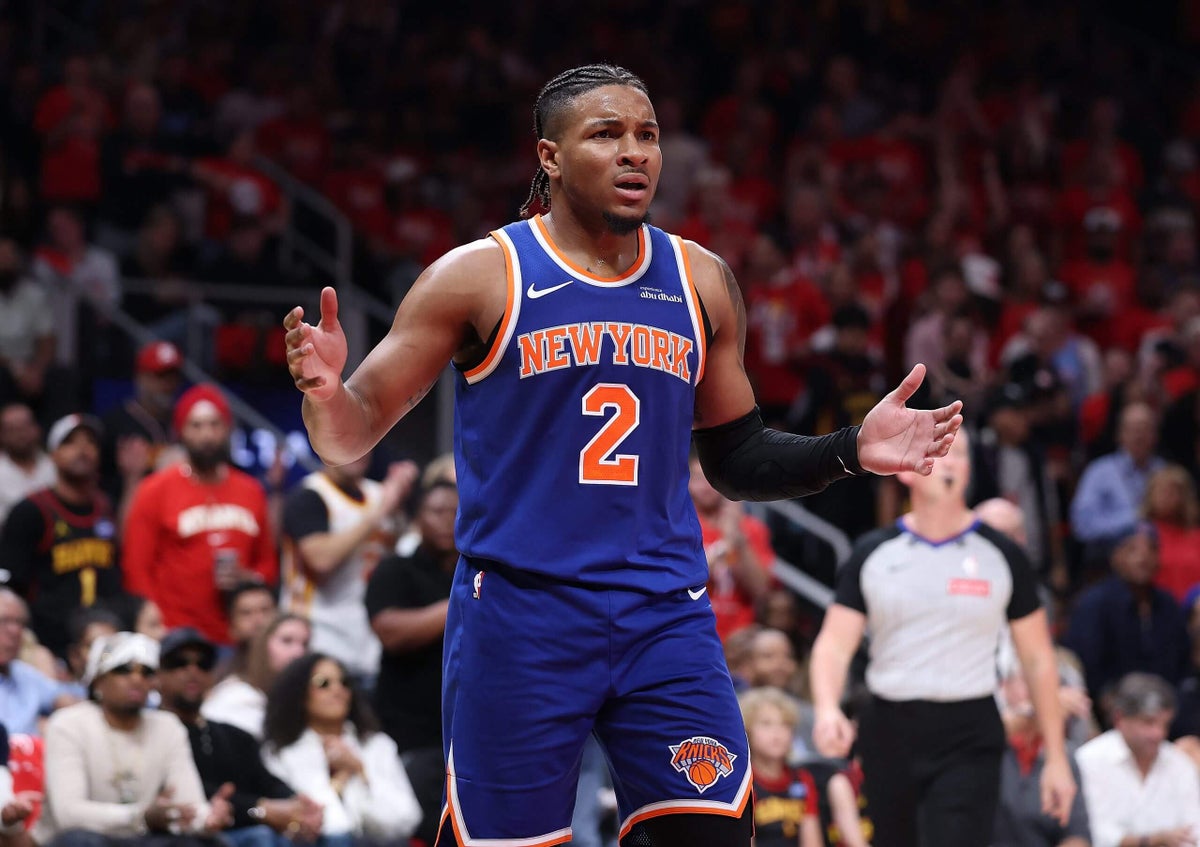
ATLANTA — Less than a year ago, the New York Knicks changed head coaches because, right or wrong, they deemed Tom Thibodeau, the man at the helm, too slow to react. He maintained the same starting lineup all season, despite its consistent struggles, until finally adjusting the first unit when it was too late, down 2-0 in a playoff series that ended the Knicks’ push for a title.
The next coach would be more “collaborative,” more willing to experiment with lineups, team sources told various media outlets, including The Athletic, at the time of his hire. The goal? Never having to experience such a saga again.
Never needing to dust off a bench guy without any idea what he could provide. Never showing up to a playoff series unaware of their best combinations. The only way such troubles could re-emerge would be if they played the same starting lineup for another entire season, and if the numbers on that unit (comprising Jalen Brunson, Mikal Bridges, Josh Hart, OG Anunoby and Karl-Anthony Towns) turned out to be even less flattering the second time around.
The Knicks can thank the mighty heavens they never have to waste brain energy on such a preventable complication.
Could you imagine if the same routine occurred again for a second consecutive spring? Could you imagine, in some other universe where the most ironic outcome always comes true, if the new coach went the same route as the former one did? Even richer, could you imagine if they encountered first-unit difficulties that were even more dire during an even earlier round of the playoffs? Or if they somehow trailed in that series and were missing data on any other realistic fivesome to try?
Imagine the distress, the anxiety, the uncertainty, the junk they’d have to throw at walls that would stick with the paste of a moist towelette, if they hadn’t toggled around with lineups all season; if they hadn’t gotten a look at Miles McBride spliced in for each of the three starting wings, just to get an idea of what it might look like; if they hadn’t given all those double-big lineups with Towns and Mitchell Robinson but without Hart, thus keeping only one non-spacer on the court, ample time during the regular season. Any change that happened would come while closing their eyes and hoping for the best.
To those who say collaboration is just a fancy word for “When we tell you what to do, you listen,” guffaw. Guffaw to you all.
Now, the Knicks are cooking in their Eastern Conference first-round series against the Atlanta Hawks, because they took 82 games to learn the best groups to start and the best ones to close, to nail down that they can’t scrounge up offense unless at least one of Towns or Brunson is on the court.
Unlike last year, there are no questions about the starting unit. No one, certainly not head coach Mike Brown, said the starting lineup would be a “game-time decision” for a pivotal Game 4. There are no questions about Bridges, who started the season as an improved facilitator and continued to rise. With new leadership, Bridges would never go scoreless in a playoff game. He would never have an assist-to-turnover ratio that looked like it was ripped from the Fibonacci sequence.
Even if that were the case in this mythical land of irony, the Knicks would know where to go next.
They spent all season compiling evidence that McBride could run in the place of Bridges, as he did so well in Game 3 against the Hawks. Get this: Despite an injury that cost McBride half of his season, the Knicks still managed to place him alongside Brunson, Anunoby, Hart and Towns for — you won’t believe it — 28 non-garbage time possessions, according to Cleaning the Glass. Twenty-eight possessions! That’s approximately one quarter of a basketball game. How they found the time to use that crew together so much will be studied in textbooks years from now.
They don’t have to worry about how bringing Bridges, a career-long starter, off the bench would affect his mentality. They don’t need to concern themselves with the politics of potentially sitting someone for whom the front office traded five first-round picks and a first-round swap. The point of experimentation isn’t the experiment itself. It’s to gather the results of those experiments and then learn from them.
It’s why the Knicks had no choice but to make a gutsy move last season, when they rushed to their first conference finals since 2000. If they hadn’t, then they may have found themselves in the same situation again.