
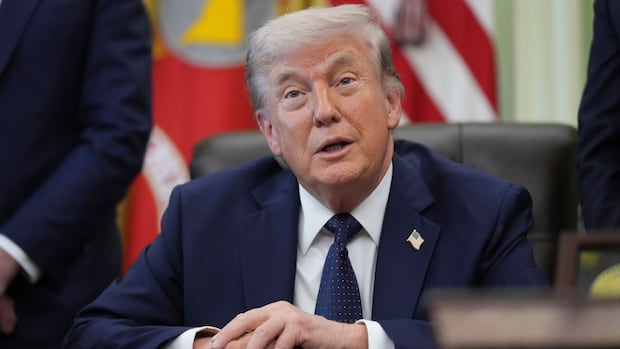
The latest ceasefire talks between the United States and Iran appeared to fail before they began, as Tehran’s top diplomat left Pakistan on Saturday and U.S. President Donald Trump soon afterward said he had told envoys not to travel to Islamabad.
The negotiations were meant to follow historic face-to-face talks earlier this month between the U.S. — led by Vice-President JD Vance — and Iran, led by parliament speaker Mohammad Bagher Ghalibaf.
But Iranian officials have questioned how they can trust the U.S. after its forces started blockading Iranian ports in response to Tehran’s grip on the Strait of Hormuz.
In announcing his decision Saturday to not send envoys to Pakistan, Trump said on social media: “If they [Iran] want to talk, all they have to do is call!!!”
“Too much time wasted on traveling, too much work!” he added.
The White House had said Friday that Steve Witkoff and Jared Kushner would be going to Islamabad.
Iranian Foreign Affairs Minister Abbas Araghchi left Pakistan on Saturday evening, two Pakistani officials told The Associated Press, speaking on condition of anonymity because they were not authorized to talk to the media.
“Shared Iran’s position concerning workable framework to permanently end the war on Iran. Have yet to see if the U.S. is truly serious about diplomacy,” Araghchi later said on social media.
Another ceasefire, between Israel and the Iranian-backed Hezbollah, was shaken Saturday as each side fired at the other and Israeli Prime Minister Benjamin Netanyahu ordered the military to “vigorously attack Hezbollah targets in Lebanon.”
WATCH | Iran slams previous peace talks with U.S. as ‘hypocritical’: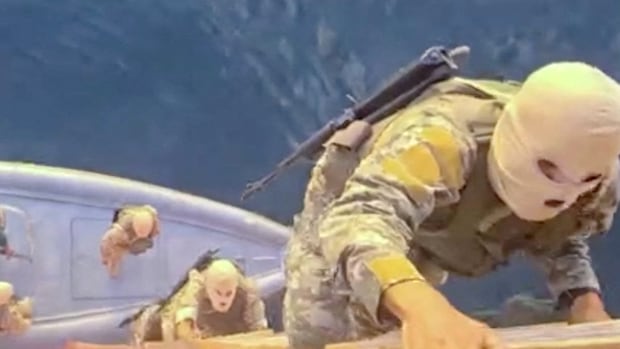
Iran seizes ships, slams ‘hypocritical’ and ‘empty’ peace talks
Iran seized two container ships after firing on three vessels in the Strait of Hormuz on Wednesday. Iranian officials also slammed now-stalled peace talks with the U.S. as ‘hypocritical’ and ’empty.’Iran had said talks will be indirect
Trump this week announced an indefinite extension of the ceasefire with Iran. It has paused most fighting, but the economic fallout is growing two months into the war as global shipments of oil, liquefied natural gas, fertilizer and other supplies are disrupted by the near-closure of the Strait of Hormuz.
Both sides have continued to make military threats. Iran’s joint military command on Saturday warned that “if the U.S. continues its aggressive military actions, including naval blockades, banditry, and piracy” it will face a “strong response.”
Even before Saturday’s developments, Iran’s foreign ministry said any talks would be indirect and that Pakistani officials would convey messages. In Pakistan, Araghchi met with Army Chief Field Marshal Asim Munir and Prime Minister Shehbaz Sharif about what he called Iran’s red lines for negotiations.
Araghchi went on to Oman, a mediator in talks before the war and the country on the other side of the Strait of Hormuz. The foreign minister will visit Pakistan again on Sunday before visiting Russia, the state-run IRNA news agency reported.
Trump later told journalists that within 10 minutes of him cancelling the envoys’ trip to Pakistan, Iran sent a “much better” proposal, with no details. He stressed that one of his conditions is that Iran “will not have a nuclear weapon.”
The fact that the White House opted to send Kushner and Witkoff instead of Vance or Secretary of State Marco Rubio suggests the U.S. “maybe didn’t have a lot of high hopes for this particular negotiation, said Bryan Clark, a senior fellow for the Hudson Institute in Washington and expert on war gaming.
“It seemed like they were looking to just kind of make sure that they had done the due diligence of having somebody signed up to go, not expecting that to really turn into anything substantial,” he said in an interview with CBC News.
Contentious points in talks include Iran’s enriched uranium and the standoff on the Strait of Hormuz as well as concerns about Iran’s missile program and its support for armed proxies in the region.
WATCH | Roadblocks to ending war in Iran:
Why the U.S. and Iran can’t reach a peace deal | About That
Andrew Chang explains what’s keeping the U.S. and Iran from reaching a peace agreement following six weeks of ongoing war and a recent marathon negotiating session in Pakistan.
Images provided by The Canadian Press, Reuters, Adobe Stock and Getty Images
Clark said the U.S. attempts to play hardball likely won’t go very far towards reaching a deal.
“I think what the Iranians are looking at is they actually do have the cards. They’ve managed to close off the strait. They’ve put a chokehold on the world economy. They’ve prepared for the potential of doing this for a long time,” he said.
“And they are just making the bet that the U.S. doesn’t have the same staying power because there’s a lot of political pressure on the president … from pretty much the entire international community that depends on the Strait of Hormuz operating as per usual.”
Tehran has noted that indirect talks with the U.S. last year and early this year over its nuclear program, the issue long at the center of tensions, ended with Iran being attacked by the U.S. and Israel, adding to its wariness.
Standoff over Strait of Hormuz continues
The price of Brent crude oil, the international standard, is still nearly 50 per cent higher than when the war began, because of Iran’s grip on the Strait of Hormuz, a strategic waterway through which a fifth of the world’s oil passes in peacetime.
Iran attacked three ships this week, while the U.S. maintains a blockade on Iranian ports. Trump has ordered the military to “shoot and kill” small boats that could be placing mines.
WATCH | Strait of Hormuz chokehold creating ‘biggest energy security threat in history’: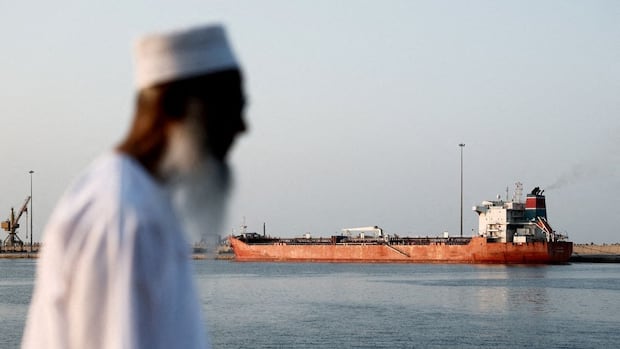
How Strait of Hormuz shutdown caused history’s biggest oil crisis
The effective shutdown of traffic through the Strait of Hormuz has caused the ‘biggest energy security threat in history,’ says Fatih Birol, executive director of the International Energy Agency. Ryan Cummings of the Stanford Institute for Economy Policymaking says the closure so far is the equivalent of a billion barrels of oil missing from the economy.
German Defence Minister Boris Pistorius said Saturday his country is sending minesweeper ships to the Mediterranean to help remove Iranian mines from the Strait of Hormuz once hostilities end.
The squeeze on shipments through the strait has rippled through global maritime trade, including through the Panama Canal nearly halfway around the world.
Also Saturday, Iran resumed commercial flights from Tehran’s international airport for the first time since the war began with U.S. and Israeli strikes two months ago.
Flights were scheduled to depart for Istanbul, Oman’s capital of Muscat and the Saudi city of Medina, according to Iran’s state-run television. Iran partly reopened its airspace earlier this month due to the ceasefire.
Growing death toll even as ceasefires hold
Since the war began, at least 3,375 people have been killed in Iran and more than 2,490 people in Lebanon, where new fighting between Israel and the Iran-backed militant group Hezbollah broke out two days after the war started, according to authorities.
Additionally, 23 people have been killed in Israel and more than a dozen in Gulf Arab states. Fifteen Israeli soldiers in Lebanon and 13 U.S. service members throughout the region have been killed.
Trump announced Thursday that Israel and Lebanon had agreed to extend a ceasefire by three weeks. Hezbollah has not participated in the Washington-brokered diplomacy.
But Israel struck southern Lebanon on Saturday, killing at least six people it said were Hezbollah militants, and several rockets and drones were launched at Israel from Lebanon.
Additionally, 23 people have been killed in Israel and more than a dozen in Gulf Arab states. Fifteen Israeli soldiers in Lebanon, 13 U.S. service members in the region and six members of the U.N. peacekeeping force in southern Lebanon have been killed.