
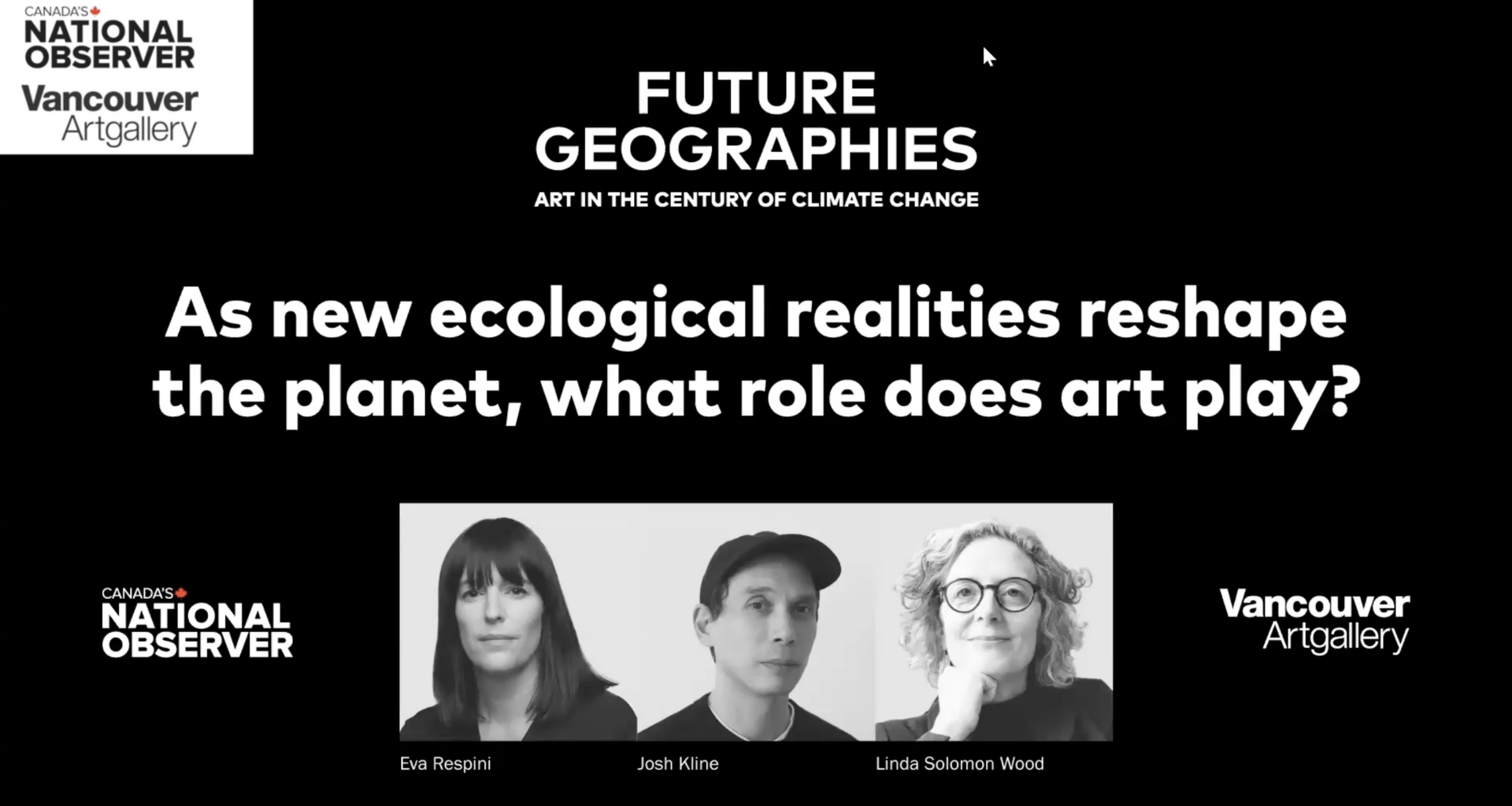
A few years back, Linda Solomon Wood stepped into a New York climate art show where visuals of the warming world hit her harder than any news story.
“I was so moved by the images, and by the power of what art can do that is different than what journalism does,” she said April 22 on Earth Day during a live online conversation between the Vancouver Art Gallery and Canada’s National Observer.
“And yet, as a journalist covering climate change, it had a lot of meaning to me.”
It led Solomon Wood, the publisher and founder of Canada’s National Observer, to connect with Eva Respini, the Vancouver Art Gallery’s interim co-CEO and curator at large.
Together, they created “Future Geographies: Art in the Century of Climate Change,” an exhibition opening May 10 and featuring more than 35 artists from around the world.
Respini said she didn’t begin with a rigid theme but knew she wanted to avoid a doom-and-gloom approach. She noticed artists across the globe already exploring the climate questions in both poetic and less didactic ways.
“Artists are not scientists,” she said. “They’re not journalists, but they do ask questions that can promote a kind of shared understanding [and] can promote some creative solutions to how we might imagine our shared future on this planet.”
Among the featured works, she pointed to Canadian photographer Ed Burtynsky’s work, which captures humanity’s massive ecological footprint through sweeping images of quarries and abandoned industrial sites. She also highlighted Pakistani artist Huma Bhabha’s cork sculpture, a sci‑fi‑like figure that blurs the line between ancient relic and futuristic survivor, and Korean‑American artist Jean Shin’s installation, a garden made entirely of outdated 1990s cell phones that transforms electronic waste into a reflective landscape.
The exhibition’s title, “Future Geographies,” draws directly from Brazilian artist Clarissa Tossin’s “Future Geography Cosmic Cliffs,” a weaving of NASA images of distant star clusters with discarded Amazon delivery boxes. Respini described the work as “the ubiquitous emblem of global consumption and environmental impact.”
New York artist Josh Kline also joined the Earth Day conversation to discuss his contribution. His sculpture, Desperation, is a makeshift raft that also works as a camping tent. He said these tents are often used as temporary shelters by unhoused people, especially on the US West Coast, and symbolize desperate circumstances like losing your home or becoming a refugee.
Scientists and policy experts predict at least one foot of sea-level rise by 2050, which could flood low-lying cities like New York, San Francisco and possibly Vancouver without major protections like seawalls. Kline said climate change will force large numbers of people to move inland and across borders, putting climate refugees at the center of the future.
Solomon Wood said Kline’s work made her think about art’s power to raise societal challenges to a mythic, universal level, “almost in the way that literature and science fiction does.”
Kline drew inspiration for “Desperation” from Kim Stanley Robinson’s novels, which even in the 1990s depicted a flooded Earth, and from his personal experience living through Hurricane Sandy in 2012. Both he and Respini were in New York at that time and endured Lower Manhattan’s two-week blackout, which “almost felt like … a kind of trailer or a preview for the climate crisis,” he said.
Survivor accounts have directly shaped his work, from Hurricane Sandy to Hurricane Katrina in New Orleans and Hurricane Harvey in Houston, along with stories from those affected by West Coast wildfires, the fires in Australia and Greece and refugees fleeing the war in Ukraine.
Respini pointed to BC artists’ works, including Lawrence Paul Yuxweluptun’s history paintings of Okanagan wildfires making use of Indigenous formline, Brian Yung’s whale skeleton assembled from 500 plastic chairs like those at Home Depot or Canadian Tire to critique museum waste and Cease Wyss’ dome film, narrated by herself as she walks viewers through the Squamish Nation’s ancient cedar forest sanctuary on BC’s Sunshine Coast.
“Perhaps through art, we can imagine ourselves in someone else’s shoes, a different perspective, that artists might spark different ways of thinking that perhaps haven’t occurred to us before,” Respini said.
But the exhibition isn’t solely focused on art. It also folds in journalism from Canada’s National Observer on all four of its central themes: Living Knowledge; Consumed Earth; Speculative Worlds; and Material Memory. Each of these themes draws in works of journalism — news stories, investigations, profiles and multi-part series. On a website created for the exhibition, “Ontario First Nation battles Australian-owned company over Ring of Fire mine” by John Woodside lives next to “Unbound (one way ashore, a thousand channels),” by Firelei Báez, suggesting new ways to understand both kinds of work.
The exhibit opens in May and runs in Vancouver until Jan. 10, 2027, before heading to the Art Gallery of Ontario in Toronto in March 2027.
“I hope that this is the living embodiment of how journalism can provide a bridge between art and policy and action and building towards a future that we all want to live in,” Solomon Wood said.