
By Erik Hertzberg
(Bloomberg) — The Bank of Canada is likely to hold interest rates steady as officials weigh the inflationary impact of the war in Iran against the economic damage wrought by U.S. tariffs.
Markets and economists in a Bloomberg survey expect Governor Tiff Macklem and his council to hold the benchmark interest rate at 2.25% on Wednesday. That would mark the fourth consecutive meeting at which they’ve left borrowing costs unchanged.
In March, the central bank said it would “look through” any immediate spike in inflation from the Middle East war. Officials also called the impact on Canada’s growth “highly uncertain,” and pointed to ongoing weakness in the economy.
This time around, policymakers will have to offer more clarity, in the form of a monetary policy report, on how they expect inflation and growth to evolve.
Officials have said they expect higher gasoline prices to hit inflation and near-term expectations, but they’ve also said it’s too early to assess the effects that might come later if rising price pressures become embedded. That would be more likely to prompt rate hikes from the central bank.
For now, the on-again, off-again combat and diplomacy between the US and Iran are adding to uncertainty, and the central bank is likely to hold off on any guidance on where interest rates are headed.
“There’s no urgency to really change the stance much at all,” Veronica Clark, an economist with Citigroup, said by email. “There’s nothing really in the hard data so far that would worry them.”
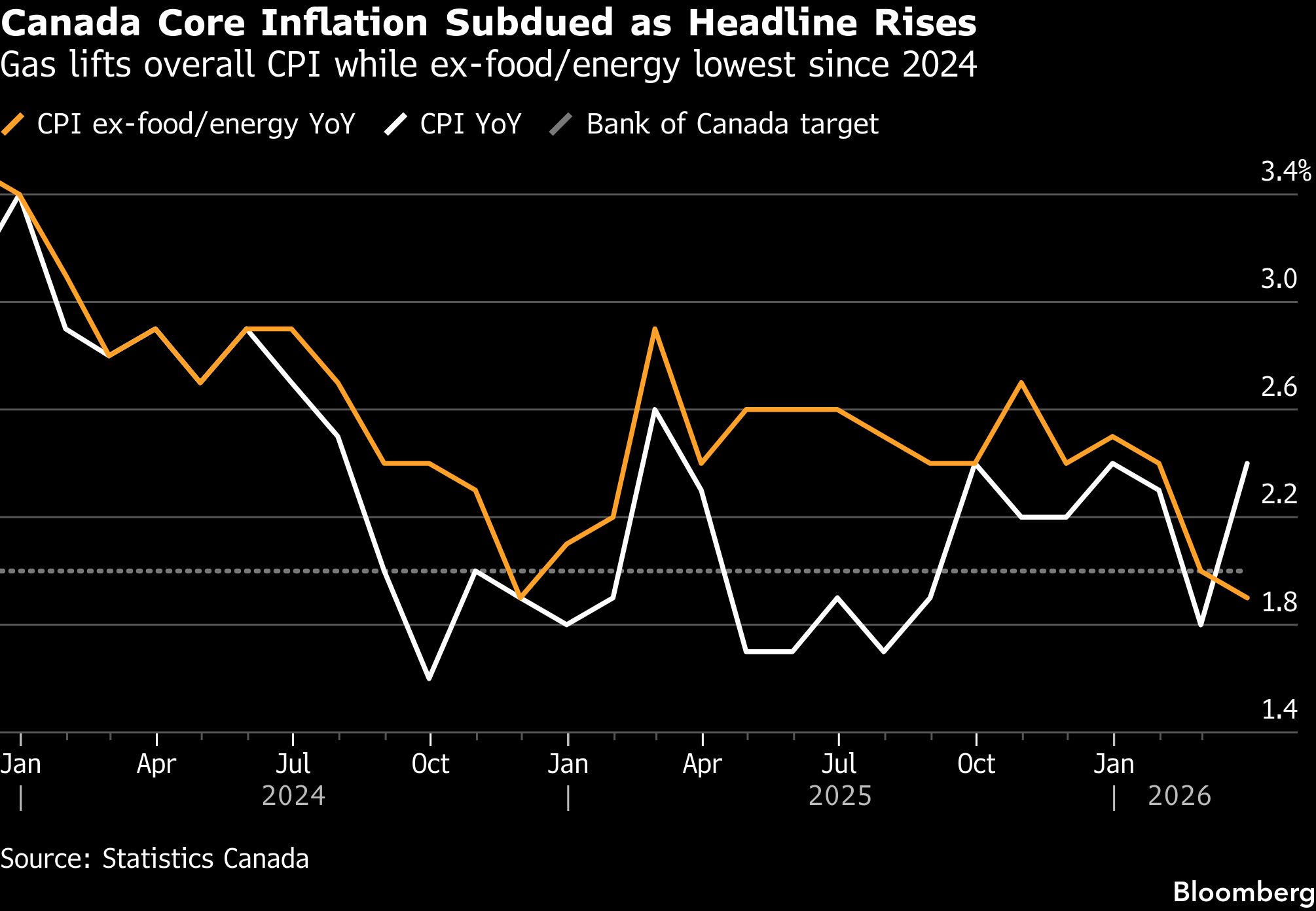
Yearly inflation accelerated to 2.4% in March, driven higher by a surge in gasoline prices. But underlying price pressures remain subdued, with inflation excluding food and energy up 1.9% from a year earlier, the slowest pace since November 2024.
“Despite the surge in gas prices, recent inflation data has been encouraging as underlying price pressures continue to cool,” National Bank Financial’s Ethan Currie and Taylor Schleich wrote in a report to investors. “For now, soft core inflation supports looking through the headline CPI spike.”
Canada’s economic growth has been choppy, due in large part to export damage from U.S. tariffs on the country’s steel, aluminum, autos and forestry sectors, but also from a slowdown in population growth. Preliminary gross domestic product data suggest the economy expanded around 1.5% in the first quarter.
In March, BOC officials were focused on excess supply and downside risks, arguing that the weakness in the economy meant the oil shock wouldn’t lead to a broader spike in prices, as happened in the aftermath of the COVID-19 pandemic.
So far, the bank has also eschewed any attempt to quantify the growth impact of higher oil prices. As a net exporter of energy, the shock hits Canada differently than other countries. There’s a potential boost to GDP from higher oil revenues, but that depends not only on how long crude prices stay elevated, but also whether the increase in profits is reinvested back into capital expenditures. Companies say that’s not yet happening.
Wednesday’s new projections aren’t likely to incorporate the latest fiscal plans from Prime Minister Mark Carney’s government. Finance Minister Francois-Philippe Champagne will publish an update on spending and revenues late Tuesday afternoon in Ottawa. Debt and related metrics are seen improving amid upward revisions to GDP and some extra revenue.
Earlier this month, the Carney government also temporarily dropped some federal excise taxes on fuel, lowering gas prices by 10 cents per liter and diesel by 4 Canadian cents. While that’s likely to help offset some of the damage to household budgets and consumption, prices at the pump remain about 40% higher than at the start of 2026.
Macklem and Senior Deputy Governor Carolyn Rogers will speak to reporters at 10:30 a.m. Ottawa time on Wednesday.
–With assistance from Mario Baker Ramirez.
©2026 Bloomberg L.P.
Visited 603 times, 603 visit(s) today
Bank of Canada Bank of Canada preview bloomberg BoC boc policy rate BoC preview BoC rate decision Dashboard Editor’s pick tiff macklem
Last modified: April 28, 2026