
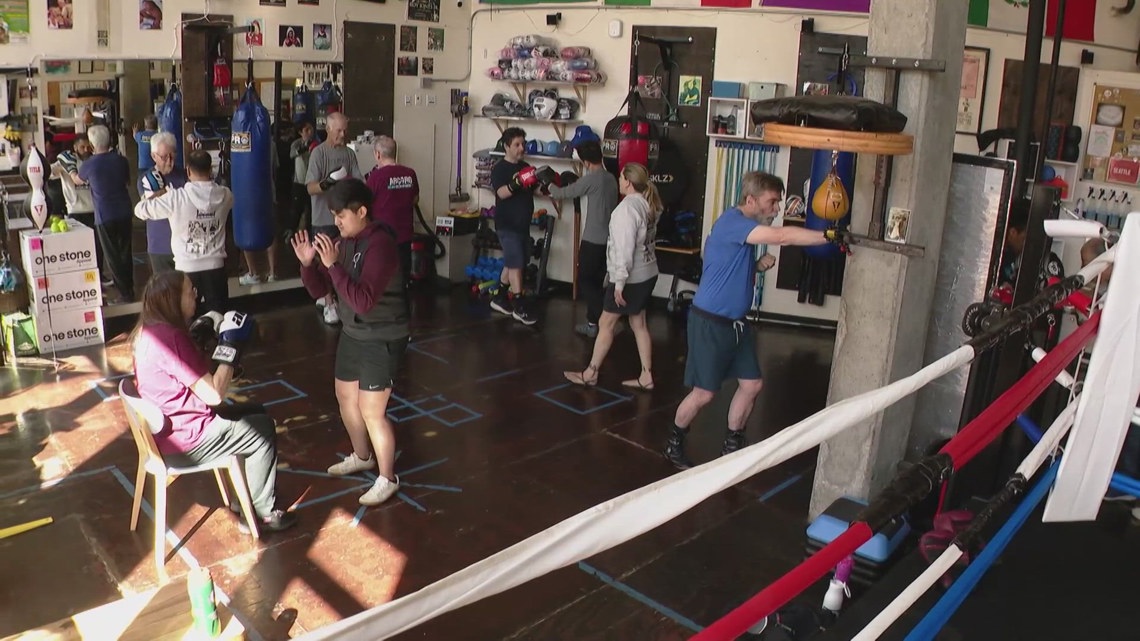
At Arcaro Boxing in Seattle, individuals with Parkinson’s disease find strength and community in a unique boxing class that helps manage symptoms and boost morale.
SEATTLE — For people living with Parkinson’s disease, the daily battle extends well beyond any single opponent. At Arcaro Boxing in the Central District, a dedicated class is helping patients push back — one punch at a time.
The KO Parkinson’s class has operated for the past decade, offering a unique blend of physical training and community support for those diagnosed with the progressive neurological disease.
Head coach Cassidy Bernaski said exercise won’t cure Parkinson’s, but it can slow its progression.
“It’s a disease where there really is no cure and there’s not necessarily anything that makes it better, but what exercise does is it helps to plateau the symptoms,” Bernaski said.
Student Sue Bay echoed that sentiment, emphasizing the importance of staying active and intentional about movement.
“The more exercise you do, the better your symptoms will be. And you sort of have to force yourself to do big movements,” Bay said.
The benefits extend beyond the physical. For Carl Carter-Schwendler, an original class member, the Central District gym has become a substitute for traditional support groups.
“So, I don’t actually go to any support groups. For me, this is my support group,” he said.
His wife, a fellow original member and supporter, Karen Carter-Schwendler said the class offers two things that are difficult to find elsewhere: specialized physical coordination training and a consistent community.
“Really there’s two things, there’s the coordination part of it because it kind of gives an exercise type that people don’t get anywhere else,” she said. “And I think the other part is just to have a community to get together with on a regular basis.”
Owner and coach Tricia Arcaro-Turton said welcoming the Parkinson’s community into the Seattle gym was an easy decision.
“It’s our passion for the sport, it’s our passion for the people, and that’s very infectious,” Arcaro-Turton said.
She added that the program is designed to be inclusive regardless of a participant’s fitness level or physical limitations.
“No matter what afflictions you’re dealing with, you can come and train,” she said. “You don’t have to be a young, fit boxer. You can be anybody and come in and work out to your ability, and everyone can do that at the same time and that’s really powerful.”
Bernaski said the program’s philosophy sets it apart from similar offerings elsewhere.
“We’re treating these people like boxers, even though they can’t get hit in the head due to their Parkinson’s,” Bernaski said. “It’s a boxing class tailored for Parkinson’s as opposed to a Parkinson’s class with a little bit of boxing.”
For the Carter-Schwendlers, the program has reshaped what they believe is possible after a Parkinson’s diagnosis.
“There are things that people with Parkinson’s can do that are maybe outside of what they thought was possible,” Karen Carter-Schwendler said.
Carl Carter-Schwendler said he hopes others hear the same message.
“It’s not a death sentence. You can still have a vibrant and dynamic life after diagnosis and that the worst that you see may not even happen,” he said.