
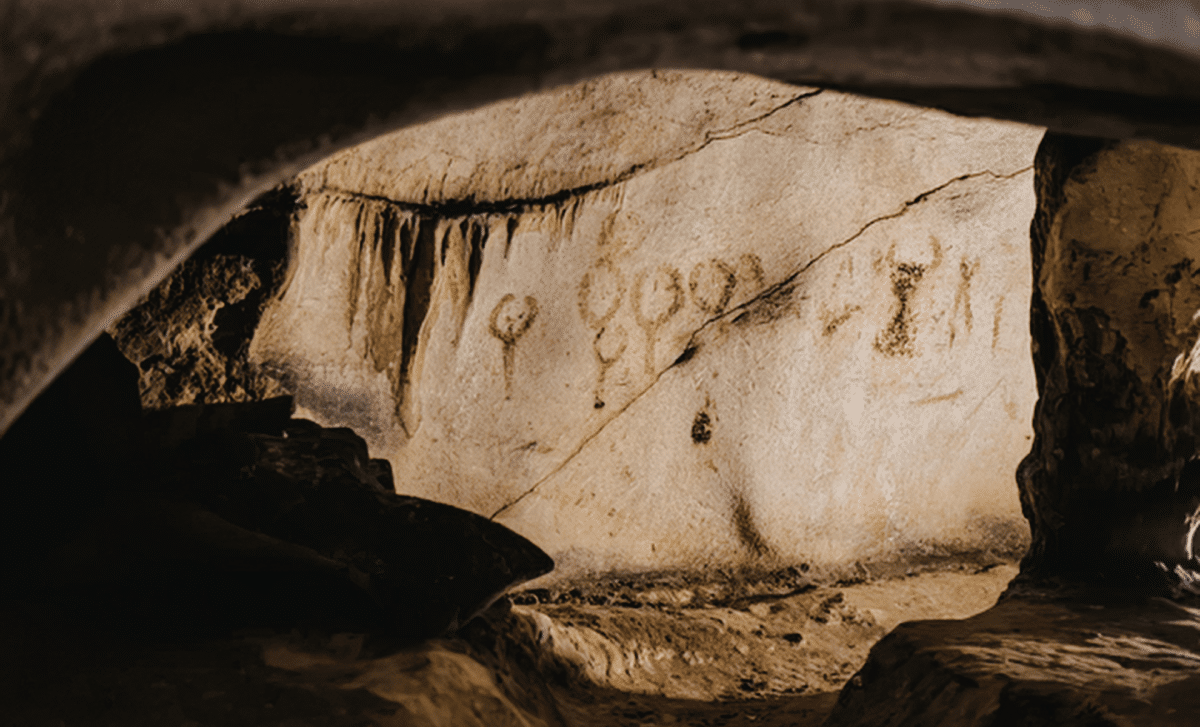
For decades, the shift from hunting and gathering to farming, often labeled the Neolithic Revolution, has been portrayed as a defining turning point in human history. Yet this transformation did not unfold as a single, uniform process. Across regions, communities adopted agriculture in different ways, raising a persistent question among archaeologists: did farming spread through migrating populations, or was it locally developed and gradually adopted? A new study published in Nature now brings fresh clarity to this debate, revealing that in North Africa’s Maghreb, the rise of farming was neither linear nor isolated, but shaped by sustained interactions between diverse human groups over thousands of years.
Ancient DNA Uncovers a Layered Human History in Morocco
The research, detailed in Nature, draws on genetic evidence recovered from human remains at three key Moroccan archaeological sites: Kaf Taht el-Ghar, Ifri n’Amr Ou Moussa, and Skhirat-Rouazi. These sites provide a rare chronological window into the transition from hunter-gatherer societies to early farming communities between roughly 5500 and 4500 BC.
At Kaf Taht el-Ghar, individuals carried ancestry linked to early European farmers who reached North Africa around 7,400 years ago. This finding points to movement across the Strait of Gibraltar far earlier than traditionally assumed. At Ifri n’Amr Ou Moussa, the picture becomes more nuanced: individuals buried there retained fully local genetic signatures even while practicing elements of farming culture, including pottery use. This indicates that indigenous hunter-gatherers were not displaced but instead adopted new techniques while maintaining their biological continuity.
The study reveals that cultural transformation did not require population replacement. Instead, local communities selectively integrated external innovations into existing ways of life, creating hybrid societies that blur the line between foraging and farming traditions.
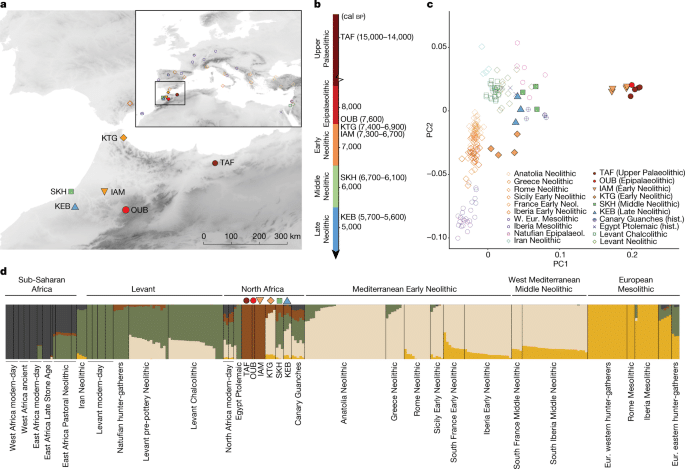 Overview of ancient northwestern African genetic composition.
a, Geographic location of investigated archaeological sites. Symbol legend given in c. The map was generated using the open source QGIS Geographic Information System, http://qgis.osgeo.org. b, Chronological representation of the investigated archaeological time periods of northwestern Africa, with each site’s radiocarbon-dated timeline indicated. c, Enlarged view of a PCA plot (Supplementary Fig. 3) with focus on the ancient individuals analysed. Each projected ancient individual is represented by a coloured symbol. W. Eur., West European; hist., historical. d, Estimated ancestry proportions for relevant African, Middle Eastern and European (Eur.) modern-day and ancient individuals (assuming five ancestry components; additional results are presented in Supplementary Fig. 4). Pre-Neolithic and Neolithic northwestern African populations/individuals are highlighted by the same symbols used in a and c.
Credit: Nature
Migration and Cultural Exchange Reshaped the Maghreb
By the time of the Skhirat-Rouazi site, roughly a millennium later, the genetic landscape had shifted again. Researchers identified ancestry connected to pastoralist groups originating from the Fertile Crescent, suggesting a westward movement of herding populations across North Africa.
This genetic evidence aligns with archaeological discoveries of new pottery styles and subsistence strategies. Rope-pattern decorated ceramics found at Skhirat-Rouazi differ sharply from earlier traditions and are closely associated with Saharan pastoralist cultures. These material changes reflect deeper demographic processes, where incoming groups introduced not only technologies but also new genetic lineages.
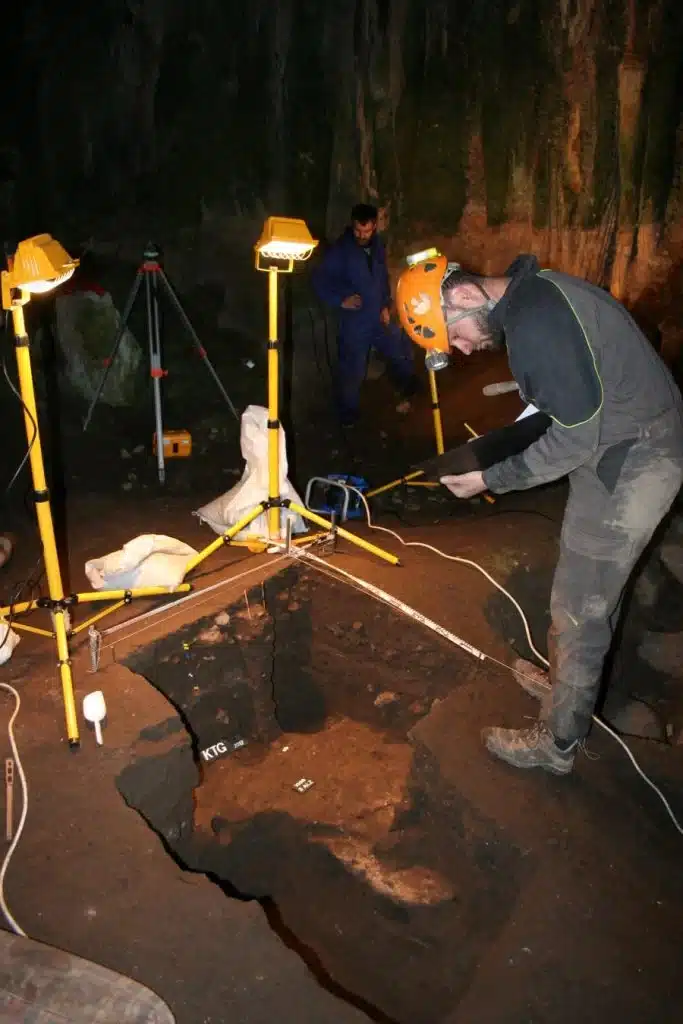 Credit: University of Cordoba
Rafael M. Martínez of the University of Córdoba said the study marks “a turning point in our understanding” of how the Neolithic spread in the region, adding that “the unidirectionality of the process now seems quite clear, probably from Iberia.” His statement underscores the growing consensus that maritime and coastal connections played a key role in shaping early North African societies.
The findings also highlight that the Maghreb was far from isolated. Instead, it functioned as a crossroads where influences from Europe, Sub-Saharan Africa, and the Near East converged, producing a deeply interconnected prehistoric world.
A Genetic Legacy That Shaped Modern North African Populations
Beyond reconstructing ancient movements, the study provides insight into the long-term formation of North African populations. According to the researchers, the genetic ancestry of later groups in the region, including the ancestors of the Imazighen (Berbers), reflects a blend of three primary sources: indigenous hunter-gatherers, European Neolithic farmers, and pastoralist groups moving westward from the Fertile Crescent through Sinai.
This tripartite ancestry model challenges earlier narratives that favored either local development or external replacement as the dominant explanation. Instead, it reveals a cumulative process in which repeated interactions over centuries gradually reshaped both culture and biology.
Complementary findings from a separate 2025 Nature study further complicate the picture. While the western Maghreb shows strong evidence of migration and admixture, eastern North Africa appears to have followed a different trajectory, with populations maintaining greater genetic continuity while still adopting selected Neolithic practices.
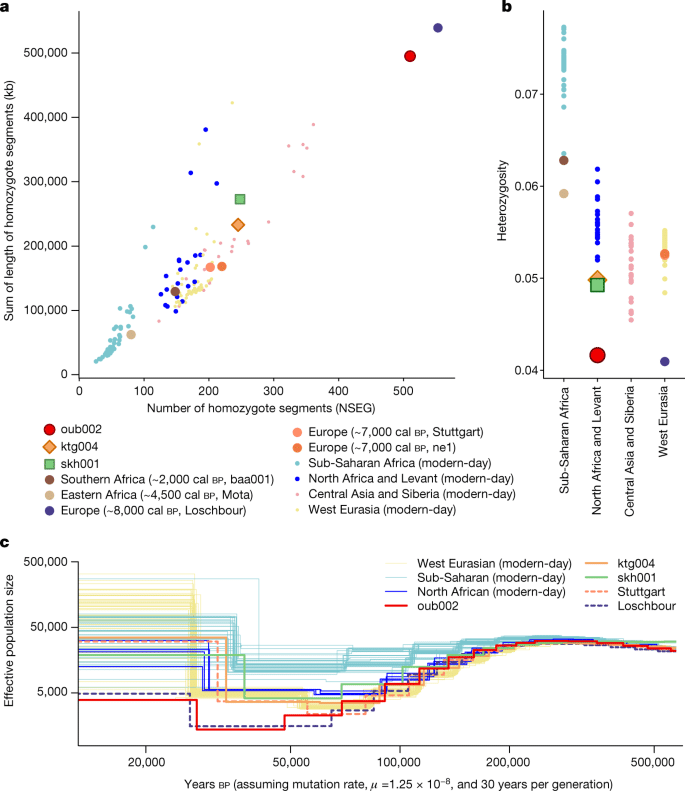 Measures of genetic diversity in ancient (northwestern and sub-Saharan) Africans and Eurasians, computed using diploid calls from higher-coverage (over ninefold genome coverage) individuals.
a–c, Ancient individuals (including oub002, ktg004 and skh001) are compared with modern-day individuals from geographically corresponding regions. a, Runs of homozygosity. ne1, Neolithic European 1; NSEG, number of homozygote segments. b, Heterozygosity, calculated from the number of variable positions per individual divided by the number of single-nucleotide polymorphism (SNP) sites per individual. c, Effective population size over time, as inferred by pairwise sequentially Markovian coalescent, for three ancient northwestern Africans with over ninefold genome coverage, as well as for a Mesolithic European individual (Loschbour) and a Neolithic European individual (Stuttgart), and modern-day individuals for comparison.
Credit: Nature
Multiple Pathways to Farming Across North Africa
Taken together, these discoveries dismantle the idea of a single “Neolithic Revolution” spreading uniformly across regions. In the Maghreb, the transition to agriculture unfolded along multiple pathways shaped by geography, mobility, and cultural exchange.
In western areas, population movements and genetic mixing played a prominent role, creating diverse communities with blended ancestries. In the east, local groups demonstrated resilience, incorporating new tools and crops without large-scale demographic disruption.
This emerging picture portrays early North Africa as a dynamic environment where innovation spread through contact rather than conquest. Farming was not simply introduced or invented; it was negotiated, adapted, and transformed by the people who adopted it.
The study ultimately reframes one of humanity’s most significant transitions as a mosaic of regional stories rather than a single sweeping event.