
Stay up to speed with stories written by drivers, for drivers.
Get automotive news, DIY tips, market trends, in-depth car profiles, and more right in your email inbox.
Formula 1 drivers and team bosses are currently under investigation by Italian authorities for tax evasion. According to reports in Italian media, the Guardia di Finanza is looking into whether the sport’s stars handled their tax affairs correctly under Italian law.
Lawyer Alessandro Mei, who filed the complaint against F1, said, “It is undisputed that athletes who earn income in Italy, even if resident abroad, must declare it in Italy and pay taxes there.”
While there are no criminal proceedings so far, “Taxgate” is just one of a long list of scandals to hit the sport for F1, from technical infringements and questionable team orders to deliberate crashes and criminal activity.
These are the dramatic F1 stories that not even Netflix could make up.
Cornergate
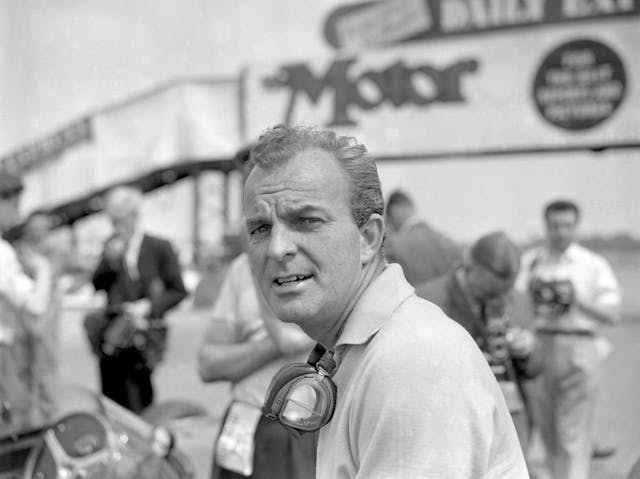 Harry Schell, circa 1959.PA Images/Getty Images
At the 1959 United States Grand Prix at Sebring, American driver Harry Schell managed to secure third place in qualifying behind his Cooper-Climax teammates Jack Brabham and Stirling Moss. He only did so by taking a massive shortcut that avoided the entire back straight and slashed some six seconds off his previous best time. Ultimately, Schell’s shenanigans had no impact on the race, as he retired six laps in with a busted clutch.
Weightgate
At the start of F1’s turbo era in 1982, the naturally aspirated cars weighed less than their boosted rivals and had to run with ballast. The cars would be put on the scales in scrutineering with all fluids on board, and that gave Brabham, Williams, and McLaren an idea. By fitting water-cooled brakes, they could start each race at the required weight and shed the water from storage tanks to run lighter. Then, before post-race inspection they could top the tanks back up. The cunning plan worked, and Brabham’s Nelson Piquet and Keke Rosberg came in first and second at the Brazilian Grand Prix. However, the turbo teams protested, and both were subsequently disqualified.
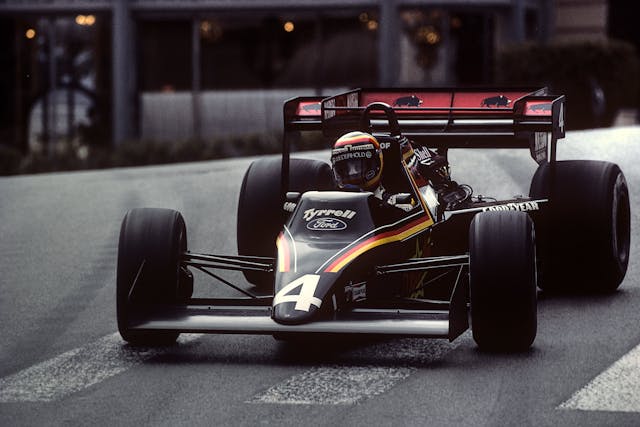 Stefan Bellof in the Tyrrell-Ford 012 during the Grand Prix of Monaco on June 3, 1984.Paul-Henri Cahier/Getty Images
In 1984, Tyrrell also aimed to make up some of its car’s power deficit by running light. Although mid-race refueling was banned, teams were permitted to top up tanks for the car’s water injection system, so Tyrrell used its final pit stops to add a mix of water and lead shot to bring its cars back up to the legal limit. What’s more, the water mix also included some added fuel for a performance boost. When these antics were discovered, the team was kicked out of the championship.
Some 40 years later, it was BAR that would find a creative way to run its cars light. Having scored points at the San Marino Grand Prix in 2005, Jenson Button’s BAR-Honda was found to be 5 kg underweight, after race stewards discovered a small secondary fuel tank and drained it. Initially, BAR won its protest at disqualification, but the FIA wouldn’t give up, proving at the International Court of Appeal that the only way the car could have run at the 600 kg limit was by using this fuel as a ballast. A two-race ban followed.
Crashgate
The idea of deliberately crashing a 200 mph race car seems insane, yet it has happened time and time again in F1—mostly thanks to one driver: Michael Schumacher. The ruthless German didn’t win seven world championships by playing nice, after all. In 1994’s season-closer at Adelaide, Australia, just one point separated Benetton’s Schumacher and Damon Hill racing for Williams. Schumacher was leading, made a mistake and clouted the wall. As Hill went for an overtake, Schumacher was having none of it and turned into him. The two cars collided, Hill was out of the race, and the title was decided. At Jerez in 1997, it was Jacques Villeneuve in the Williams who would be on the receiving end of a Schumacher shove, although this time it was the Canadian’s car that survived, and Villeneuve took his one and only F1 title. Schumacher in the Ferrari was disqualified from the whole season, but still undeterred. And in 2006, as he battled Fernando Alonso for pole at Monaco, Schumacher had the edge and then somehow locked up and parked his car at the Rascasse corner, preventing Alonso from improving. The stewards did not look kindly on this behavior and demoted Schumacher to the back of the grid.
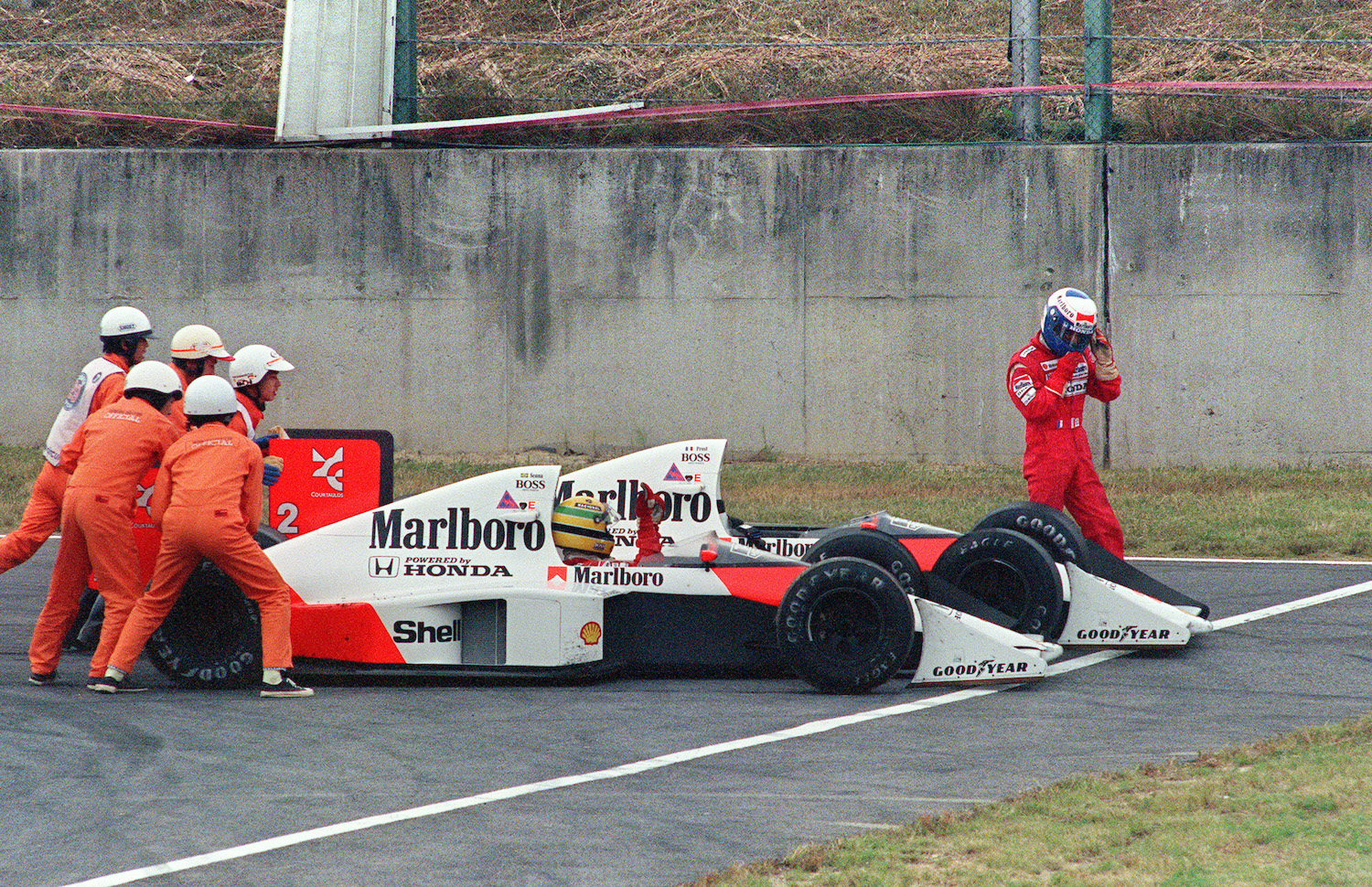
A precedent for Schumacher’s tactics may well have been set by the late, great Ayrton Senna. In Japan in 1989, Senna and his McLaren teammate Alain Prost were locked in a title fight. As Senna attempted an overtake on lap 47, Prost turned in early and the two collided. The move took out Prost, and although Senna was able to restart he was subsequently disqualified and Prost took the world championship. One year later there would be a repeat, but this time it was Senna whose move up the inside of Prost took both drivers out of the race and secured him the drivers’ title.
These tactics are dubious, but can, perhaps, be blamed on the heat of the moment. The same absolutely cannot be said for Nelson Piquet Jr’s crash at the 2008 Singapore Grand Prix. Renault team bosses Flavio Briatore and Pat Symonds calculated that Piquet’s teammate Fernando Alonso could take the lead if a safety car was deployed, so they instructed Piquet to crash into the wall at turn 17. It worked, and Alonso crossed the finish line in P1. They would have gotten away with it, too, if Renault hadn’t axed Piquet the following year, after which he spilled the beans. The team was disqualified, Symonds got a five-year ban from F1, and Briatore (now in charge at Alpine) was given an indefinite ban.
Tractiongate
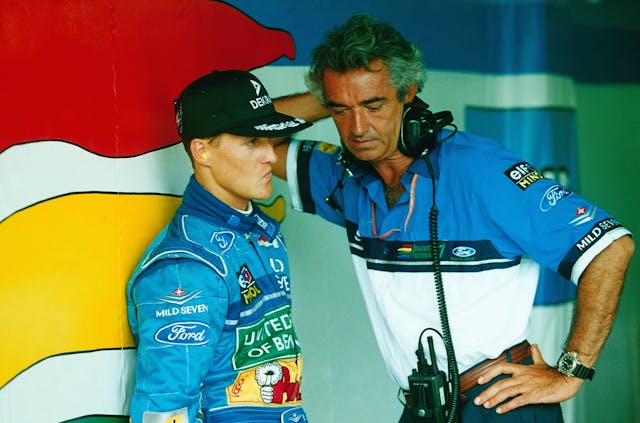 Stephan/Ullstein Bild /Getty Images
That Briatore would flagrantly breach the rules of F1 should have been no surprise as, during the 1994 season, as head of Benetton, he oversaw another regulation-bending brouhaha. A host of driver aids had just been banned, including antilock brakes, traction control, and launch control, but the Benettons continued to make suspiciously swift starts and strange noises. Along with McLaren and Ferrari, Benetton was told to hand over its software for analysis, and a launch control code, known as Option 13, was discovered. The FIA couldn’t prove definitively that it had been used in competition, and the team also escaped penalty after running its refuelling pump without a filter, blaming the rig’s supplier.
Team Ordersgate
In 2002’s Austrian Grand Prix, Ferrari ordered Rubens Barrichello to slow down and let Michael Schumacher go by, and the FIA subsequently banned teams from such behavior. So, in Germany 2010, Ferrari had to be a little less obvious in their instructions. “Fernando is faster than you. Can you confirm you understood the message?” Rob Smedly said to Felipe Massa. It was an expensive radio call, costing Ferrari a fine of $100,000.
Although the ban on team orders was subsequently removed in 2013, Red Bull had an agreement between its drivers Mark Webber and Sebastian Vettel at the Malaysian Grand Prix that whoever was ahead in the closing stages of the race would not be challenged by his teammate. The team duly told both drivers that “Multi 21” was in play, which meant that the Webber, in car 2, should remain ahead of Vettel in car 1. Vettel ignored the instructions and passed with 13 laps to go. In his autobiography, Aussie Grit: My Formula One Journey, Webber recalled, “Whatever his thinking was, when he overtook me I wasn’t so much angry as very sad that the team had reached this sorry state.”
Tiregate
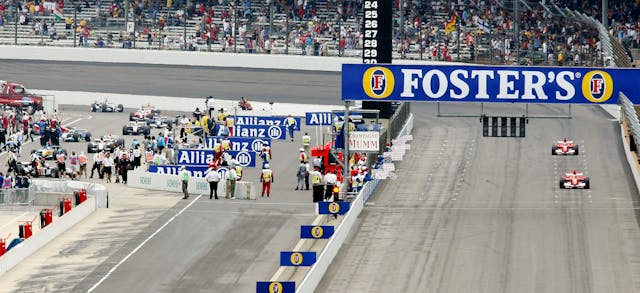 At the 2005 U.S. Grand Prix at Indianapolis, drivers with Michelin tires enter the pits after the warm-up lap, while both Ferrari cars of Michael Schumacher and Rubens Barrichello (on Bridgestones) take their places on the starting grid and prepare to race.Vladimir Rys/Bongarts/Getty Images
The 2005 United States Grand Prix is one that Formula 1 would like everyone to forget. At the time, F1 had two tire suppliers, Michelin and Bridgestone, and after two failures in practice, the French manufacturer advised that teams running its tires would have to reduce their speed significantly in turn 13—and even then the tires would only last 10 laps. Since no tire swaps were permitted that season, this was a major problem. The Michelin runners had to withdraw from the race before it even began, leaving just six cars to compete. It was an all-time record low for Indianapolis and for F1 fans.
Spygate
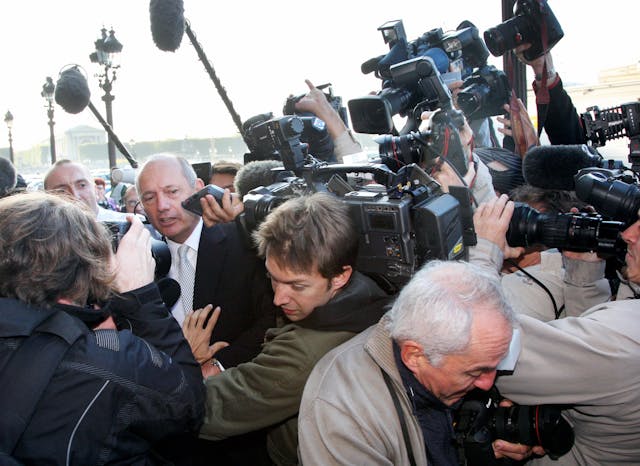 It was a chaotic scene when McLaren-Mercedes team principal Ron Dennis (in suit), arrived at the World Motor Sport Council headquarters in Paris on September 13, 2007.AFP via Getty Images
F1’s biggest case of industrial espionage was revealed in 2007. Ferrari chief mechanic Nigel Stepney was seriously disgruntled after being overlooked for promotion at the Scuderia. As revenge, he copied some 800 pages of confidential information, including the designs for Ferrari’s 2007 challenger. He gave the lot to Mike Coughlan, McLaren’s chief designer. Rather naively, Coughlan’s wife used a local copy shop to get duplicates, and the owner just happened to be a Ferrari fan. When he noticed just what was being copied, he emailed Maranello, who immediately took action. The saga didn’t end there, as during the season, Fernando Alonso fell out with McLaren boss Ron Dennis and threatened to send incriminating emails to the FIA. The case was heard in Italy and the U.K., and McLaren ended up with a $100M fine—the largest in sporting history—and expulsion from the constructors’ championship.
Jailgate
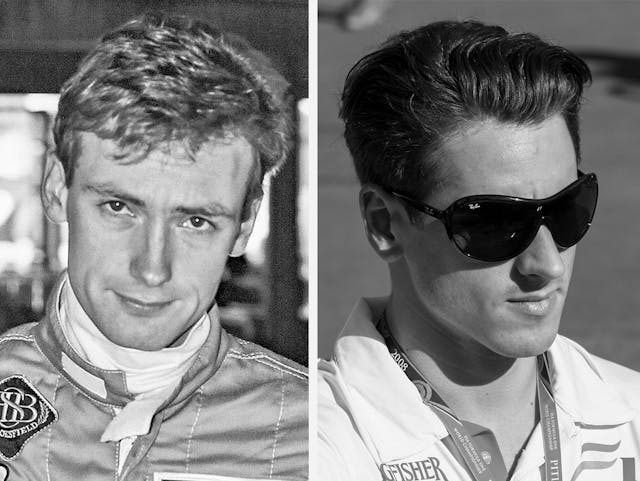 Bertrand Gachot (L) and Adrian Sutil, two drivers who faced criminal charges for wrongdoing off the track.Wiki Commons
F1 drivers are used to the tight confines of a racing cockpit, but two have found themselves in even more restricted circumstances—behind bars. The 1991 season should have been a breakout one for Bertrand Gachot. In F1 he was driving for Jordan, and he had won the 24 Hours of Le Mans with Mazda. However, not long after his victory, Gachot was sentenced to 18 months in prison. In December the previous year, Gachot had gotten into a road rage incident with a London cab driver and sprayed him with CS gas, resulting in being charged with actual bodily harm and possession of a prohibited weapon. Gachot only served two months and later described his time in jail as “a fantastic human experience.”
On the night after the 2011 Chinese Grand Prix, Germany’s Adrian Sutil was partying in a Shanghai nightclub when he got into an argument with Lotus F1 team owner Eric Lux and hit him with a champagne glass. Despite the incident occurring in China, German prosecutors pressed the case against Sutil, who received an 18-month suspended sentence. Unlike the reformed Gachot, Sutil appears to have been encouraged to embark on a life of crime and was arrested in December 2025 on charges of fraud and embezzlement. He is currently being held in pretrial custody.
AbuDhabigate
The 2021 Abu Dhabi Grand Prix is one that Lewis Hamilton fans will never forget—or forgive. The title fight between the seven-time champ and his rival, Max Verstappen, was down to the wire. Everything was going to plan for Hamilton to pick up an eighth title as he led the race with just a handful of laps to go. Yet it was not to be. On lap 53, Nicholas Latifi crashed his Williams and the safety car was deployed. Verstappen dived into the pits, while Hamilton stayed out, his Mercedes team fully expecting the race to end under the safety car. However, as the debris from the crash was cleared up, Red Bull boss Christian Horner urged race director Michael Masi to get “these lapped cars out of the way.” Masi then instructed only the five cars between Hamilton and Verstappen to overtake the safety car, leaving Verstappen on new tires, right behind the leader. “Michael this isn’t right!” exclaimed Mercedes boss Toto Wolff over the radio. “Toto, it’s called a motor race, OK? We went car racing,” replied Masi as Verstappen passed Hamilton on the final lap to win the race and the Formula 1 World Championship. A 2022 review by the FIA agreed with Wolff that Masi had incorrectly applied the regulations, but the result still stands. Masi was relieved of his position.