

Hidden beneath layers of sediment and preserved by unique environmental conditions, traces of an ancient construction have emerged from deep prehistory. Unlike the stone tools that dominate the archaeological record, this discovery is made of wood, a material rarely preserved across such vast stretches of time. Reported in Nature, the find dates back 476,000 years and points to early human ancestors building structured wooden forms long before Homo sapiens existed.
A Discovery That Challenges the “Stone Age” Narrative
The excavation at Kalambo Falls uncovered an extraordinary set of preserved wooden artifacts, including a wedge, a digging stick, a carefully cut log, and a notched branch. These objects suggest intentional design and construction, pointing to a level of planning rarely attributed to such ancient populations. The waterlogged conditions of the site played a decisive role in preserving these materials, which would otherwise have decomposed over time and remained invisible to science.
Professor Larry Barham emphasized the broader implications of the find, stating,
“This find has changed how I think about our early ancestors. Forget the label ‘Stone Age,’ look at what these people were doing: they made something new, and large, from wood.” He added, “They used their intelligence, imagination, and skills to create something they’d never seen before, something that had never previously existed.”
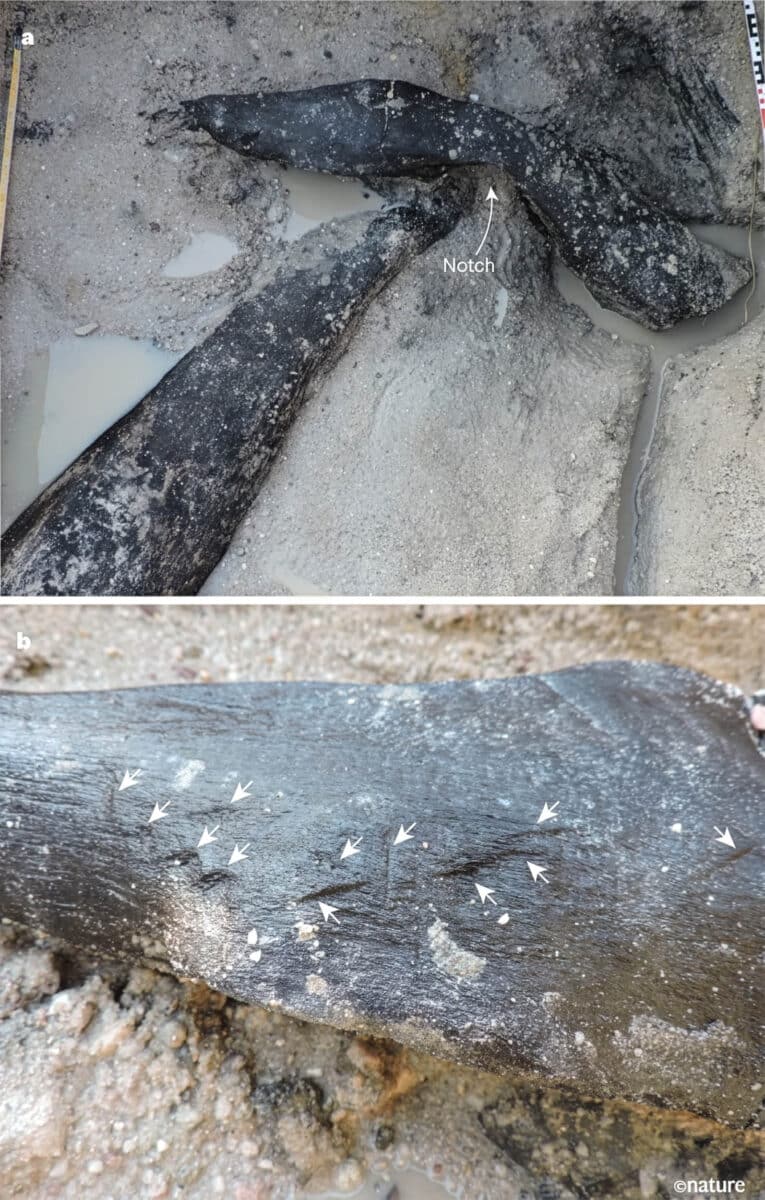 The oldest-known wooden structure, built 200,000 years before Homo sapiens. a, Barham et al.1 report the discovery in Zambia of 476,000-year-old wood in the form of two logs that were shaped to interlock together around a notch. b, Regions of the wood adjacent to the interlocking part, such as this one, show signs of deliberate tool marks (arrows).
Credit: Nature.
Dating the Deep Past With Modern Techniques
Establishing the age of organic materials this old presents significant challenges, as wood rarely survives long enough for conventional dating methods. To overcome this, the research team employed luminescence dating, a technique that determines when minerals were last exposed to sunlight. This method allowed scientists to confidently place the artifacts at nearly half a million years old, offering a rare window into deep prehistory.
Professor Geoff Duller from Aberystwyth University explained the importance of this approach:
“At this great age, putting a date on finds is very challenging and we used luminescence dating to do this. These new dating methods have far reaching implications – allowing us to date much further back in time, to piece together sites that give us a glimpse into human evolution.” He also noted the historical context of the site, saying, “The site at Kalambo Falls had been excavated back in the 1960s when similar pieces of wood were recovered, but they were unable to date them, so the true significance of the site was unclear until now.”
This technological leap not only validates earlier discoveries but also opens new possibilities for reexamining other ancient sites where organic materials may have been overlooked or undervalued.
Evidence of Planning, Creativity, and Engineering
The wooden structure discovered at Kalambo Falls is more than a collection of tools; it represents a constructed feature, possibly a platform or foundation. This implies that early hominins understood how to manipulate natural materials to create stable, functional forms. Such activity requires an appreciation of structural properties, including weight distribution and durability, as well as the ability to select appropriate materials from the environment.
This level of craftsmanship suggests that species such as Homo heidelbergensis may have possessed cognitive abilities closer to modern humans than previously believed. Rather than reacting passively to their surroundings, these early builders actively shaped their environment to meet specific needs. The presence of notches and fitted components indicates deliberate design choices, reflecting a mental blueprint before construction began. This challenges the idea of a slow, linear progression in human technological development and instead points to periods of innovation that emerged earlier and more abruptly than expected.
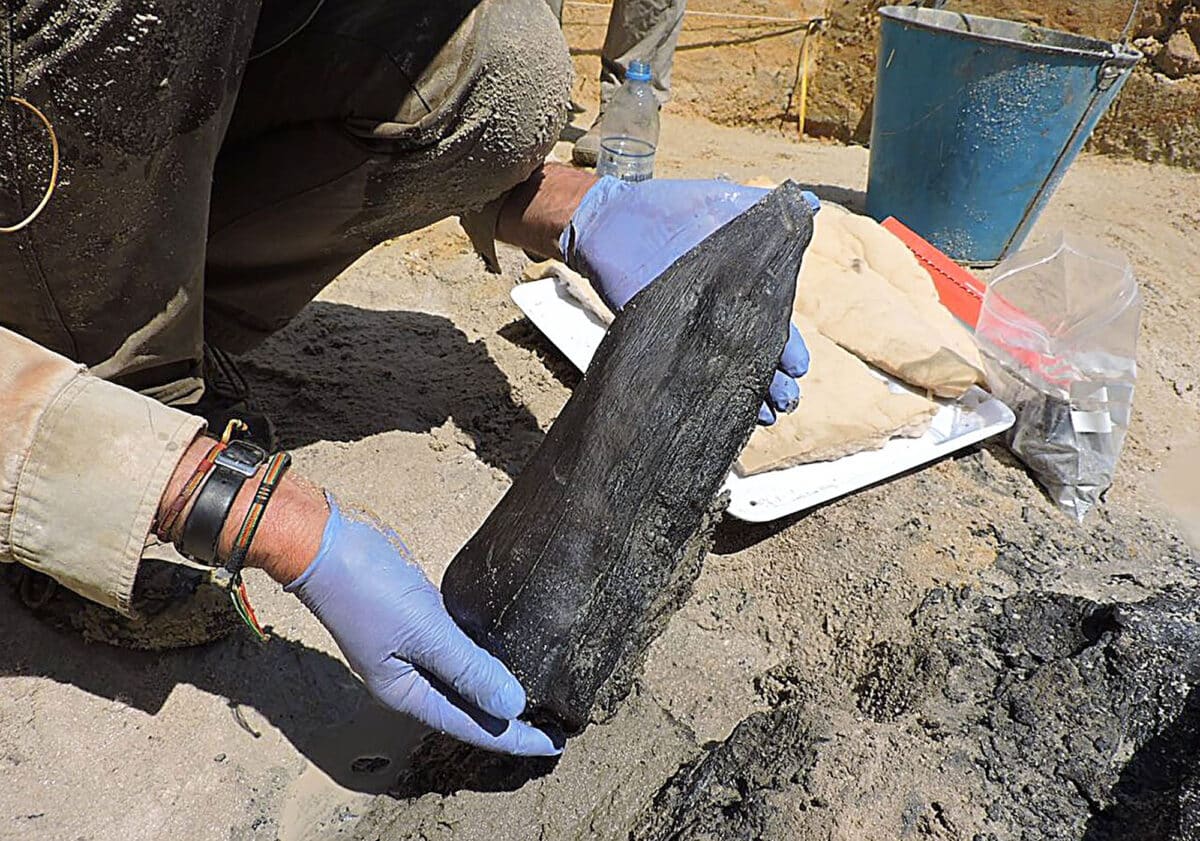 A wedge shaped piece of wood discovered at Kalambo Falls is found to be 476,000 years old.
Credit: Professor Larry Barham, University of Liverpool.
Rethinking Early Human Technology and Culture
The dominance of stone artifacts in the archaeological record has long shaped our understanding of prehistory, largely because stone endures while organic materials decay. The Kalambo Falls discovery disrupts this bias, offering direct evidence that wood played a significant role in early human life. It suggests that entire categories of tools and structures may have been lost to time, leaving an incomplete picture of past capabilities.
By demonstrating that early hominins could work with wood in sophisticated ways, the research, published Nature, broadens the scope of what is considered possible for ancient populations. It invites scientists to reconsider other sites and to develop new methods for detecting traces of organic technology. The findings also raise questions about how these skills influenced daily life, from shelter construction to food gathering and tool production. In this context, wood emerges not as a secondary material but as a central component of early innovation.