
More than 2.7 million people in Quebec used a bicycle for transportation in 2025—a number that has more than tripled since the mid-1990s. But the bigger story isn’t just growth. It’s a shift in how cycling is perceived: not as recreation, but as a legitimate, everyday transportation option.
According to a new report from Vélo Québec, cycling has become “an integral part of mobility habits” across the province. In total, 4.5 million Quebecers rode a bike last year, reflecting widespread adoption that cuts across age groups, trip types, and geography.
This transformation has been especially visible in cities like Montreal and Quebec City, where cycling’s share of trips has surged by more than 50% in just five years. In central Montreal, nearly 8% of all trips are now made by bike—numbers that place it among the leading cycling cities in North America.
How this is happening should surprise nobody: safe and separated cycling infrastructure. Since 1995, Quebec has expanded its cycling network fivefold, now totaling more than 11,500 kilometres, including nearly 5,000 kilometres of routes physically separated from traffic. In recent years, high-profile projects like Montreal’s express bike network have accelerated that momentum, creating safer, faster corridors that make cycling a viable alternative to driving.
“The data are unequivocal: infrastructure directly influences usage,” the report notes. When cities build safe, connected bike networks, people ride—often in large numbers.
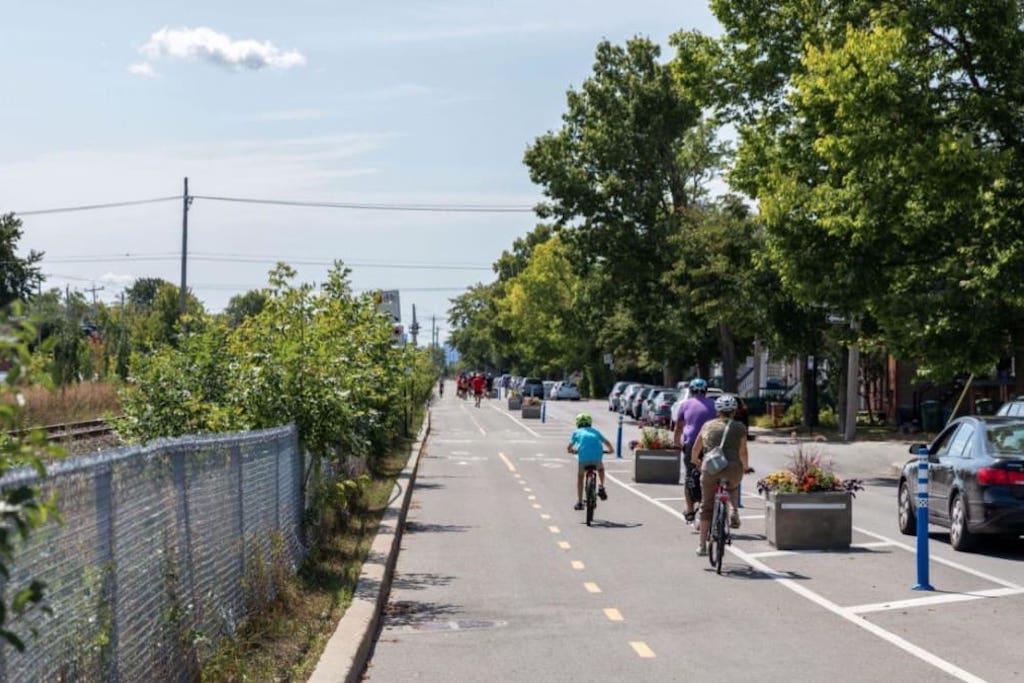
Montreal bike network
That pattern is increasingly familiar across North America, where cities from New York to Vancouver have seen similar spikes in cycling following investments in protected lanes. Quebec’s experience reinforces the idea that demand for biking isn’t fixed—it responds quickly to the right conditions.
According to the report, this isn’t a story about replacing cars. Not entirely. The vast majority of Quebec cyclists—93%—still hold driver’s licenses, and 87% own a vehicle. Instead, cycling is emerging as a complementary mode, particularly for shorter urban trips. With nearly 40% of workers living within five kilometres of their workplace, the potential for mode shift remains significant.
New technology is also widening the appeal. Electric-assist bikes now account for nearly one in three bicycle sales in the province, helping riders tackle longer distances, hills, and time constraints. Cargo bikes are gaining traction as well, offering families and small businesses a practical alternative to the car. Together, these trends are reshaping what cycling looks like—and who it’s for.
Beyond transportation, the economic impact is substantial. Cycling generates hundreds of millions of dollars annually in spending on bikes, gear, and services, while bicycle tourism alone contributes more than $800 million to the provincial economy. For smaller communities, in particular, bike tourism has become a powerful driver of local development.
Still, challenges remain. Cycling participation is not yet evenly distributed, with men accounting for a larger share of riders than women, highlighting ongoing gaps in perceived safety and accessibility. And while youth participation remains high, frequency of use is declining—mirroring broader concerns about physical activity levels.
Even in success stories like Montreal, bike infrastructure can be politically contentious, with debates over road space, safety, and design playing out in real time. But the long-term trend is difficult to ignore.
For cities grappling with congestion, climate goals, and quality-of-life concerns, Quebec offers a clear lesson: build for bikes, and people will ride. The combination of infrastructure, policy, and cultural momentum has created a virtuous cycle—one that is steadily redefining urban transportation in Quebec and, hopefully, beyond.