
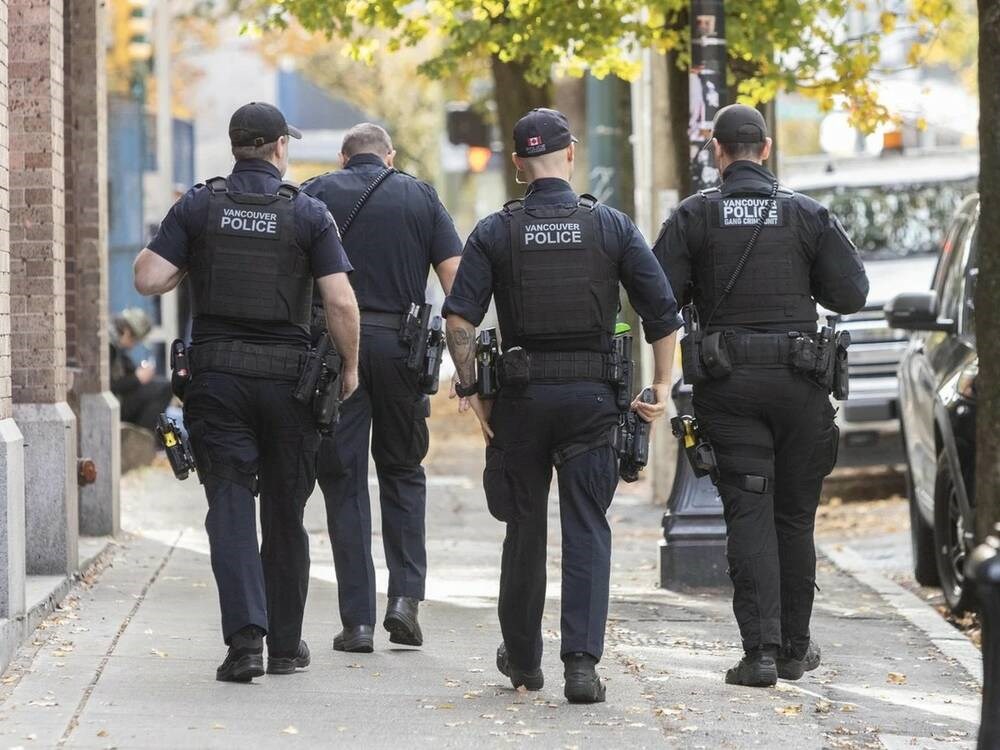
Financial incentives are being used to persuade police officers to leave one force for another, which is costly but not necessarily better for public safety.
A “bidding war” between police forces in Metro Vancouver is driving up costs for municipal taxpayers, but that doesn’t mean public safety is necessarily getting a boost.
Financial incentives are being used to persuade police officers to leave one force for another.
That hiring strategy means the pool of experienced officers in the region is being relocated from one municipality to another at taxpayer expense, rather than more police officers being added to patrol the streets.
The Surrey Police Service increased its signing bonus for trained and experienced officers in March to $30,000, from the previous $20,000.
Meanwhile, the Vancouver Police Department is offering a $10,000 signing bonus, and the RCMP increased on April 1 its allowance for new recruits going through the training academy to $26,000, nearly doubling from the original $13,650.
“I worry that these astronomically high signing bonuses could drive a bidding war for the really limited police resources that we have in the Lower Mainland right now,” said Carson Binda, B.C. director for the Canadian Taxpayers Federation.
While signing bonuses and financial incentives are common, a criminologist said they may not be helpful in increasing the overall supply of police officers in the region.
“Many police agencies across the province, the country and even the continent, are experiencing staffing challenges. This focus on the recruitment of new officers and retention of existing officers really appears to be a universal struggle for policing at the moment,” said Rylan Simpson, an associate professor from Simon Fraser University’s criminology department.
“I think there’s a variety of reasons that policing has seen a decline in interest, from issues of public perceptions to organizational challenges, to a lack of interest in public-sector jobs.”
Binda said the root cause of the shortage should be tackled instead of increasing pay.
“I think a lot of it falls on the government,” he said. “I’d much rather see the province and the federal government create conditions where police officers want to stay in their jobs and want to sign up for police services, rather than having taxpayers stuck with these really big signing bonuses.”
In Surrey, police are budgeting $900,000 toward police recruitment. To Binda, the amount being offered is much too high.
“At the end of the day, that $900,000 that’s going towards signing bonuses is money that’s not going towards fixing potholes, making sure our schools are providing a high-quality education, and making sure the officers that we already have are safe and able to do their jobs keeping the public safe,” he said.
Overall compensation for Surrey police is also “really high,” Binda said, pointing to Chief Norm Lipinski’s compensation of more than $300,000 last year.
Simpson said it’s difficult to say the bonuses are actually helping.
“It’s possible that they could help to fill vacancies in the hiring agency, at least in the short term, but then it’s also possible that they can create vacancies in the agencies that the officers are departing from.”
According to the recruiting department at the Surrey Police Service, the increased bonus, introduced at the end of March, has already attracted applications.
Surrey Police Service Staff Sgt. Lindsey Houghton acknowledged that all of the experienced officers come from other agencies throughout the Lower Mainland. He said signing bonuses have been common across Canada for decades.
“The experienced officer pool is a finite and limited number, and agencies are all competing for the same officers to either replace vacancies or hire to keep up with attrition,” Houghton said.
The RCMP also justified its increase in pay for the 26 weeks of training.
“The increase is part of ongoing efforts to recruit and retain qualified applicants in an increasingly competitive labour market,” said Robin Percival, a media relations representative for the RCMP.
“It aims to alleviate some of the financial pressures for cadets at home, whether it’s housing, utilities and other necessary expenses for them or their families.”
Vancouver Police Const. Darren Wong, meanwhile, said that department has been successful in recruitment recently, not solely because of the $10,000 signing bonus, but for reasons including the chance to work in a large city and more varied career opportunities.
Still, Simpson warned, “if new officers don’t start joining the profession at a sustainable rate, the pool of potential officers who are looking to move as part of lateral hiring initiatives will eventually dry up, and that will cause concern for the institution writ large, especially from a staffing perspective.”