
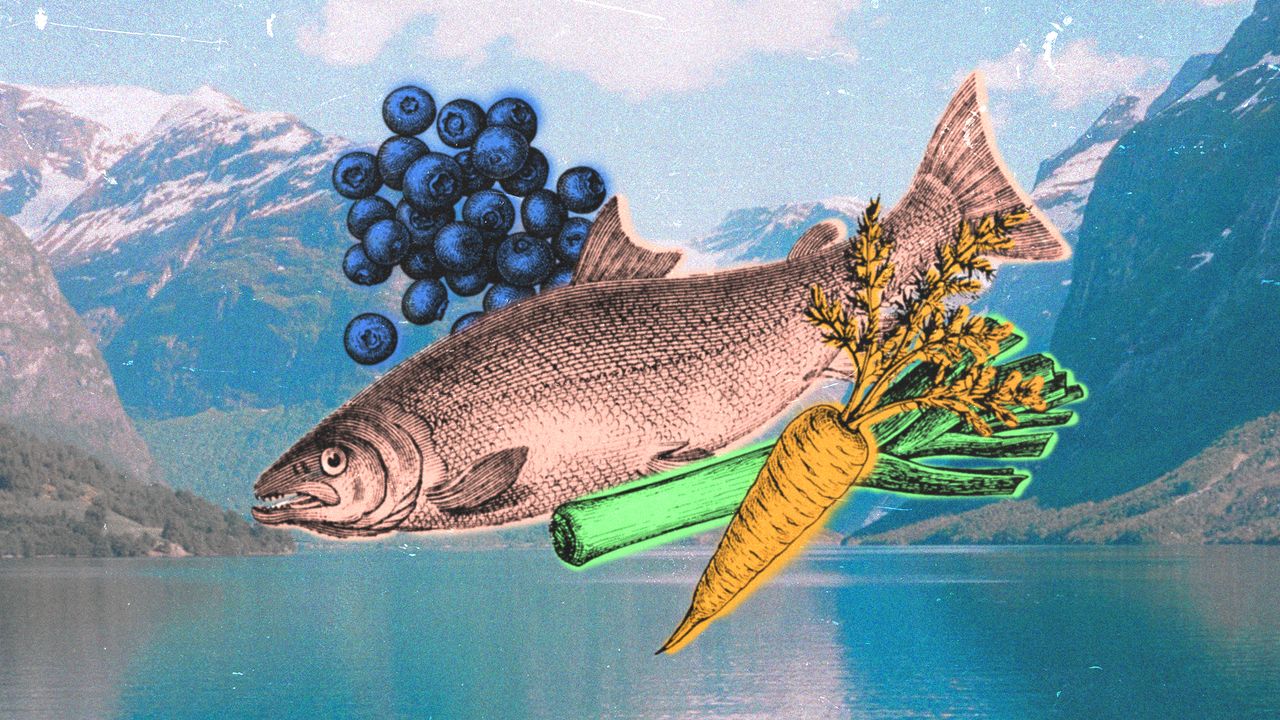
Given recent revelations about ultra-processed foods, there’s never been a better time to simplify what you eat. Enter: the Nordic diet.
“We’ve really reached a tipping point with regards to the industrialized food industry,” says Dr. Colin Robertson, nutritionist, exercise physiologist, and chief product officer at Swedish health tech company Zinzino. “A lot of what had been discussed and debated in the past has really come to the forefront, and we now know, quantifiably, that this food is associated with health problems and we need to do something about it.”
It’s no surprise, then, that the Nordic diet, which eschews ultra-processed foods and added sugars in favor of heart-healthy fish and grains, fiber-packed root vegetables, and gut-boosting prebiotics, is trending. “It’s got a real earthiness to it, and the core components are backed by science,” Dr. Robertson says. “It’s practical, it’s pragmatic, and it actually fits with what I would call the modern take on how we should be doing agriculture in the 21st century, which is to go back to local provision and sustainability.”
But the Nordic diet isn’t just about winding back the clock on how you source and prepare your food. According to nutritionists who spoke with GQ, it also offers one of the most powerful and accessible ways to combat inflammation. Here’s everything you need to know, as well as how to get started.
What is the Nordic diet?
Even if you have absolutely no idea what the Nordic diet is, you’ve probably heard of the Mediterranean diet, long the poster boy for healthy eating. The former is actually quite similar, with just a handful of key differences. “The Nordic diet is largely a plant-based derivative that focuses on certain types of fats,” says Dr. Robertson. “You can’t really discuss the Nordic diet without discussing the Mediterranean diet.”
Whereas the Mediterranean diet relies heavily on olive oil, the Nordic diet emphasises rapeseed oil. “There you find the fundamental difference, which sets the comparison up perfectly,” says Dr. Robertson. While the Mediterranean diet goes all in on omega-3s, the Nordic diet dials up the omega-6s. According to the British Heart Foundation, rapeseed oil has the best balance of omega-3 and omega-6 polyunsaturated fats of all plant oils. It also has the lowest saturated fat content—roughly half of what you’d get from olive oil. Meanwhile, the American Heart Association supports the inclusion of omega-6 fatty acids as part of a healthy diet.
Both diets prioritize seafood as the primary protein source, flanked by an assortment of fruits, vegetables, and whole grains, but the Nordic diet is a bit more specific here. While the Mediterranean diet allows for poultry and red meat a couple of times a week, the Nordic diet recommends mostly avoiding these. And in contrast to the Mediterranean diet’s rainbow-colored salads rich in phytonutrients, the Nordic diet calls for healthy servings of root vegetables and berries.
And because these diets prioritize different fats, the types of fish they recommend vary slightly, too. “When you look at the types of fish in the Mediterranean diet, they’re more what we call meaty fish,”—varieties like cod, halibut, and sea bass—while “the Nordic diet has a preference for fatty fish, like salmon, mackerel, and herring,” says Dr. Robertson.
At the end of the day, both diets share a strong emphasis on whole foods and locally sourced, seasonal produce, with a few differences stemming mainly from their respective regions of origin. “The Nordic diet is often compared to the Mediterranean diet as its ‘cold water’ relative,” says Ashley Koff, RD, nutrition course director for UC Irvine’s Susan Samueli Integrative Health Institute’s Integrative and Functional Medicine Fellowship.