
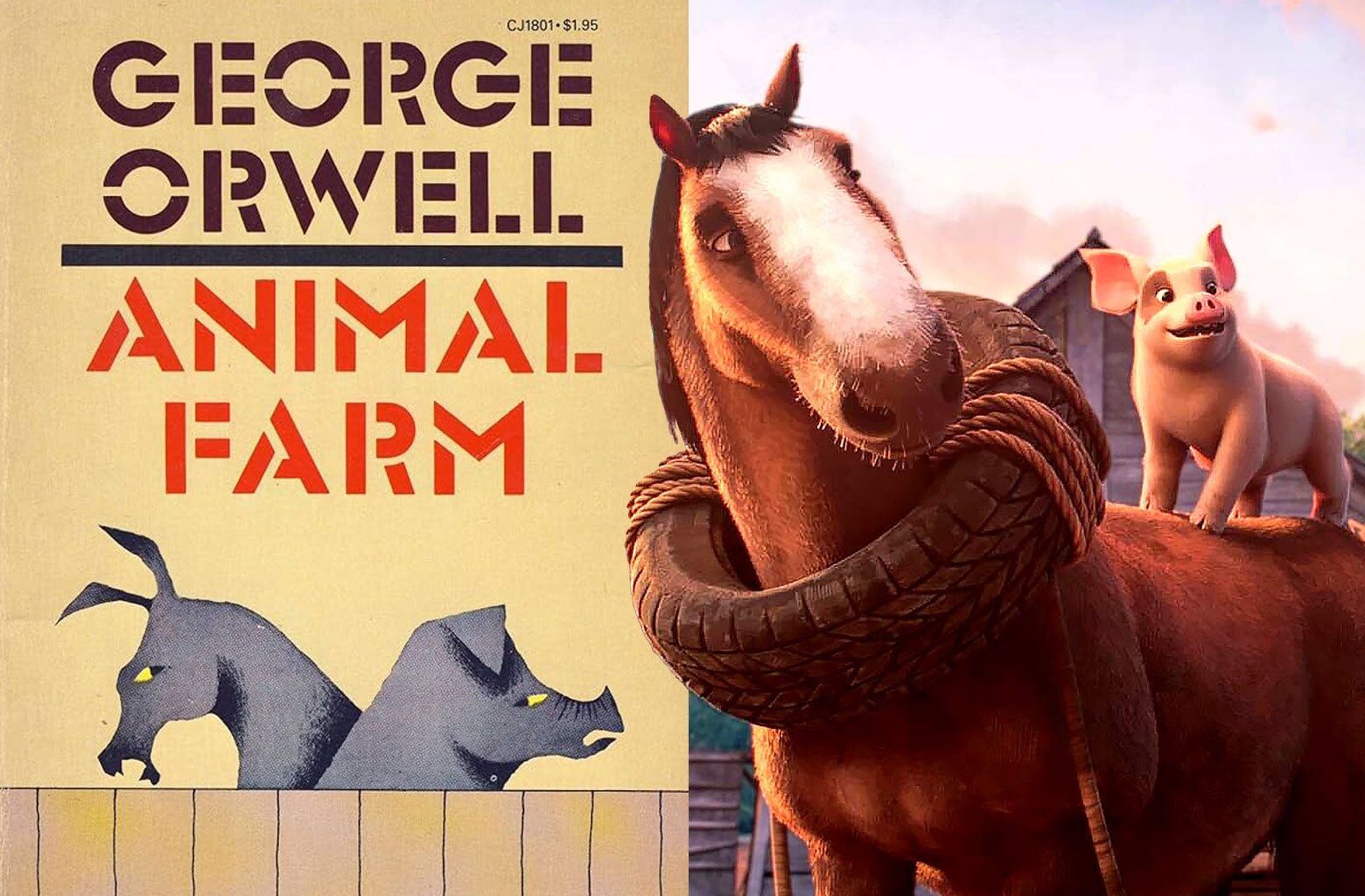
When first published in 1945, George Orwell’s Animal Farm featured a subtitle: A Fairy Story. It’s likely Orwell was being ironic in labeling his satire of the corruption of Russian communism this way, given that children, the assumed audience for fairy tales, have little interest in such matters as industrialization and collectivization. Fable might be a more accurate term, anyway, for a story like Animal Farm, a tale with a moral message in which anthropomorphized animals illustrate some enduring truths. But whatever you call it (the pedant in me must point out that Animal Farm is not technically an allegory), the book was meant for adults. Distilling the complex early history of the Soviet Union into a parable of animals rebelling against their dissolute farmer was Orwell’s way of compelling his readers to acknowledge both the particular atrocities of Stalinism and how predictable they were.
A new animated film adaptation of Animal Farm, directed by Andy Serkis, is the third attempt to bring this story to the screen, and it suffers from the same problem as its 1954 and 1999 predecessors. The talking animals pretty much require either animation or the kind of puppetry mixed with live action that makes the 1999 adaptation, directed by John Stephenson, an unsettling jaunt through the uncanny valley. Cartoons, puppets, talking animals: These are the hallmarks of kids’ programming, yet Animal Farm itself is not for kids.
Every Animal Farm adaptation has made some fundamental changes to the text. For example, the 1954 version—later revealed to have been a Cold War propaganda project funded by the CIA—wanted the character of Snowball the pig to be depicted less sympathetically. Based on Leon Trotsky, Snowball champions the early ideals of Animalism, the egalitarian philosophy behind the revolt of the barnyard creatures, and it’s Snowball who composes the tenets, painted on a barn, that are later covertly altered by the pig Napoleon, based on Stalin, who becomes the farm’s tyrant. Orwell himself was a socialist who, while hardly a Trotsky fan, appreciated the exiled-and-assassinated Bolshevik’s critique of Stalinism, which many on the British left insisted on defending even after the horrifying show trials of the 1930s. Although, during the Cold War, Animal Farm became a book routinely assigned to American schoolchildren as an anti-communist tract, Orwell intended it as a reproach to his fellow Western leftists, who refused to see how Stalin had betrayed the revolution.
But Orwell’s politics have proved less challenging to his adaptors than his pessimism. The character in Animal Farm widely regarded as the closest parallel to Orwell himself is Benjamin the donkey, a cynic who anticipates that, no matter who’s in charge, “life would go on as it always has gone on—that is, badly.” Animal Farm ends bleakly, with the animals worse off than ever and the pigs indistinguishable from their human exploiters. This won’t do in a children’s film, so every screen version finds some way for the bad guys to be toppled and a fresh note of hope to be struck in the end.
Serkis’ new computer-animated Animal Farm does this with a confusing and quasi-biblical climactic catastrophe that leaves the movie’s main character—Lucky (voiced by Stranger Things’ Gaten Matarazzo), a young pig who does not appear in the novel—realizing that true freedom means “helping each other, not because we have to, but because we choose to.” If all this sounds vaguely Christian, be aware that this movie has been released by Angel Studios, the Mormon-founded independent film distributor best known for Sound of Freedom, a biopic of dubious veracity about the showboating anti–child trafficking crusader Tim Ballard and linked with the conspiracy fantasia that is QAnon.
It may surprise some, then, that this adaptation of Animal Farm is manifestly anti-Trump. Whether this is because Angel Studios, like some conservative Christians, has finally realized that the current administration is not actually compatible with its religious values or because Serkis and established Hollywood screenwriter Nicholas Stoller (Get Him to the Greek, Neighbors 2, Bros) simply slipped the Trump parody past it, the message is pretty clear.
Heather Schwedel
I Think I Know Why Melania Trump Really Just Went After Jimmy Kimmel
Read More
Napoleon (Seth Rogen) in this movie is smugly coarse—a scene in which he farts at length as a demonstration of what “freedom” really means has roused the ire of many reviewers but is also something that’s criminally easy to imagine Donald Trump doing. Napoleon’s power as a leader, furthermore, is perversely based on the fact that the other animals find him funny, and when he takes Lucky under his trotter as a substitute son, he tells the bright-eyed youngster, “Pigs kinda have to stick with pigs, and cows gotta stick with cows.” He repeats Trumpian phrases like “Everyone’s saying I’m doing a really good job.” He even joins forces with a high-tech human mogul, voiced by Glenn Close, who drives something suspiciously similar to a Cybertruck. There’s also a scene in which Napoleon is making a speech while two unnamed pigs stand loyally behind them, and—I swear to you—their faces look like Pete Hegseth’s. (The movie was produced from 2022 to 2024, by three British studios, before Angel bought the distribution rights, so it’s likely that some of this is a coincidence, but it seems impossible that all of it is.)
Orwell has come under some criticism from the left for his depiction of the working class—or, rather, the animals who supposedly represent it—in Animal Farm. From Boxer, the noble but slow plow horse who ends up worked to death and sold to the knackers, to the easily led sheep, these characters are uniformly dumb and gullible. Serkis’ movie has added a single sheep, Carl (Jim Parsons), who occasionally objects when Napoleon blithely lies and rewrites history, but then he catches himself, looks around (yes) sheepishly, and falls in with the rest of the flock. The novel places enormous value on which animals can read, this being the line dividing the independent thinkers from the dupes, and although the film doesn’t focus on literacy quite so much, it has Napoleon seducing the animals with mindless consumer technology and bling, promising them that his alliance with the humans will guarantee them “free food forever”—which he, unsurprisingly, fails to deliver.
Although Animal Farm can’t really be called a good movie, it does illustrate how easily Orwell’s novel can be bent to apply to the preening populism of Trump and his ilk. That doesn’t mean, though, that the forces Napoleon displaces come off any better. Snowball (Laverne Cox)—before she is sent away for a “vacay,” escorted by a couple of Napoleon’s Doberman thugs—advances prudent policies, like saving the farm’s grain stores for the winter and building a water mill to supply the farm with electricity. But she cannot conceal the fact that she considers the rest of the farm’s denizens to be too simpleminded to understand the merits of such plans. “These barn animals don’t know what’s good for them,” she tells Lucky, sounding just like the self-satisfied “coastal elite” of every Fox News fever dream. “They need to be shown.” Napoleon tricks her into blurting out these thoughts publicly, then pronounces the water mill “boring,” while at least the farmer was not “so boring.” The problem with Snowball, he remarks, securing her ouster, is that “many animals have been saying that Snowball is … condescending.” Later, he will reintroduce the water mill and pretend it was his idea, much as Trump seems on the verge of a deal with Iran similar to the one he once reviled Obama for signing.
The Devil Wears Prada 2 Gives Its Predecessor a Much-Needed Makeover
One of the Biggest Boondoggles in Sports History Is All but Dead. The Damage Is Real.
There’s nothing like the rise of populism to make you wonder if Orwell was right about the stupidity of the working class. MAGA seems intent on confirming that suspicion when it comes to Trump supporters. Right-wing influencer Riley Gaines recently posted on X that she appreciated the movie’s confirmation that “Marxism always has and always will fail,” a statement that provoked outraged followers to reply that the movie is “anti-capitalist,” which is also not really true. Initially, in order to pay off the farmer’s mortgage, the animals host a successful farmers market to sell their produce to humans tickled by the notion of an animal-run farm, but this is depicted positively. Only when the pigs are tempted by the promise of wide-screen TVs, smartphones, and sports cars into colluding with a big corporation does Napoleon’s reign become fully oppressive. Gaines’ critics also seem to believe that Orwell’s novel was anti-Marxist, as opposed to anti-totalitarian, a notion obtuse enough to make anyone agree with Benjamin the donkey.
Then, finally, none of this has anything to do with kids, who—because we’re still talking about an animal cartoon here—seem to be the target audience of the film. While Serkis’ Animal Farm features ample amounts of adorable piglet tushes, fuzzy yellow chicks, and comically frantic roosters to divert the under-8s, it’s hard to picture an audience who wants that plus a hip-hop-heavy soundtrack, fart jokes, thinly coded Trump parodies, and a critique either of capitalism or of Marxism as the cherry on top. That’s one weird sundae, and not, I suspect, many filmgoers’ idea of a good time.
Get the best of movies, TV, books, music, and more.