
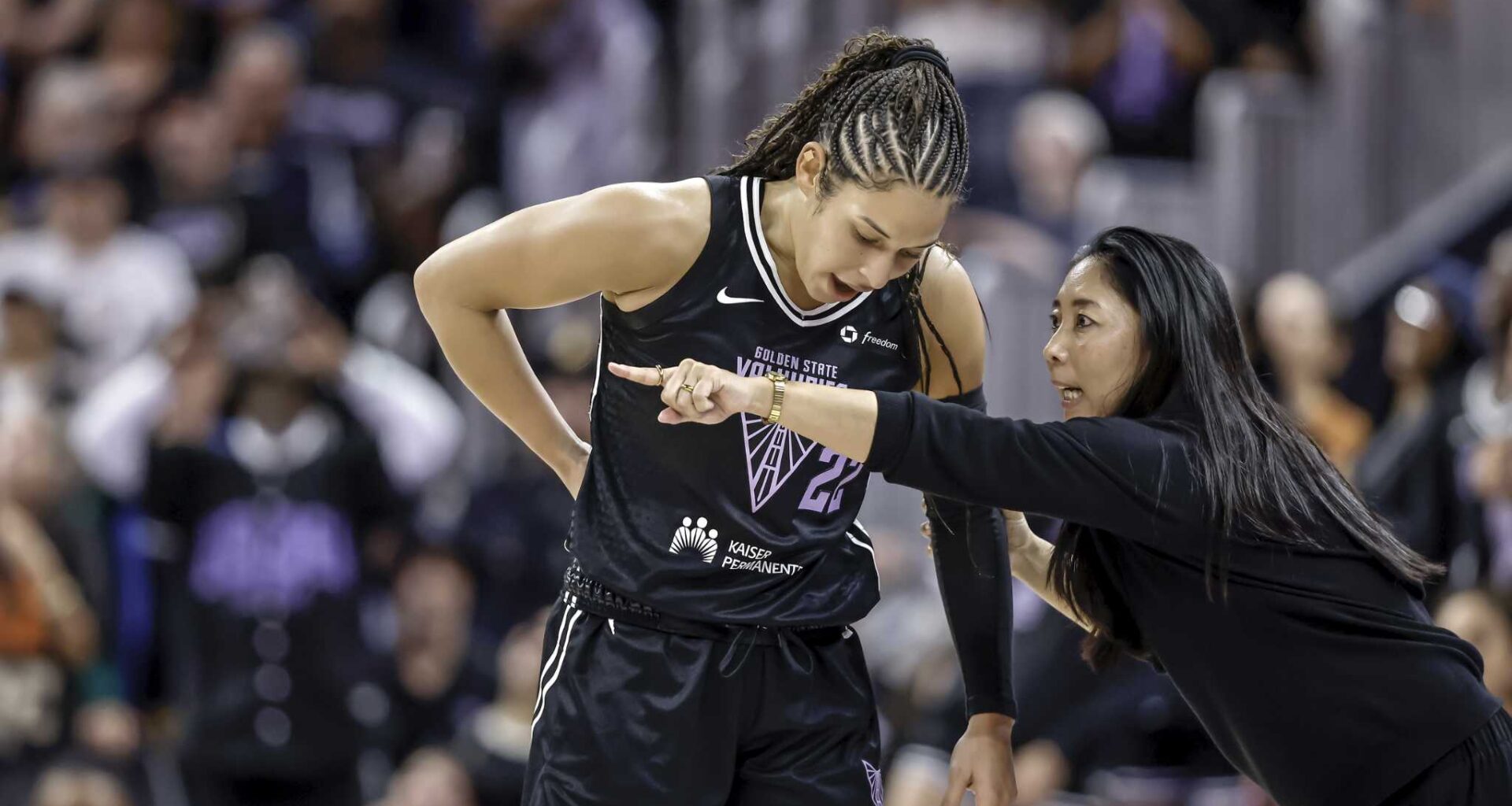
Valkyries head coach Natalie Nakase, conferring with guard Veronica Burton, said of roster expansion under the new collective bargaining agreement, “It’s just great to have fresh bodies. … I’m super grateful to the fact we get 14 players this year.”
Carlos Avila Gonzalez/S.F. Chronicle
Valkyries guard Kate Martin said the pay raises across the WNBA will make the cost of living in the Bay Area more tolerable, citing “those $10 coffees around here.”
Yalonda M. James/S.F. Chronicle
Valkyries guard Tiffany Hayes said the pay raises across the WNBA would help “teams that are in these cities like San Francisco and L.A. and even the new team Toronto and New York.”
Stephen Lam/S.F. Chronicle
The WNBA’s new collective bargaining agreement gives its players the opportunity to earn far more money than ever before in this league’s near 30-year existence.
The league’s new revenue sharing model, in theory, ties players’ financial future to the league’s success. That minimum salaries have increased by hundreds of thousands of dollars also ensures a bit more financial security for the lot.
For Golden State Valkyries players who live in the pricey Bay Area, more money means less problems.
Article continues below this ad
“Obviously this is a more expensive city, so it is nice to see our wages go up a little bit to pay for those $10 coffees around here,” said Valkyries guard Kate Martin, in her second year in the Bay Area. “It ain’t cheap!”
Martin jokes, but the $10 latte at your favorite San Francisco cafe is no joke. It’s a symbol for just how expensive it is to live in the Bay Area, especially in San Francisco, where the Valkyries play at Chase Center.
The median household annual income for a single-person home in San Francisco county is $130,600, $109,700 is low income and $68,550 is considered very low income, according to the California Department of Housing and Community Development.
San Francisco Chronicle Logo
Make us a Preferred Source to get more of our news when you search.
Add Preferred Source
That means five Valkyries players earning the league minimum in 2025 — which went as low as $66,079 with players between zero and two years of service time and $78,831 for veterans — would be considered below the low income threshold in San Francisco.
Article continues below this ad
Living well below the median income threshold is no outlier experience in the Bay Area; WNBA players on minimum salaries are just some of the tens of thousands of locals drowning under the heavy cost of living here.
But from a basketball standpoint, the CBA’s previous minimum salary posed a significant competitive disadvantage for the Valkyries and other teams in expensive cities, such as the New York Liberty, Los Angeles Sparks and new Toronto Tempo.
Thirteen-year veteran Tiffany Hayes was among the Valkyries veterans who spoke up about the importance of raising the minimum during this winter’s CBA negotiations.
“That’s why it was really important to harp on that, because that was a topic of conversation — teams that are in these cities like San Francisco and L.A. and even the new team Toronto and New York,” Hayes said.
“Me in general, I was really harping on — hey I have to live in San Francisco. This isn’t going to be an easy feat for me or rookies that are coming into this league. The housing was a big part of that. So I’m glad we were able to push that back for a couple years so people can get ready for that.”
Article continues below this ad
Said star forward Kayla Thornton: “It opens the doors for a lot of things. We fought for what we needed.”
In the new CBA, minimum salaries start at about $270,000 and the average salary for the 2026 season is estimated at $583,000, well above the median income in San Francisco, and all rookie scale contracts will be adjusted accordingly. Those minimum salaries are expected to get up to between $340,000 and $380,000 by 2032, giving veteran players an incentive to keep playing.
“It gives us a place of feeling like we still belong, feeling like we are still worth what we’re worth in this league,” Hayes said. “We put in a lot of work to be here and be able to stay here and give energy to teams to this day, so for that to be looked after is huge.”
The raised floor lifted the league’s revenue-shared ceiling tremendously, too. The previous $1.5 million salary cap in 2025 shoots up to $7 million in 2026 and it should only go higher each year.
That boost turns the Valkyries — and other teams in big cities — from a financial burden into a big-market destination. They flexed that muscle this offseason, signing All-Star forward Gabby Williams to a three-year, $3.7 million max contract and breakout star Veronica Burton to a three-year, $2.9 million guaranteed contract.
Article continues below this ad
No player epitomizes the CBA changes better than does Valkyries guard Kaila Charles, who this year will earn triple her estimated $192,365 career earnings over five seasons.
Per Sportico, the Valkyries are worth a WNBA-best $850 million, with record-breaking revenue in 2025. As of Friday, their 2026 payroll stood at just over $6 million — about $800,000 under the salary cap — according to herhoopstats.com. The Valkyries, an expansion team entering their second year, appear positioned to compete for the playoffs again after exiting in the first round of the postseason last year.
“I think that’s a choice up to the team,” Hayes said of the increased spending. “They got the budget, they do what they want with the budget. Whatever they want to do with it, that’s where it’ll go.”
It may be a bit easier to pay the rent or even invest in a Bay Area home, but the CBA keeps intact that teams provide housing or a stipend to its players at least through 2029, which is when it’ll only be guaranteed to players earning less than $500,000. Hayes says one of her biggest lessons to young players is to take full advantage of the resources teams provide from housing to food and transportation.
The boost in income across the league also can ensure that all WNBA players can make the WNBA their primary job. That may mean some players won’t play internationally in the offseason to earn extra income.
Article continues below this ad
“It could be if that’s what you want to do,” Hayes said. “Some people love overseas, some people love that life. Some people like to reset, eat healthy food over there and experience a new culture.
“I think that’s a choice, if you want to make that, you make it, but with this league doing what it did in the last CBA, it really gave us a chance to just be able to stay here and play if we want to.”
Valkyries head coach Natalie Nakase is a huge fan of the two developmental roster spots in addition to the 12 roster players guaranteed in the CBA. Having two players learn the team’s system and playbook can be an advantage when the roster goes through its fluctuations. Rosters will grow more vulnerable as the league is adding more games in the coming years beyond the 44 and playing a World Cup in September.
“Love it. More bodies,” Nakase said. “The W is adding more games, so in the future when they add more games — and compress it with the World Cup — what does that look like? Are they considering that a lot of players will be off for 18 days? Are they navigating that and understanding that some of our players will be in the World Cup?
“So it’s just great to have fresh bodies. It’s not like we can — then have to bring someone in on a seven-day contract and teach them our stuff. They’re going to be with us. So I’m super grateful to the fact we get 14 players this year.”