
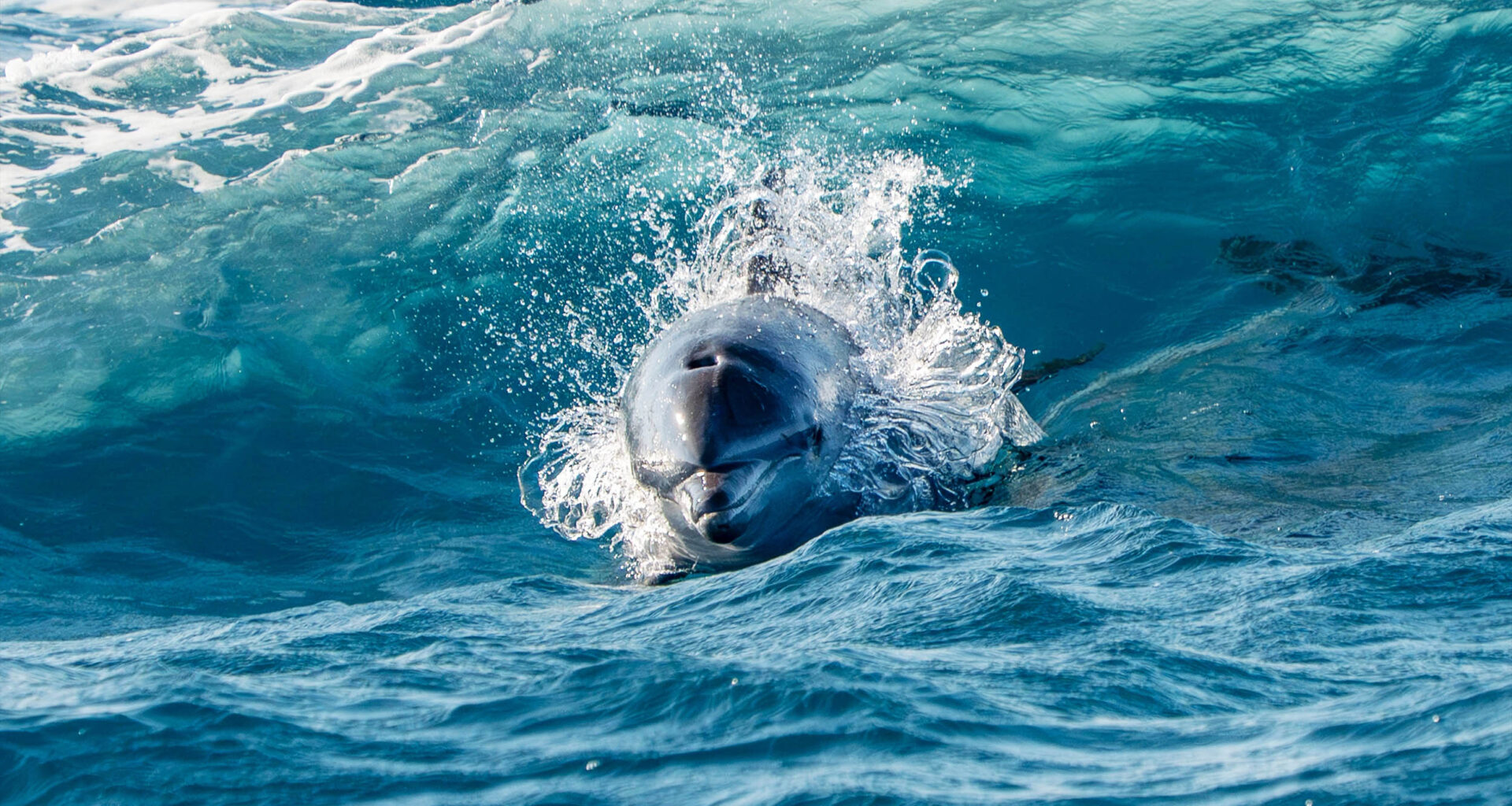
A new study has found that large rings of swirling water provide most of the push behind dolphins’ ability to swim so incredibly fast.
By distinguishing useful thrust from turbulent water noise, this discovery gives engineers a clear blueprint for designing faster underwater robots.
Dolphin tail creates water rings

Inside a computer-built trail behind the dolphin, the strongest evidence appeared in the moving water near the tail.
By tracing those rings, Yutaro Motoori, who studies moving water at The University of Osaka (UOsaka) in Japan, showed that the largest swirls drove the useful push.
The smaller swirls still filled the trail, but they mostly came from larger rings stretching and breaking the water.
That separation sharpens the next question: how a tail kick turns those large rings into forward speed.
Rings push dolphin forward
Engineers call each ring a vortex, a rotating pocket of fluid that carries motion through water.
When the dolphin’s tail moves down, the ring forms along the tail edge and then peels away.
As that ring leaves, it pushes water backward, and the dolphin gains forward momentum from the exchange.
In the simulations, the backward jet carried the main share of thrust, the forward force that moves a swimmer.
Turbulence sorts itself
Fast swimming also creates turbulence, an unstable flow that breaks into changing swirls of many sizes.
Large rings stretched nearby water, and that stretching created smaller swirls through an energy cascade, a handoff of motion from large to small.
Many tiny eddies, small swirling currents, appeared in the wake, yet their number did not make them the main engine.
For dolphin speed, size mattered more than clutter because the biggest rings carried the strongest backward momentum.
Computer model shows flow
To test the flow without disturbing a living animal, the team used a direct numerical simulation, a computer model that solves fluid motion step by step.
A related visualization effort handled about 1.9 billion grid points, digital locations where the program tracked water movement, to show layered swirls.
“Using a supercomputer, we can simulate and decompose the flow to determine which components play dominant roles,” said Motoori.
On Fugaku, a supercomputer in Kobe, Japan, that detail exposed wake patterns that real-world filming would struggle to capture.
 The smallest-scale vortices identified help explain the fast swimming of dolphins by polygonal isosurfaces around their bodies. Credit: European Journal of Mechanics – B/Fluids. Click image to enlarge.Bigger rings give thrust
Large vortex rings won because they formed at the moving tail edge, where muscle-driven motion met the water directly.
During the downstroke, the downward part of the kick, the tail swept water into a ring that detached and carried momentum backward.
After detachment, the dolphin moved forward because the water had received an opposite push from the tail.
That cause-and-effect chain explains why the largest structures, not the smallest ones, dominated propulsion across tested speeds.
Small swirls still matter
Tiny vortices did not become irrelevant, because they showed how a large push becomes ordinary turbulent motion.
As bigger rings stretched the water, small swirls spun off and filled the trail behind the dolphin.
Numerous small structures helped researchers check the flow’s realism, but they added little to forward force.
For designers, ignoring them entirely would lose detail, while treating them as the main source of speed would miss the point.
Robots copy dolphin motion
Underwater engineers care about this result because many machines still waste power pushing water in messy patterns.
Robots that copy animal swimming, called biomimetic robots, already use flexible bodies, tails, fins, and control systems.
A dolphin-style lesson points designers toward building strong, well-timed rings instead of merely adding more tail motion.
Such designs could help inspection vehicles, ocean sensors, and search tools travel farther on the same stored energy.
Limits of the model
Simulated water still has limits, even when the numbers are large and the physics is carefully solved.
The modeled body came from measurements of a Pacific white-sided dolphin, a real dolphin species used for the body shape.
Its swimming motion was set in advance, which means nerves, decisions, fatigue, and live muscle feedback stayed outside the calculation.
Those boundaries do not erase the result, but they keep the finding focused on tail-driven motion rather than dolphin behavior.
Same idea may apply to other animals
Beyond dolphins, the same hierarchy may help explain other animals that move through water or air.
Bird wings, fish tails, and insect wings all leave organized swirls that can carry useful momentum.
Seeing those structures by size helps researchers separate the force-making flow from the smaller leftovers.
That view could improve turbulence control, reducing unstable flow to cut unwanted drag, noise, and wasted energy.
What the finding gives
The dolphin’s wake now has a clear sequence: tail motion, large vortex rings, backward water, forward thrust.
Future tests can compare simulations with animal-safe measurements and robot trials, while keeping the main lesson clear and usable.
The study is published in Physical Review Fluids.
—–
Like what you read? Subscribe to our newsletter for engaging articles, exclusive content, and the latest updates.
Check us out on EarthSnap, a free app brought to you by Eric Ralls and Earth.com.
—–