
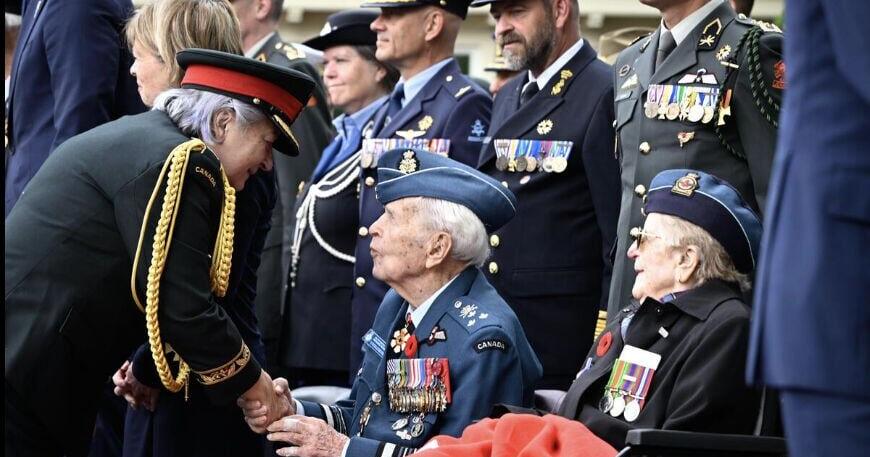
Canada and the Netherlands have a long history together. As of the 2021 census, there are over one million Canadians with Dutch heritage, and roughly 40,000 of those are dual citizens. As a result, many people across this country celebrated two Dutch holidays this week, both related to the Second World War. The first is a solemn day of remembrance, and the second is a celebration.
Winnipeg Celebration
May 4th was the Netherlands’ National Remembrance Day. This is a yearly commemoration of the civilian and military lives lost in all conflicts since the beginning of the Second World War. Originally, the day was only for WWII casualties, but this was expanded in 1961.
To honour the day, the Consul General of the Kingdom of the Netherlands for Ontario and Manitoba, Marjan Schippers, did a wreath laying ceremony at the Manitoba Legislative building.
The next day, May 5th, was Dutch Heritage Day, which has been celebrated nationally in Canada since the Trudeau government recognized the holiday in 2019. This year’s celebration was extra special because the day marked the closing out of the 80th anniversary commemorations of the Allied liberation of the Nazi-occupied Netherlands on May 5th, 1945. To commemorate the event the city of Winnipeg did a Dutch flag raising ceremony at city hall led by Marjan Schippers and Mayor Scott Gillingham.
WW2 History
Beyond the ethnic ties to many Canadians and Dutch, there is a special bond between the two countries over their shared experience in World War Two.
On May 10th 1940, the Nazis invaded the Netherlands. It took only four days for the main army to surrender. Thereafter, the civilian population endured half a decade of brutal German occupation, the latter half of which was marked by considerable famine and suffering. The Dutch Royal Family fled, living in Canada during their exile. This sparked the annual Ottawa tulip festival as a sign of friendship. When it came time to liberate the Netherlands, starting in the Autumn of 1944, the Canadian forces played a significant part, providing over 100,000 soldiers for the 8-month operation.
Canadian military sacrifice was greatly appreciated then and now by the Dutch people. In fact, to show their gratitude, Dutch charities and the government facilitated thousands of veterans making pilgrimages back to the Netherlands to visit the battlefields of their youth and have their service celebrated.

Monument Vandalized
As commemorations occur in Winnipeg, naturally so too they occur in the Netherlands. Yet, this year, the holiday was tarnished by vandalism to Amsterdam’s National Monument.
Erected in 1956, Amsterdam’s National Monument serves as the city’s cenotaph –a memorial to those who fell in World War II, and the conflicts since. Located in Dam Square, the historic heart of Amsterdam, the monument occupies a place of great significance alongside other major landmarks such as the Royal Palace. It regularly serves as the focal point for important public events, most notably the annual National Remembrance Day.
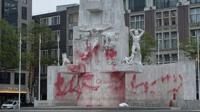
Overnight, before the annual ceremony, the monument was defaced with red paint and text saying “genocide.” Police are actively investigating, but there are no suspects for the crime. Last summer, the monument was covered in graffiti by Pro-Palestinian activists. Then, a couple of months later, “fuck Israel” was graffitied onto the Royal Palace with the group “Palestinian Action” taking claim for the defacement; however, this time no group has stepped forward to take responsibility for the incident. Although these three listed incidents were all just graffiti recently, the vandalism escalated into terrorism when there was an explosion at a Jewish school in Amsterdam this March.
Terrorism Threat
The defacement of the National Monument received universal condemnation from Dutch Politicians, many of whom made appeals to unity and respect. Despite firm rhetorical resolve, the pattern of events has clearly alarmed Dutch security services, who have placed the country on high alert.
The government uses a 5-tier scale to warn the public about threats to national security, with it currently being on level 4, “substantial: there is a real chance of a terrorist attack in the Netherlands.” As of May 4th, the Canadian government even updated its Netherlands travel advice to say “exercise a high degree of caution in the Netherlands due to the threat of terrorism.” As a result, special security procedures have been implemented. Along with the accustomed rise in police presence, the Mayor of Amsterdam, Femke Halsema, took the step to ban political demonstrations from taking place to ensure the commemoration remains respectful.
Fortunately, no terrorist attack took place. Yet the mere threat was enough to cause significant disruption, highlighting a deeper breakdown in civil society. Worse still, meaningful solutions remain absent. Politicians appear either unable or unwilling to identify the apparent root causes of these incidents, let alone confront them. Instead, we see a continued creep toward the militarization of domestic police forces and the steady expansion of the security state into personal privacy.