
Bioluminescent creatures have fascinated people for centuries, from glowing fireflies to the shimmering blue waves created by marine algae. But that natural light is usually brief, unpredictable, and difficult to control.
Now, researchers have figured out how to switch on bioluminescent algae and keep them glowing continuously for up to 25 minutes using simple chemical solutions.

They even embedded the living algae into 3D-printed structures that stayed alive and glowing for weeks.
Sustained light from algae
Plenty of living things glow. Fireflies, anglerfish, and certain mushrooms – in the deep ocean, up to 90% of creatures may be capable of producing their own light through chemical reactions in their cells.
One of them is Pyrocystis lunula, a type of algae that emits an icy blue flash when disturbed by waves or passing boats. It lives on seawater, sunlight, and CO2, and it glows for a fraction of a second when agitated.
The question researchers from the University of Colorado Boulder (UC Boulder) wanted to answer was whether they could keep it on. Not for milliseconds, but for minutes, and not through physical agitation, but through chemistry.
Previous research had hinted that certain chemical compounds might trigger P. lunula‘s bioluminescent reaction.
Chemistry keeps algae glowing
So the team tried two simple solutions – an acidic one at pH 4, roughly the acidity of tomato juice, and a basic one at pH 10, comparable to mild soap. Both worked.
The acidic condition was the more impressive of the two: the algae glowed brightly and stayed lit for up to 25 minutes. The basic condition produced a more diffuse, shorter-lived glow.
Either way, the light stayed on in a way it never does in nature.
“It was a very exciting moment when we found the right chemical stimulant that allowed the light to stay on for a long time,” said the study’s first author, Giulia Brachi, a research associate at UC Boulder.
“This is the first time we have figured out how to sustain luminescence.”
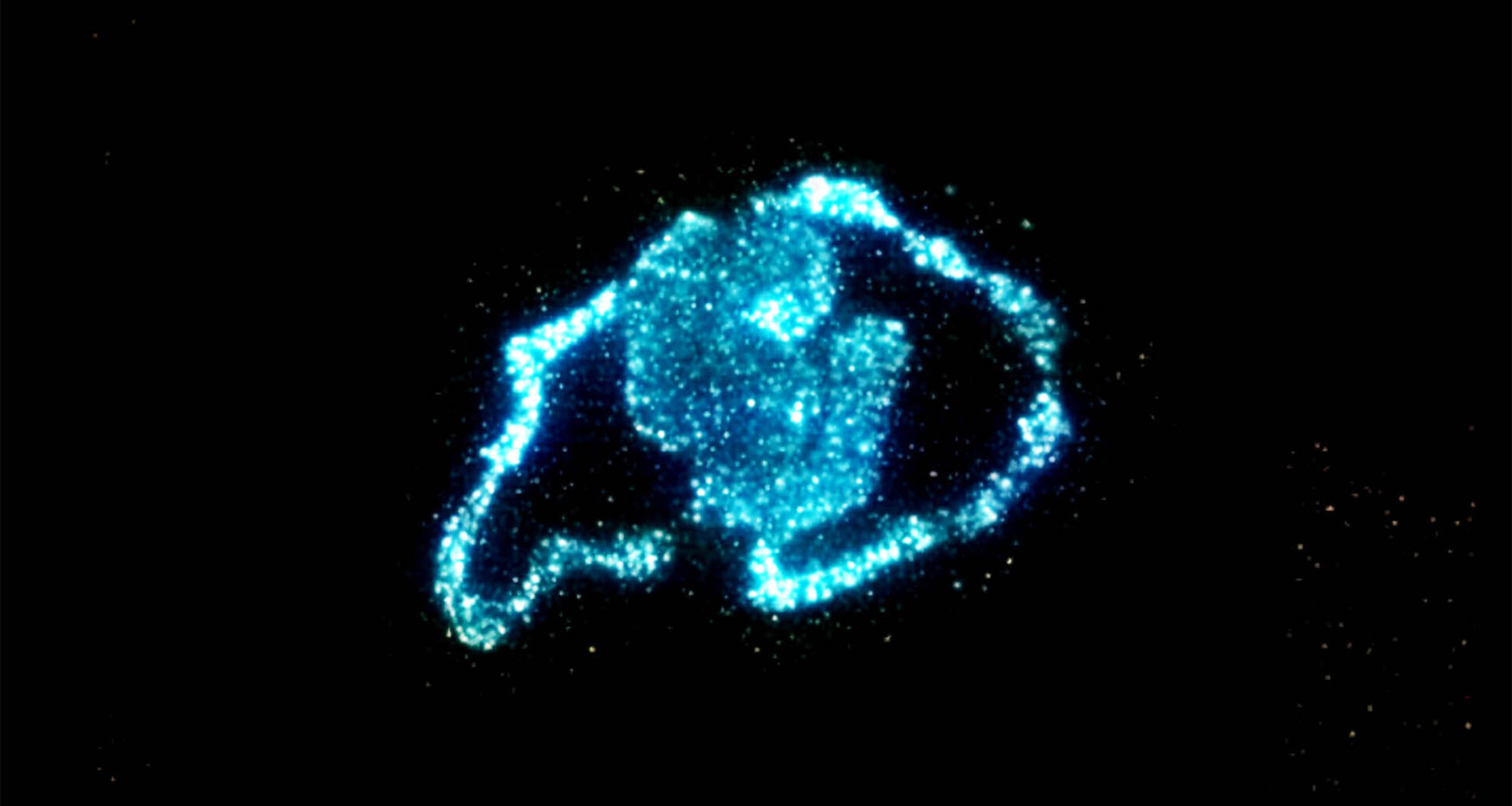
 3D bioprinting of Pyrocystis lunula infused algae bioinks enables spatially defined, chemically stimulated bioluminescence in the form of blue light. Credit: University of Colorado Boulder. Click image to enlarge.3D-printed living light
Finding the chemical trigger was one thing. Turning it into something usable was another.
The team embedded the algae into a hydrogel – a water-based gel derived from natural materials – and used 3D printing to shape it into structures, such as a crescent or a CU Buffalo logo. Shapes that held together and held the algae inside them.
When they exposed those printed structures to the acidic solution, the P. lunula inside lit up, illuminating the whole shape in blue.
And the algae didn’t just glow once and die. Inside the printed structures, they stayed alive for weeks – retaining 75 percent of their original brightness after four weeks under the acidic condition.
That’s not a lab curiosity. That’s a material that lives, glows, and persists.
What this could be used for
The applications the researchers have in mind go well beyond novelty lighting.
One of the more compelling possibilities is autonomous robots operating in dark environments (deep-sea or space exploration) that could be lit by living bioluminescent material instead of batteries. No power source required, no recharging, no cables.
There’s also a monitoring angle. The team is now exploring whether P. lunula responds to other chemicals beyond simple acids and bases.
If it does, the algae could potentially be used as a living sensor for water quality – glowing when it detects the presence of toxins.
“This project was a moonshot idea,” said study author Wil Srubar, a professor of Civil, Environmental and Architectural Engineering at CU Boulder. “I was curious if we could create a world in which we don’t use electricity but rather use biology to produce light.”
“This discovery really paves the way for engineering other living light materials and devices.”
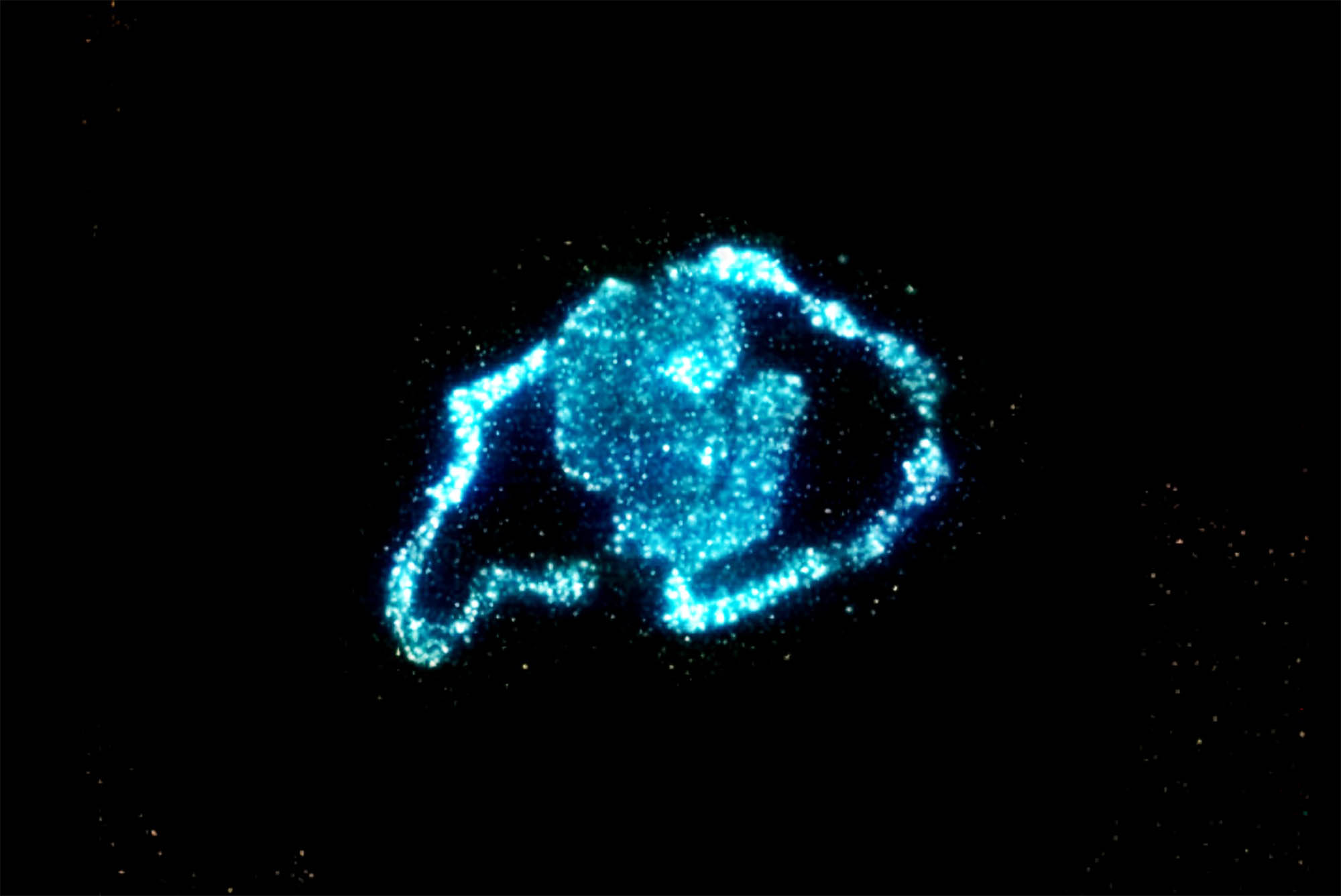 Acidic environment activated 3D printed pattern that contains bioluminescent algae, Pyrocystis lunula, generating blue light in the form of a buffalo. Credit: Giulia Brachi/CU Boulder. Click image to enlarge.Glowing algae can absorb carbon
There’s one more thing worth noting about P. lunula that sets it apart from conventional light sources.
Because it’s photosynthetic, it pulls carbon out of the water and converts it into energy as it grows. While conventional lighting emits carbon to produce light, this does the opposite.
“We’re storing carbon while we’re producing light, whereas conventionally, we emit carbon to light up spaces,” Srubar said.
Whether glowing algae ever makes it into concert venues, deep-sea robots, or water monitoring systems at scale remains to be seen. But the underlying capability – sustained, controllable, living light – is now demonstrated.
The researchers even acknowledge the obvious: yes, future raves could one day be lit by living algae. Stranger things have happened.
The study was published in the journal Science Advances.
—–
Like what you read? Subscribe to our newsletter for engaging articles, exclusive content, and the latest updates.
Check us out on EarthSnap, a free app brought to you by Eric Ralls and Earth.com.
—–