
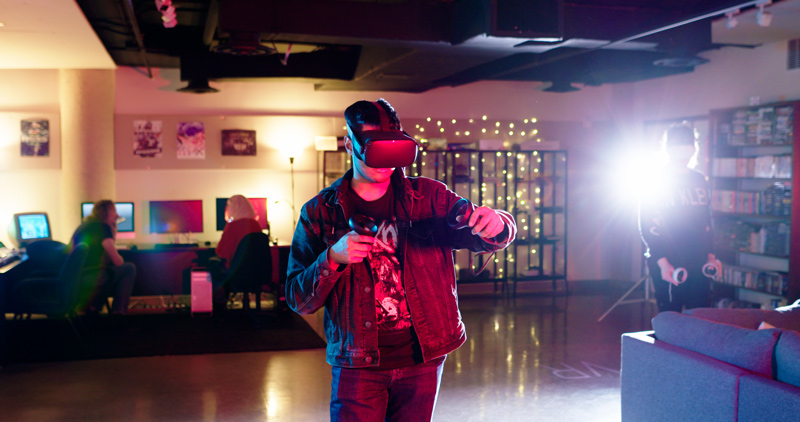
 The directors of the ACCP have taken incorporating video games in the classroom beyond reading them as texts. They use them in their courses as an alternative to the traditional essay. And they’ve had a great deal of success with it.
In her classes on Roman history, Dr. Swain has incorporated video games depicting that period, and had students study them as they would Ovid’s Metamorphoses, for example. Then, instead of producing a final essay, students had the option of making a playthrough video explaining what they’re doing and what the games are communicating to us about Roman civilization.
“I realize that what we do for students here is not just test their knowledge, but the assignment did reveal the depth of the students’ knowledge in a way that certainly wouldn’t have come through in an essay. Their creativity allowed them to create this artifact that represented that knowledge while also representing that knowledge in a very unique way.”
For Dr. Saklofske, he’s taken it a step farther by having students design and build a video game, using easy to learn and open-source tools, rather than writing an essay in some of his English courses.
When they’re designing a game for his class, Dr. Saklofske explains that students “have to put information together and arrange it. We do that when we write essays and can communicate in other ways as well. So, they start figuring out how to make an argument in the form of a game.”
It’s not every students’ cup of tea, so he still gives the option of writing a traditional essay. But for those ready to try something new, it’s an exciting opportunity to learn creatively.
“It’s a different kind of assignment. It’s unfamiliar, it’s a bit daunting, but I think it’s exciting in that unfamiliarity. I think that working in an unfamiliar mode is one of the best ways to get them to start really paying attention to the assignment at hand.”
That was certainly the case for Gwen Trombly, who took a course with Dr. Saklofske in which she got to try her hand at creating an argument through a game. She describes the experience as “a very deeply thoughtful process.”
“You have to think about your understanding and how you’re going to showcase it in an entirely different way than you’re used to. You’re not just looking at it to write it down in an essay, you’re looking at it and thinking, ‘How can I develop this so that somebody can play this and understand the message that I’m trying to convey?’”
An added bonus to assignments like this, Dr. Swain points out, “is that as soon as you start asking students to do assignments that are not what they expect, they’re less likely to fall back on ‘well, I’ll just get ChatGPT to do it.’”